
QUICK CONTACT
Get in touch
Sem fringilla ut morbi tincidunt augue interdum velit. Consequat interdum varius sit amet mattis vulputate enim nulla aliquet. Sed risus pretium quam vulputate dignissim suspendisse in.
×


Motorcycle

Get a Quote or speak to your insurance broker
Select a product
Boat and Personal Watercraft Insurance
- 24/7 claims support
- Accidental loss or damage cover, including from fire, storm, and lightning.
- $10 million legal liability cover (incl water skiers cover as standard)
Motorcycle
Insurance
- New for old replacement cover available for new bikes
- Riding gear cover included (limits apply)
- Fire and theft options to choose from
Caravan and Motorhome Insurance
- New for old replacement cover available for new caravans and motorhomes
- Automatic contents cover (limits apply)
- Optional Annexe cover
Boat and Personal Watercraft Insurance
Nautilus Marine Insurance are a leading provider of insurance solutions for recreational vessels.
Motorcycle Insurance
Choose from on-road and off-road motorcycle insurance products
Cover your ride with insurance for both on-road and off-road motorcycles.
Have peace of mind with insurance for both on-road and off-road motorcycles.
Caravan and Motorhome Insurance
Comprehensive insurance solutions for caravans, pop tops and camper trailers.
Cover for your caravan, pop top or camper trailer.
Comprehensive cover for your caravans. Speak to your local insurance broker to get a quote and organise a policy.
Expert’s guide to storm safety
Storm Preparation
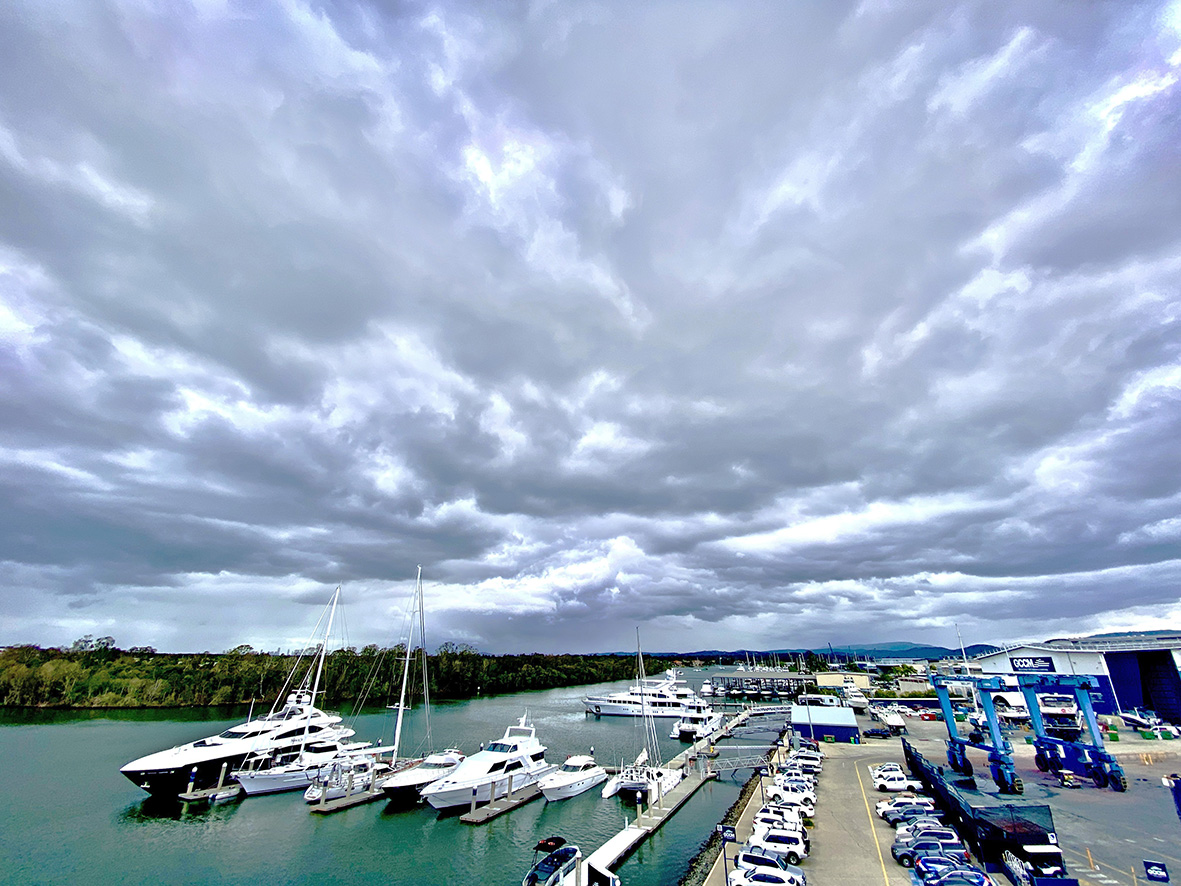
The old adage that you need a plan to succeed is absolutely relevant with storm preparedness,” says Andrew Chapman, Chief Operating Officer of Gold Coast City Marina & Shipyard (GCCM), President of the Marina Industries Association (MIA) and Certified Marina Manager. We asked Chapman to share some key risk mitigation advice to help you prepare your boat for storm season.
- Maintain your vessel and ensure it is in good, seaworthy condition with an appropriate trim. Damage should be repaired as soon as practical so as to maintain the vessel’s integrity which can be essential in some storm conditions. Vessel maintenance should include window and storm board seals and scupper operation checks.
- Have prepared storm emergency kits stocked and stored in an appropriate location on your vessel. This kit may include additional lines, torches including the new head lamps, duct tape, additional bilge pump, bucket, tools, straps, cable ties and a knife.
- Adding additional lines to alternative cleats can assist if the main mooring lines break or cleats fail. Spreading the load over longer lines allows some give when lines tighten. This spring effect will absorb some line shock and potentially extend the life of a line through extended storm events. Lines should be inspected regularly as different lines are affected by UV exposure or retained moisture. Mooring line life can be shortened by the conditions at each marina so inspect and replace as required at least twice a year. Fenders should also be inspected regularly as they are fastened with lines that are in the elements 24/7 when in use, which may include significant UV exposure. Fenders should be of an appropriate size and inflated to the designed pressure to absorb vessel movement against the dock.
- Batteries should be effectively maintained and have sufficient storage to operate bilge pumps in a prolonged power outage. Power outages may be grid orientated or marinas may turn off power in some storm surge events for safety reasons.
- Sails, biminis, cushions and dinghies should be removed or appropriately stowed from above deck if a storm is approaching to reduce windage. If a dinghy needs to remain on the boat ensure the bungs are removed and the path for rainwater to escape is clear.
- Fridges and freezers should be emptied to avoid spoiled food if power is off for any prolonged period. Frozen food that defrosts can be a major problem if it leaks outside galley fridges onto carpet and other surfaces.
- Bilge pumps should be well maintained and operationally tested and set to automatic mode. Bilges must be maintained in a clean state so as to prevent bilge pump or float switch fouling during operation. It’s imperative that bilges are also free from any fuel or oil residue so that this is not pumped into the environment. In some instances, back-up bilge pumps can be petrol-driven to give that power source redundancy in an extended event.
- Update the marina with contact information especially if you are going to be away. It’s important to nominate an additional person to make decisions in your absence.
- Consider moving your vessel to a more secure location depending on the type of extreme event that is impending. Considering a more protected marina or even an upriver mangrove refuge sometimes offers more protection than sitting in a berth close to the coast. However, each storm is very different and advice should be sought from appropriately qualified professionals with local knowledge. Remember to plan ahead and not move when the storm is in play. Your safety is most important.
- Make yourself aware of your marina’s emergency procedures and evacuation points as it’s important to remember that your personal safety is far more important than that of your vessel in a storm.
Visit gccm.com.au
Safety during a storm
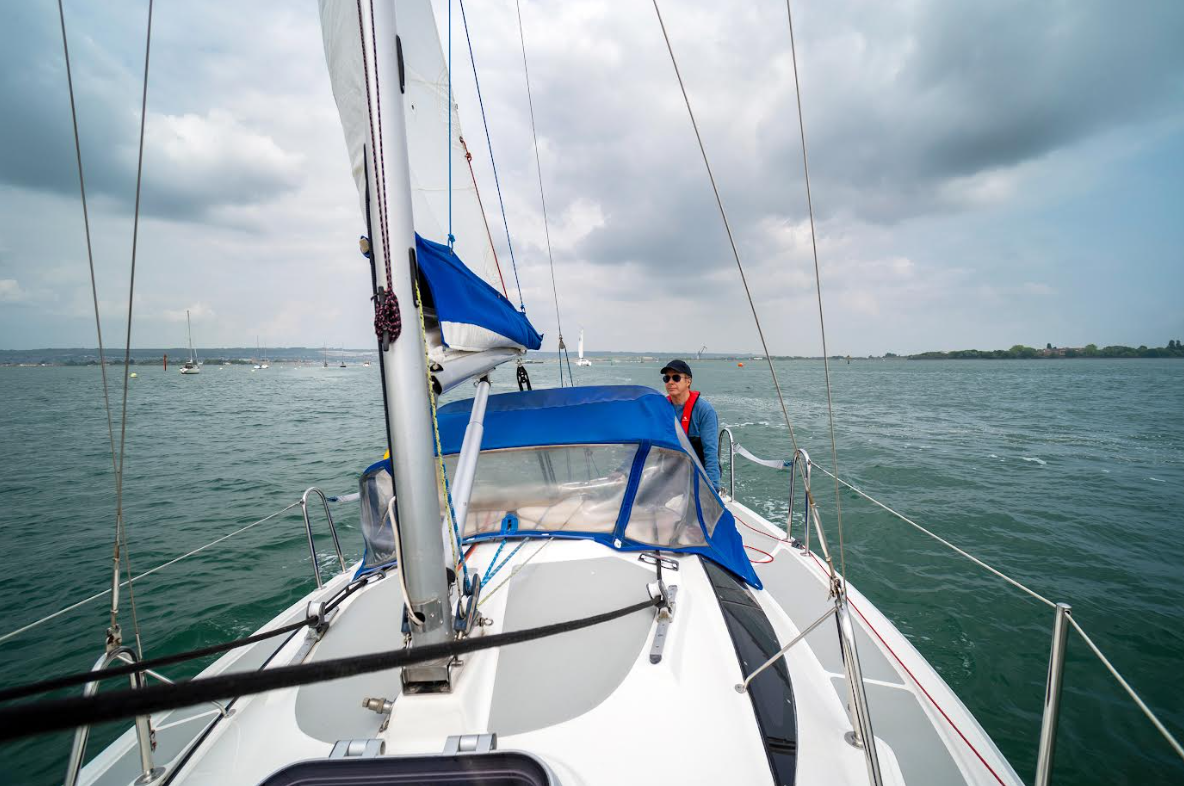
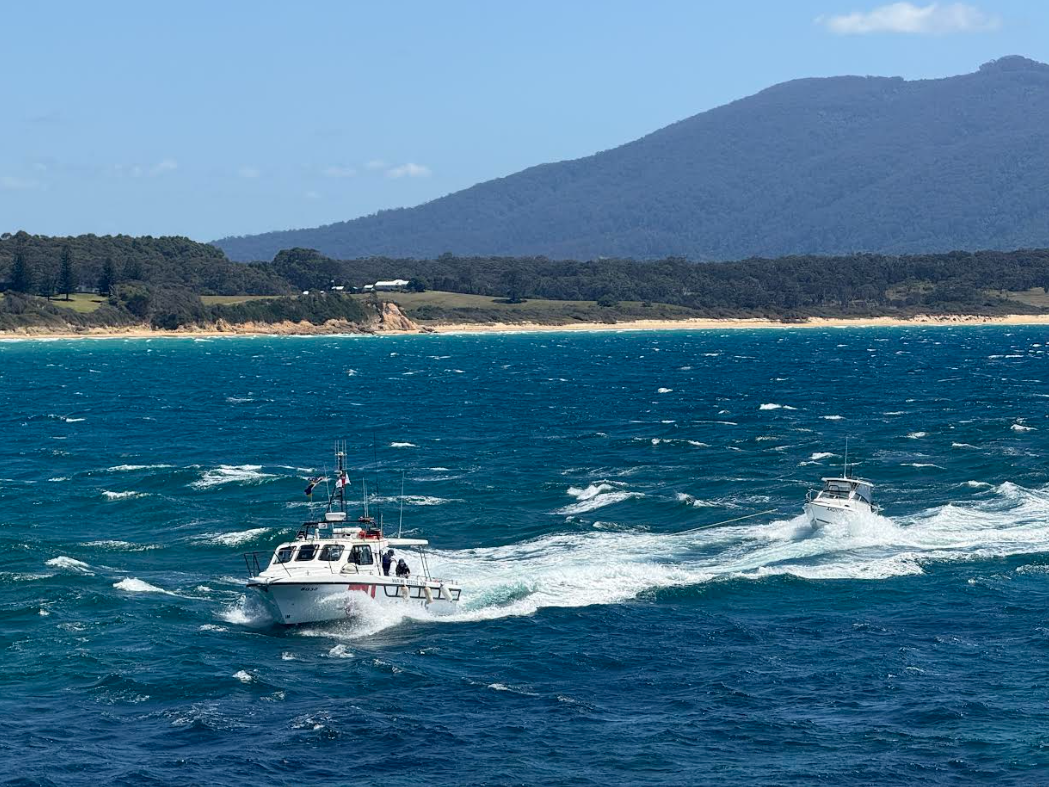
Checking the marine weather forecast is a key part of responsible boating, however sometimes conditions can change unexpectedly. Two boating safety experts share some advice about what to do if you’re caught out on the water in a storm.
Glenn Sullivan, Monaro Region Zone Duty Operations Manager with Marine Rescue NSW.
Boaters should always check the weather and conditions as part of their pre-launch procedures and monitor conditions while out on the water, but sometimes we do get caught in storms. If you do need to weather a storm, follow these safety tips:
- Stow away any loose items to prevent projectiles and load shifting and secure the deck.
- Close and secure all hatches and windows.
- Reduce the windage on the vessel and make way into the sea and storm. Your speed should be fast enough to maintain control but slow enough to ensure safety in the conditions and avoid jumping over waves. Try to approach the waves at 45 degrees.
- Assess whether heading to a safe anchorage is possible, or if it is safer to stay out wide and ride it out.
- Brief your crew and passengers on what your plan is.
- Call your local volunteer marine rescue (VMR) and provide them with your caller ID and your intentions. This will make any calls quicker if needed, and the local VMR can prepare for a potential assist. They are there to help, but they can only help if they know you need it.
- As visibility drops, turn on your navigation lights.
- Ensure crew and passengers are wearing their lifejackets correctly, and inspect to make sure they know how to use and deploy them if required.
- Make sure the emergency position indicating radio beacon (EPIRB), flares, and safety equipment are all readily available, and that everyone knows how to use them, just in case you, as the master, become incapacitated.
- After the storm passes, check everyone for injuries and any damage to the vessel. Call the local VMR again to inform them of your intentions and your condition.
The best advice when considering storms is to confirm the weather forecast by all available means, and be prepared to enter a safe harbour, even if it takes extra time.
Visit marinerescuensw.com.au
Ian Beard, Training Officer for Volunteer Marine Rescue WA’s Marine Radio Communications Support Group.
- Weather can change unexpectedly. In Australia’s north, from November to April, severe storms and heavy rainfall leading to flooding are common, not to mention tropical low-pressure systems and cyclones.
- The boater’s best friend all year is the marine weather forecast and being able to understand it is a vital part of boating safety.
- Before heading out onto the water check the marine weather forecasts. In Australia, visit the Bureau of Meteorology (BOM) website or use the BOM Weather App to access the latest weather warnings, forecasts and observations, including the MetEye forecast winds, waves and weather maps. The Golden Rule is: ‘if in doubt, don’t go out’.
- While out on the water, it’s also important to keep your Marine VHF radio tuned to channel 16 for Sécurité safety messages. This will help to keep you informed about the current weather conditions.
- If you are caught out on a boat during severe weather, personal safety should always be the number one priority.
- At the first sign of bad or severe weather while you on the water, make sure everyone on board is wearing their lifejacket correctly.
- If possible, head for the nearest mooring area, marina, boat ramp, or other safe haven, and follow any directions received from the regional harbour master, police or emergency services.
Visit vmrwa.org.au
Post-flood waters
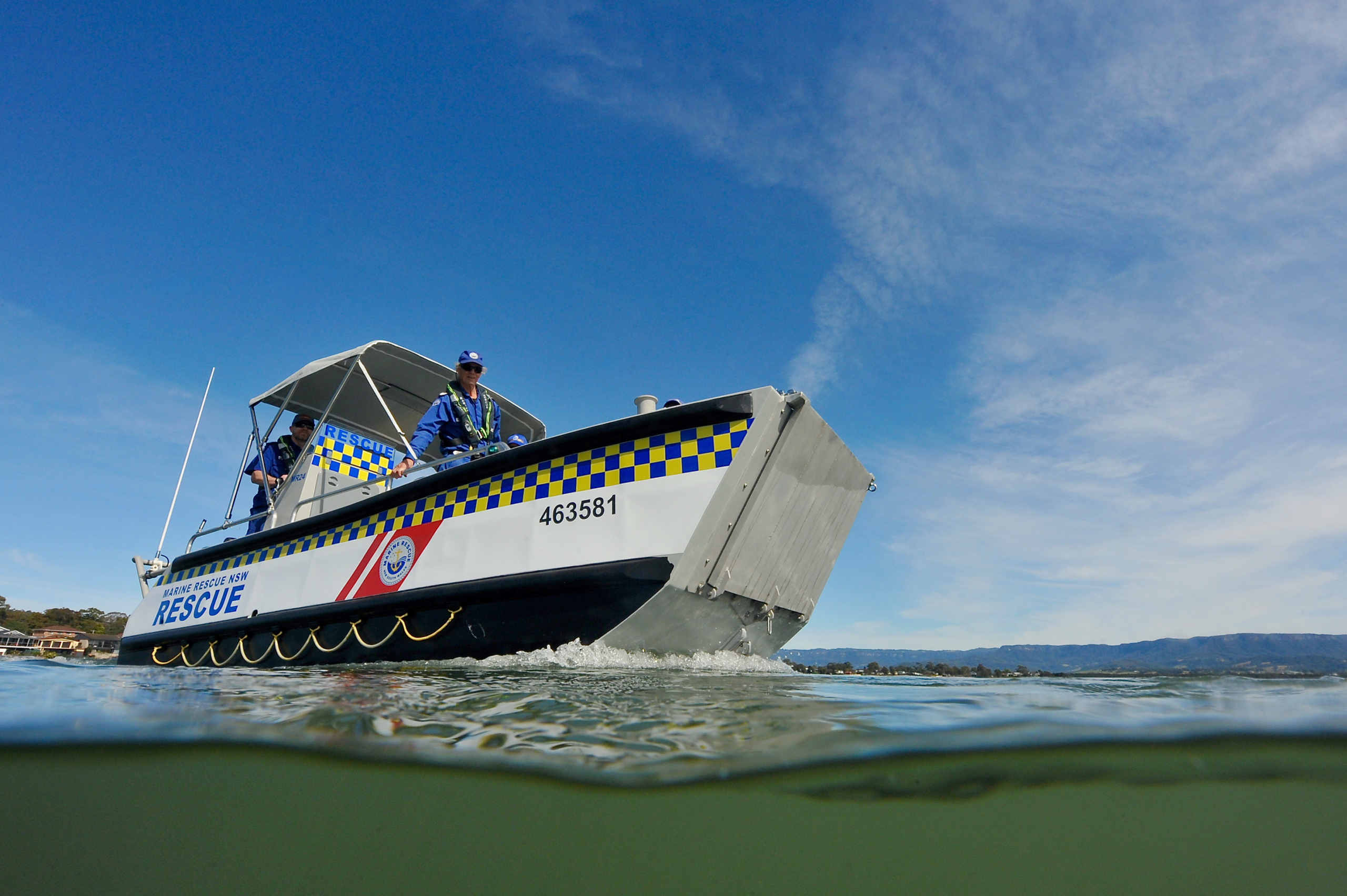
From submerged debris to compromised water quality, there can be numerous safety hazards for boaters following a flood. Two boating safety experts share some key risk mitigation advice to help you stay safe.
Adam Smith, President of the Boating Industry Association and Owner of Australian Boating College Sydney.
- Unless you absolutely have no other choice, simply avoid flooded waters. Like driving your car on a flooded road, it’s not worth the risk. The unseen hazards are as dangerous or more so than those you can see.
- After storms or flooding, enclosed waters (harbours and rivers) will contain unknown risks and hazards for some time. Debris in the water and on the seabed will be new or moved, navigation aids may have disappeared or moved, and the water itself will be murky, so you can’t see anything below the surface where you may normally have been able to.
- Extreme storms and flooding can also overload sewage systems and see untreated water discharged into waterways. In flooding, all manner of chemicals and contaminants can also be washed off the land into rivers and harbours, then out to sea. While we would all agree that we shouldn’t go into this water, there is always the risk of ending up in there unintentionally or having this water splashing on us while underway. Even touching a mooring or anything that has been in that water can transfer disease to you and make you sick. Stay off the water if you can.
- Extreme flooding and debris from it will create hazardous conditions in these rivers’ coastal waters. If you’re planning a coastal passage past areas where there have been recent storms or flooding, be aware of this risk and consider delaying or rescheduling the trip.
- Monitor your marine radio. A SECURITE message may be broadcast to advise vessels of any hazards to navigation in that area, including flood debris.
- Storms and flooding raise water levels in enclosed waters, even in tidal waterways. Storm surges and flooding also reduce clearance under structures and power lines, increasing your risk of damaging your vessel or injury to yourself and your crew.
Visit abcboating.net.au and bia.org
Glenn Sullivan, Monaro Region Zone Duty Operations Manager with Marine Rescue NSW.
- Although flood waters are primarily thought of in the enclosed waters environment, heeding the following advice when travelling in any waters inshore and off, is vitally important.
- Have all onboard keep a proper lookout and maintain a safe speed. Large objects ranging from logs to shipping containers and everything in between can be washed through the river systems and out into open waters.
- If anything is seen, please report it to the local volunteer marine rescue (VMR) so that a safety message can be broadcast so as other water users do not collide with these objects. • If an object is struck, assess everyone’s welfare and any damage caused to the vessel.
- If the vessel including hull or propulsion equipment is damaged, do not hesitate to call the local VMR via your Marine Band radio, call Triple Zero (000) by phone or even use your EPIRB and flares as required.
- In worst-case scenarios, attempt to stem the flow of water ingress and make sure everyone is wearing their lifejackets, prepare to deploy your life raft and brief your crew on the exact situation and the actions needed to prepare. Take action early to increase your chances of a successful outcome. • After a flood, a lot of pollution including chemicals, sewage and deceased animals can be found on shore and offshore. So, remember if fishing, be prepared to travel to locations that have not been affected and re-evaluate if you are going to eat your catch.
- Having larger deceased animals washing through our systems and offshore, attracts larger marine life such as sharks, so again reassess if you are thinking about entering the water.
Visit marinerescuensw.com.au
Expert’s guide to storm safety
Whether you ride a dirt bike, road bike, tourer, cruiser or learner machine, your pride and joy is always a vulnerable target.
Easy to roll away and often worth thousands in parts alone, motorcycles remain an easy score for thieves. Unlike modern cars, many bikes lack factory immobilisers or alarms, and even with chains or locks, a determined crew can lift one into a van in no time. Once stolen, recovery rates are low, especially for competition bikes with no registration, which makes prevention essential on your part.
BE ALERT
Thieves strike in many ways. Bikes vanish from trailers and utes parked in driveways or hotel carparks, from sheds and garages without heavy-duty locks, or from roadside stops on trips. Social media posts that reveal your suburb or garage photos can set you up as a target, and fake buyers posing as customers often scope out homes before returning later to steal. Some riders have even been followed home from a ride and hit overnight.
In most cases, theft is not random, it is planned, and the thief has already seen your bike. The golden rule of motorcycle security is simple: be vigilant, all of the time. Reducing risk means being discreet and consistent. Do not wash, tune or leave your bike where it is visible from the street, and keep garage doors closed. Avoid leaving trailers out front, and if you think you are being followed, circle the block before pulling in.
STAY VIGILANT
Think twice before posting, because criminals scroll the same feeds you do, and do not share images that reveal number plates, houses or driveways. When selling, always meet buyers in public and avoid giving out your home address. Teach kids not to talk about your bikes at school and remind friends to be careful with what they share online as well.
A barking dog is still one of the best deterrents, and proper locks are essential. Anchor your bike inside the shed with a heavy-duty chain, add a disc lock or alarmed padlock, and secure trailers at the drawbar and wheels. Never leave a bike on an open trailer overnight. Enclosed trailers are safer, but even then, park the door against walls or poles and use multiple locks.
TRUST TECHNOLOGY
Technology is also useful, from GPS trackers and motion alarms to dummy cameras or warning signs. Microdot systems such as DataDot can improve the odds of recovery. Keep clear photos of your bike, VIN and engine numbers, and store receipts and paperwork safely. If locks or latches show signs of tampering, treat it as a warning, not an accident. Get onto it.
BE SMART
Every motorcycle is a potential target, from minibikes to million-dollar classics. Some bikes are harder to trace than others and stolen machines are quickly stripped, hidden interstate or moved overseas – once gone, the chance of recovery is slim. That is why vigilance matters. Be private, be smart and be cautious because someone is always looking for an easy target.
Words: Jeff Ware
Expert’s guide to storm safety
Whether you ride a dirt bike, road bike, tourer, cruiser or learner machine, your pride and joy is always a vulnerable target.
Easy to roll away and often worth thousands in parts alone, motorcycles remain an easy score for thieves. Unlike modern cars, many bikes lack factory immobilisers or alarms, and even with chains or locks, a determined crew can lift one into a van in no time. Once stolen, recovery rates are low, especially for competition bikes with no registration, which makes prevention essential on your part.
BE ALERT
Thieves strike in many ways. Bikes vanish from trailers and utes parked in driveways or hotel carparks, from sheds and garages without heavy-duty locks, or from roadside stops on trips. Social media posts that reveal your suburb or garage photos can set you up as a target, and fake buyers posing as customers often scope out homes before returning later to steal. Some riders have even been followed home from a ride and hit overnight.
In most cases, theft is not random, it is planned, and the thief has already seen your bike. The golden rule of motorcycle security is simple: be vigilant, all of the time. Reducing risk means being discreet and consistent. Do not wash, tune or leave your bike where it is visible from the street, and keep garage doors closed. Avoid leaving trailers out front, and if you think you are being followed, circle the block before pulling in.
STAY VIGILANT
Think twice before posting, because criminals scroll the same feeds you do, and do not share images that reveal number plates, houses or driveways. When selling, always meet buyers in public and avoid giving out your home address. Teach kids not to talk about your bikes at school and remind friends to be careful with what they share online as well.
A barking dog is still one of the best deterrents, and proper locks are essential. Anchor your bike inside the shed with a heavy-duty chain, add a disc lock or alarmed padlock, and secure trailers at the drawbar and wheels. Never leave a bike on an open trailer overnight. Enclosed trailers are safer, but even then, park the door against walls or poles and use multiple locks.
TRUST TECHNOLOGY
Technology is also useful, from GPS trackers and motion alarms to dummy cameras or warning signs. Microdot systems such as DataDot can improve the odds of recovery. Keep clear photos of your bike, VIN and engine numbers, and store receipts and paperwork safely. If locks or latches show signs of tampering, treat it as a warning, not an accident. Get onto it.
BE SMART
Every motorcycle is a potential target, from minibikes to million-dollar classics. Some bikes are harder to trace than others and stolen machines are quickly stripped, hidden interstate or moved overseas – once gone, the chance of recovery is slim. That is why vigilance matters. Be private, be smart and be cautious because someone is always looking for an easy target.
Words: Jeff Ware
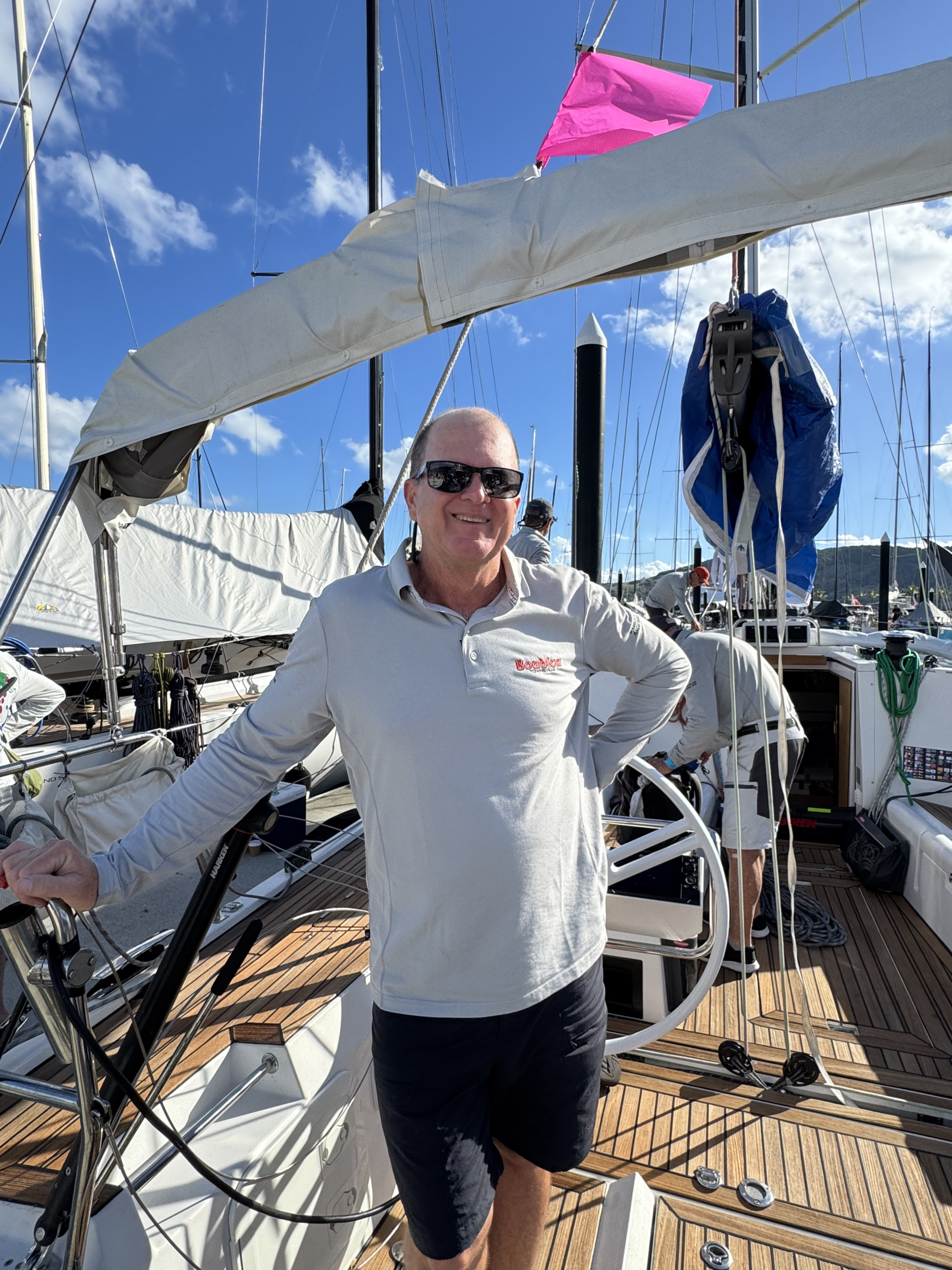
Mike Steel
Mike is the Commodore of Townsville Yacht Club and the owner and skipper of Boudica, an Elan E5 which he brought to Hamilton Island for the first time this year. Although new to the regatta with this boat, he has previously raced at Hamilton Island with two other yachts.
“I sit as Event Chairman of SeaLink Magnetic Island Race Week and have been involved in almost every edition of that regatta since its inception,” says Mike. “This was my fourth Hamilton Island Race Week. The convenience of everything being together here is a big drawcard, and the sailing conditions are always a challenge compared to what we experience at home. You learn a lot here and meet a lot of good people.”
Mike’s Race Week crew this year included friends from Sydney and locals from Townsville. He has relied on Nautilus Marine Insurance for over a decade. “I have been with Nautilus Marine for about 12 years,” says Mike. “I had one claim after bumping the bottom and they helped me repair the boat really well. They looked after me.”
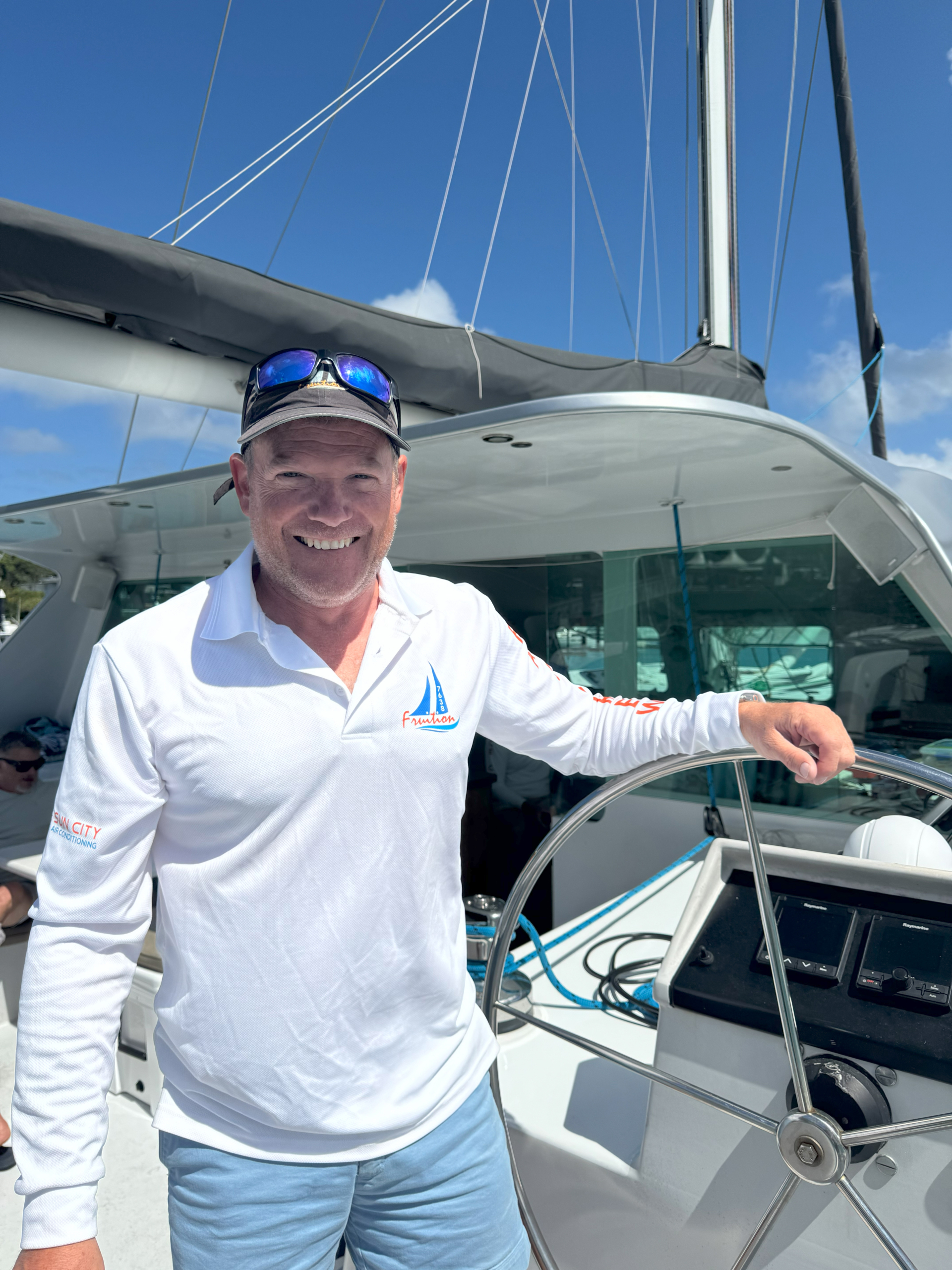
Andrew Bruce
Andrew Bruce and his co-owner Andrew Gibbs have been sailing their catamaran Fruition since 2012. Based out of the Royal Queensland Yacht Squadron, the crew made the 12-day cruise north to compete in Race Week. “This was our fourth Hamilton Island Race Week in a row. We love it,” Andrew says.
On the way up this year, Fruition struck a whale about 15 miles south of Hamilton Island, causing significant damage to the port keel. “It was very unfortunate, but Nautilus Marine Insurance responded quickly and helped us get everything sorted so we could still enjoy the regatta,” Andrew explains. Andrew has covered his yacht with Nautilus Marine for six years and says the experience has always been positive. “They have been great to deal with and really supportive,” says Andrew. “That makes a big difference when something unexpected happens.”
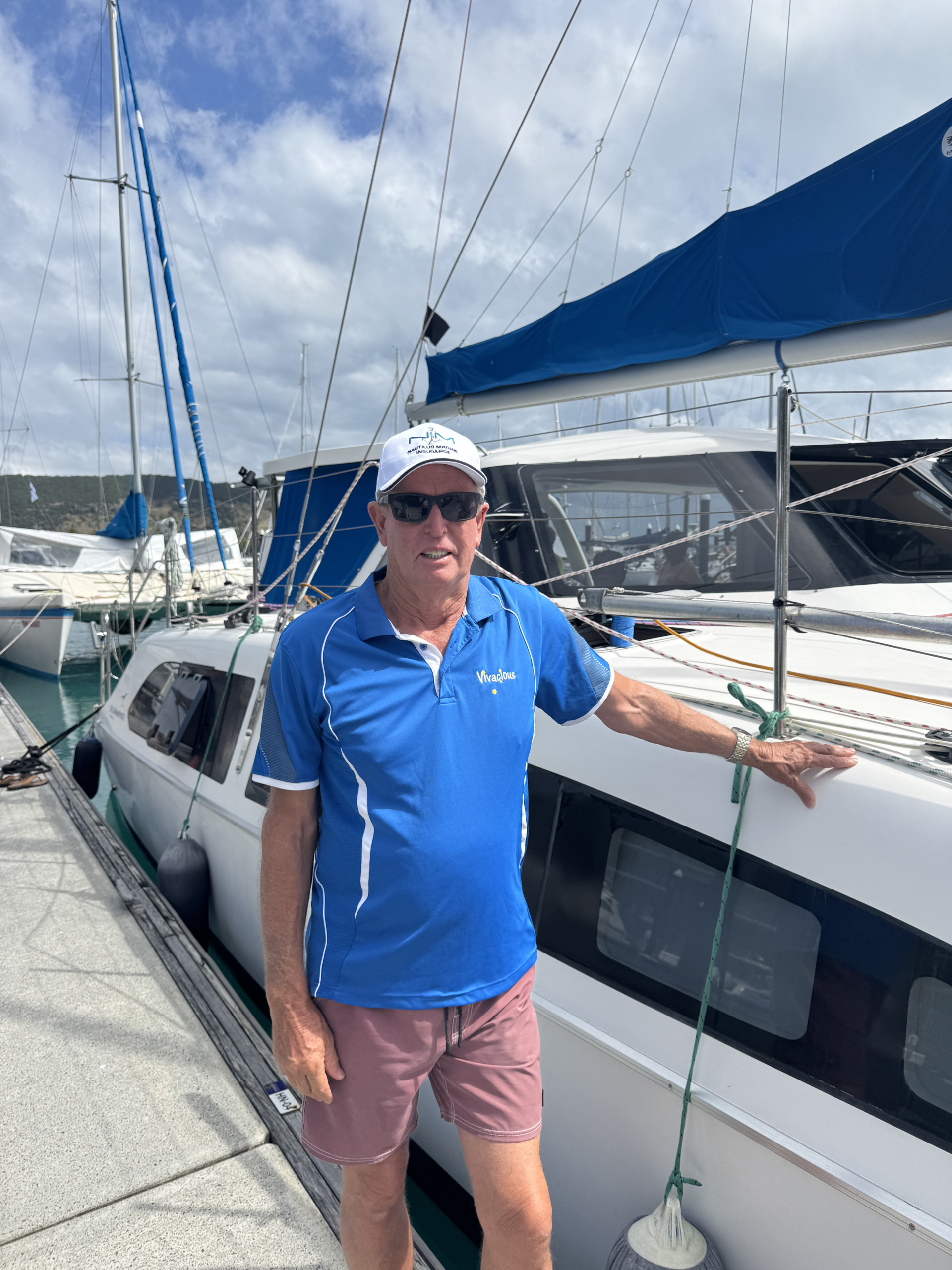
Kevin Lord
Kevin has owned his Seawind 1160 catamaran Vivacious for eight years. Based in Yeppoon, Kevin sails with the Capricornia Cruising Yacht Club and races every second week. Each year, he and his crew make the trip north to Hamilton Island, with 2025 marking their eighth Race Week.
Before purchasing Vivacious, Kevin and his family enjoyed six years with their previous yacht, Overture. Kevin’s vessels have been covered by Nautilus Marine throughout. “We had a claim on a rudder after unfortunately hitting a rock with our old boat,” Kevin recalls. “We have been very pleased with Nautilus Marine Insurance when we have had to make claims. Everything has always been handled very well.”
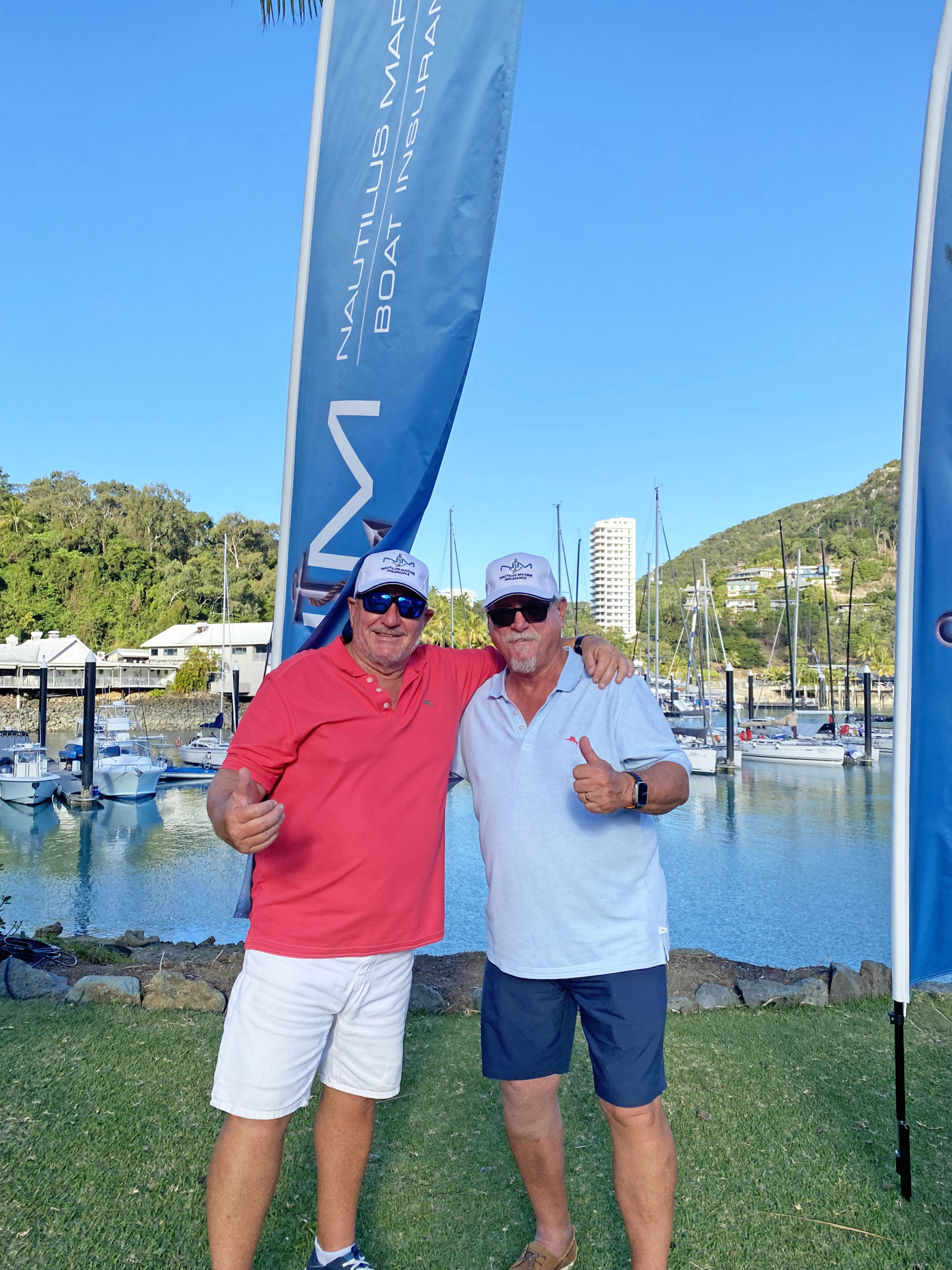
Rod Caldwell
This year marked Rod’s second Hamilton Island Race Week onboard Arietta, a Jeanneau Sun Odyssey 379 which he sold to a new owner during Race Week. “We have been with Nautilus Marine happily for five years and they have been fantastic to be with,” says Rod. “We just bought a new boat and of course we went straight to Nautilus Marine to cover that as well,” he explains. Over the years Rod has made a small claim and says it was handled with care. “Nautilus Marine were particularly helpful and really looked after us. We would not be with anyone else.”
Bruce Fish
Bruce moors his boat Paradise on Hamilton Island and says switching to Nautilus Marine Insurance was a great decision. “I was with another insurance provider and Greg [Sills] put me in touch with Nautilus Marine,” says Bruce. “It was the happiest thing I ever did and the service has been absolutely fantastic.” With the move paying off, Bruce says he plans to stay with Nautilus Marine well into the future. “I am looking forward to continuing to support Nautilus Marine,” he says.
PHOTOGRAPHY BY SALTY DINGO COURTESY OF HAMILTON ISLAND.
Expert’s guide to storm safety
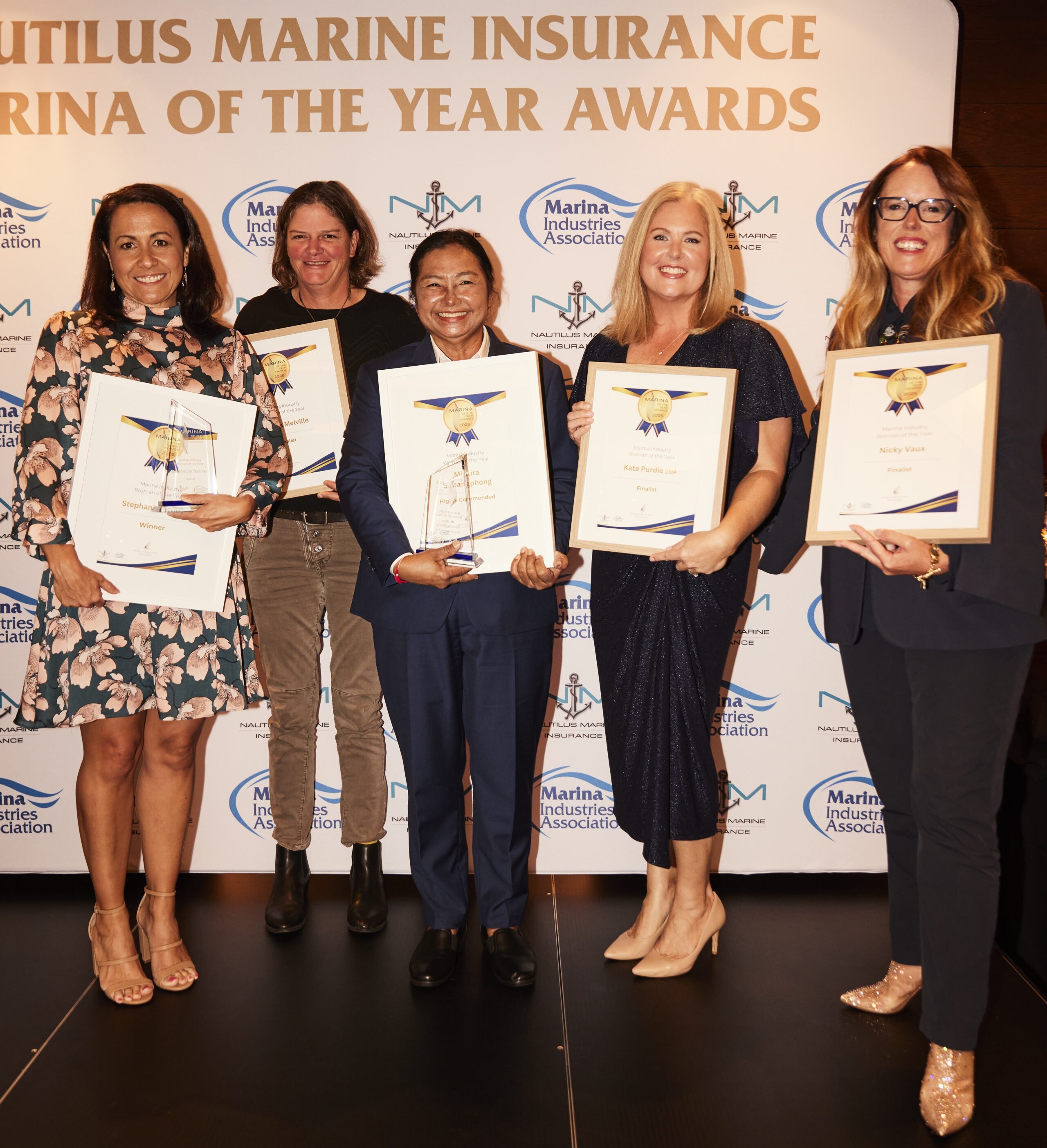
The best, brightest and proudest of the marina industry were recognised at the 2025 Nautilus Marine Insurance Marina of the Year Awards, held at Sydney’s picturesque Middle Harbour Skiff Club.
Opening the evening, Marina Industries Association (MIA) President and Master of Ceremonies, Andrew Chapman CMM remarked, “This is another incredibly successful celebration of our industry. The Awards attracted record entries across several categories, with over 110 guests and finalists gathering from across Australia, New Zealand, Thailand, the UAE and Singapore.”
Andrew Mulholland, Marketing Director / Commercial Partnerships Manager of event partner Nautilus Marine Insurance (NMI), echoed the sentiment, adding, “These Awards honour all entrants and finalists who consistently raise the bar and set new standards in our industry. While outstanding facilities are important, it’s the people who deliver the excellence we celebrate tonight.” Drawing a parallel with the Nautilus Marine Insurance values, Mullholland went on to say, “It’s about putting your customers at the core of everything you do and building trust through integrity and reliability.”
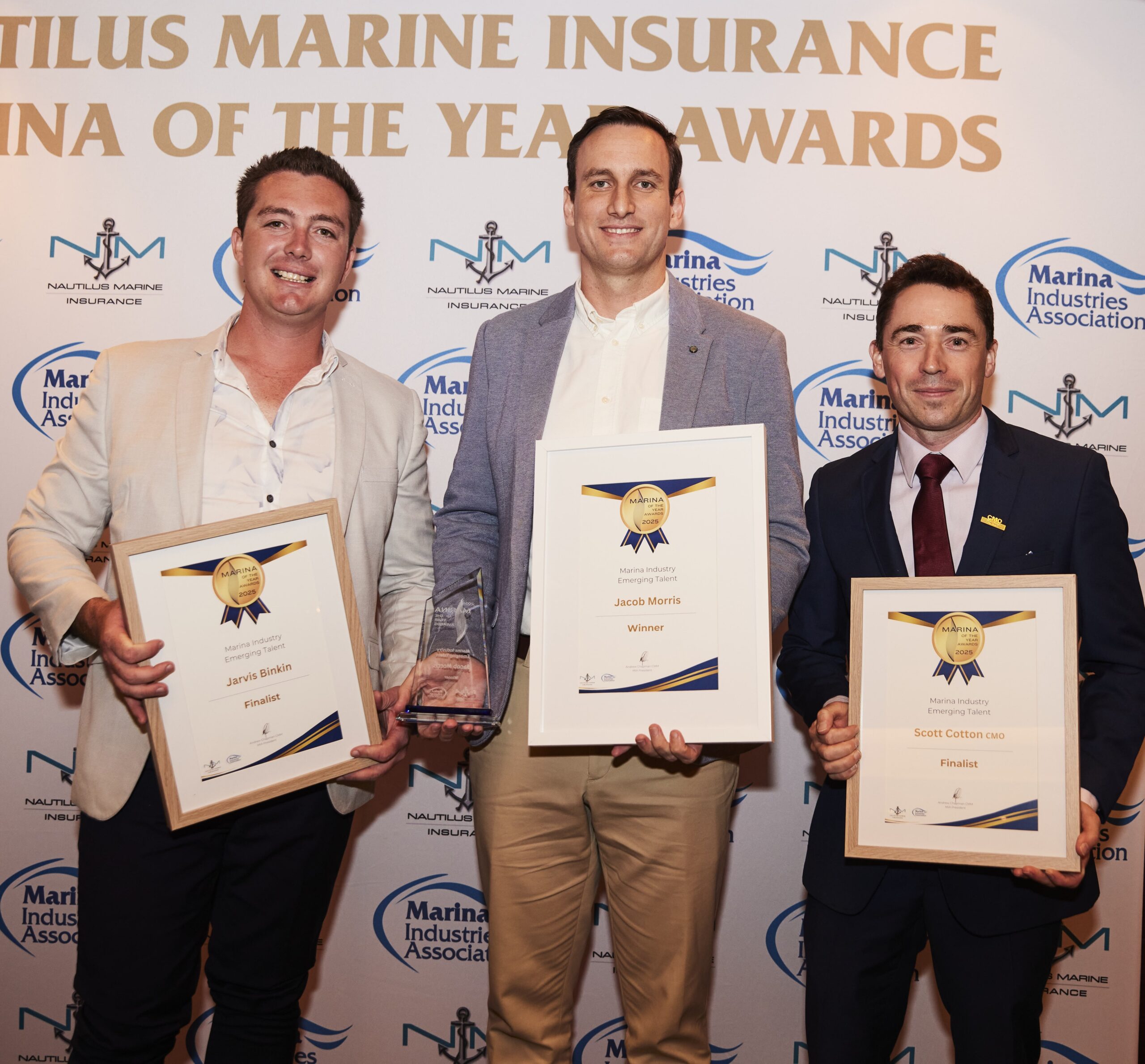
While the Awards have traditionally focused on facilities, 2025 saw the introduction of two new categories designed to spotlight and promote the achievements of individual contributions and rising talent. The inaugural Emerging Talent Award recognised future leaders under 35, with Jacob Morris, Director at Marine Structures, taking home the honour from a strong field. The new Industry Woman of the Year Award also made a strong debut, receiving a wave of impressive nominations. The winner, Stephanie Trounce, WHS Property and Compliance Manager at Gold Coast City Marina & Shipyard, was acknowledged for her deep expertise in safety systems and her leadership in maintaining high standards of property and compliance.
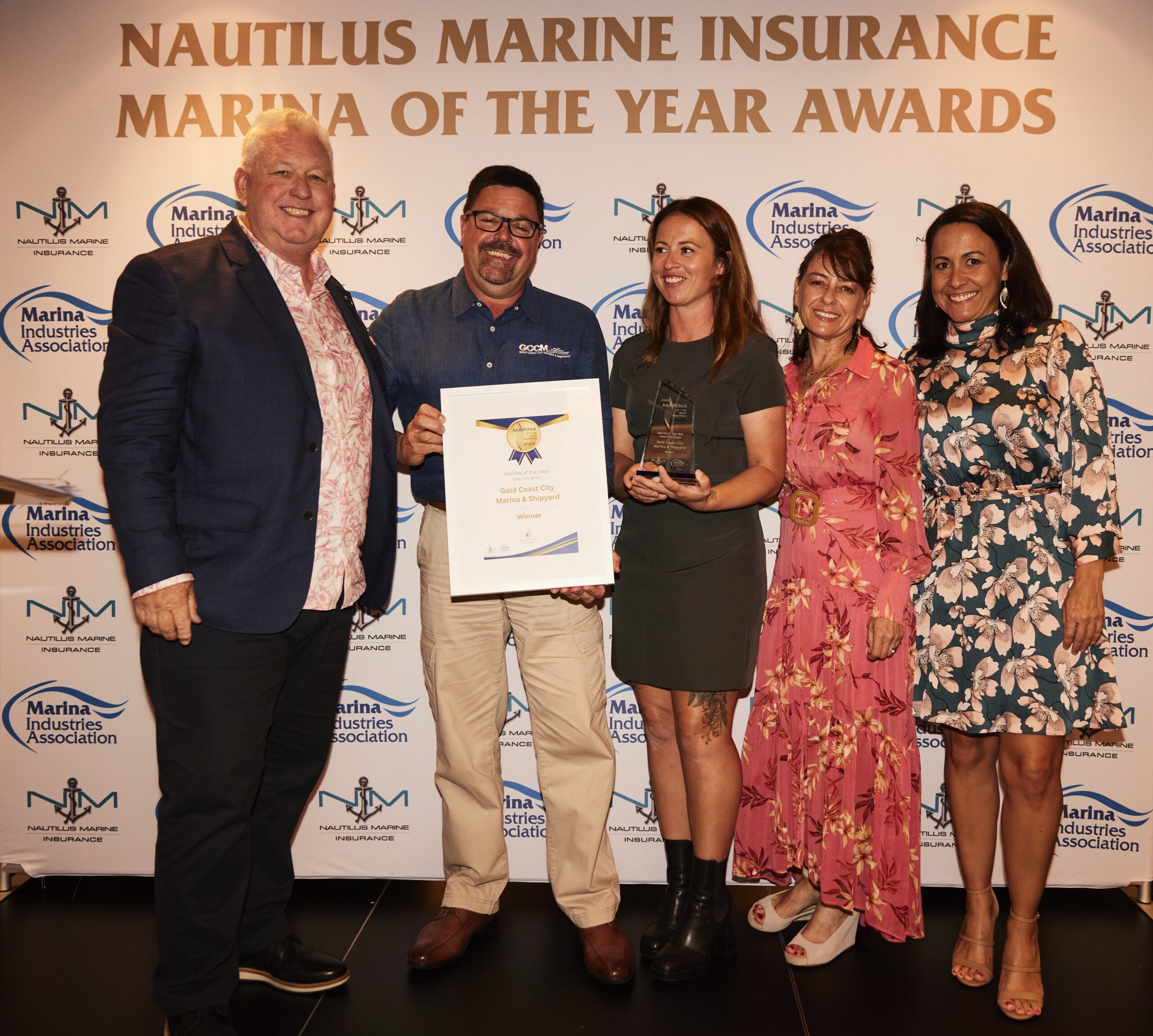
The flagship Marina of the Year categories were more competitive than ever. The recently redeveloped Jones Bay Superyacht Marina in Pyrmont, Sydney, emerged victorious as the Marina of the Year under 140 boats. It was a standout night for Gold Coast City Marina & Shipyard (GCCM), which claimed the Marina of the Year Award (over 140 boats), Boatyard of the Year (over 20 boats) and Dry Stack Facility Award. Celebrating 25 years of trailblazing excellence, GCCM has transformed former farming paddocks into a world-class marina and shipyard, playing a pivotal role in the development of the Coomera marine precinct.
Innovation was also in the spotlight this year, with Bellingham Marine taking home the Industry Innovation of the Year Award for its reimagined Unifloat system. The Royal Queensland Yacht Squadron (RQYS) once again claimed the coveted Club of the Year Award.
The competition in the Boatyard of the Year category for yards servicing under 20 boats was also strong, with White Bay 6 Marine Park taking the win. Industry veteran Lorraine Yates CMP reflected on the honour, “We’re grateful for industry recognition through awards like these. We have a beautiful facility in a stunning location, and I’m privileged that the owners trust us to manage it every day.”
The full list of Award winners for are 2025:
- Best Commercial Marina (Over 140 Boats): Gold Coast City Marina & Shipyard (GCCM), QLD
- Best Commercial Marina (Under 140 Boats): Jones Bay Superyacht Marina, NSW
- Club of the Year: Royal Queensland Yacht Squadron, QLD
- International Marina of the Year: Dubai Harbour Marina, UAE
- Dry Stack Storage Facility of the Year: Gold Coast City Marina & Shipyard, QLD
- Best Boat Yard (Under 20 Boats): White Bay 6 Marine Park, NSW
- Best Boat Yard (Over 20 Boats): Gold Coast City Marina & Shipyard, QLD
- Emerging Talent of the Year: Jacob Morris, QLD
- Industry Women of the Year: Stephanie Trounce, QLD
- MIA Environmental Award: Royal Phuket Marina, Thailand
- Industry Innovation Award: Bellingham Marine Australia, QLD
- Hall of Fame International Marina: ONE°15 Marina Sentosa Cove, Singapore
- Hall of Fame Dry Stack Storage Facility: Sydney Harbour Boat Storage





NM Insurance is a trading name of Nautilus Marine Underwriting Agency Ltd NZBN: 9429031454261, FSP: 388326. NM Insurance is an insurance underwriting agency and has a binding authority from Zurich Australian Insurance Limited (ZAIL) which allows it to enter into and arrange policies of insurance. NM Insurance acts on behalf of ZAIL and not you when providing these services but does so under its own FSP number.
Content on this website is information only and not financial advice. It is intended as a summary of the highlights of any cover available and does not take into account any person’s objectives, financial situation or needs. Always read the relevant Policy Wording before buying or renewing insurance. It contains a full description of the applicable terms and conditions.
Steadfast Group Ltd (ABN 98 073 659 677) (‘SGL’) has a majority shareholding in NM Insurance Pty Ltd (NM Insurance).
SGL may receive a professional services fee (PSF) from insurers, premium funders and underwriting agencies such as NM Insurance (Partner) for access to regulatory and compliance support; marketing and communications; data insights; and access to technology platforms. The PSF is an agreed amount between SGL and the relevant Partner, usually annually. The PSF is not determined by the volume of the business that the Steadfast Network brokers place, nor is the amount of the PSF known to the Steadfast Network Brokers, so it is not able to influence recommendations to their clients.
NM Insurance may have access to shared services from SGL, including: compliance tools; procedures; manuals and training; legal; HR banking; and group purchasing arrangements. These services are funded by SGL, subsidised by SGL or SGL receives a fee for them.
SGL’s FSG is available at www.steadfast.com.au or on request by telephoning SGL’s Company Secretary on +61 2 9495 6500.
© 2021 NM Insurance Pty Ltd. Created by Codex.
Expert’s guide to storm safety
The best, brightest and proudest of the marina industry were recognised at the 2025 Nautilus Marine Insurance Marina of the Year Awards, held at Sydney’s picturesque Middle Harbour Skiff Club.
Opening the evening, Marina Industries Association (MIA) President and Master of Ceremonies, Andrew Chapman CMM remarked, “This is another incredibly successful celebration of our industry. The Awards attracted record entries across several categories, with over 110 guests and finalists gathering from across Australia, New Zealand, Thailand, the UAE and Singapore.”
Andrew Mulholland, Marketing Director / Commercial Partnerships Manager of event partner Nautilus Marine Insurance (NMI), echoed the sentiment, adding, “These Awards honour all entrants and finalists who consistently raise the bar and set new standards in our industry. While outstanding facilities are important, it’s the people who deliver the excellence we celebrate tonight.” Drawing a parallel with the Nautilus Marine Insurance values, Mullholland went on to say, “It’s about putting your customers at the core of everything you do and building trust through integrity and reliability.”
While the Awards have traditionally focused on facilities, 2025 saw the introduction of two new categories designed to spotlight and promote the achievements of individual contributions and rising talent. The inaugural Emerging Talent Award recognised future leaders under 35, with Jacob Morris, Director at Marine Structures, taking home the honour from a strong field. The new Industry Woman of the Year Award also made a strong debut, receiving a wave of impressive nominations. The winner, Stephanie Trounce, WHS Property and Compliance Manager at Gold Coast City Marina & Shipyard, was acknowledged for her deep expertise in safety systems and her leadership in maintaining high standards of property and compliance.
The flagship Marina of the Year categories were more competitive than ever. The recently redeveloped Jones Bay Superyacht Marina in Pyrmont, Sydney, emerged victorious as the Marina of the Year under 140 boats. It was a standout night for Gold Coast City Marina & Shipyard (GCCM), which claimed the Marina of the Year Award (over 140 boats), Boatyard of the Year (over 20 boats) and Dry Stack Facility Award. Celebrating 25 years of trailblazing excellence, GCCM has transformed former farming paddocks into a world-class marina and shipyard, playing a pivotal role in the development of the Coomera marine precinct.
Innovation was also in the spotlight this year, with Bellingham Marine taking home the Industry Innovation of the Year Award for its reimagined Unifloat system. The Royal Queensland Yacht Squadron (RQYS) once again claimed the coveted Club of the Year Award.
The competition in the Boatyard of the Year category for yards servicing under 20 boats was also strong, with White Bay 6 Marine Park taking the win. Industry veteran Lorraine Yates CMP reflected on the honour, “We’re grateful for industry recognition through awards like these. We have a beautiful facility in a stunning location, and I’m privileged that the owners trust us to manage it every day.”
The full list of Award winners for are 2025:
- Best Commercial Marina (Over 140 Boats): Gold Coast City Marina & Shipyard (GCCM), QLD
- Best Commercial Marina (Under 140 Boats): Jones Bay Superyacht Marina, NSW
- Club of the Year: Royal Queensland Yacht Squadron, QLD
- International Marina of the Year: Dubai Harbour Marina, UAE
- Dry Stack Storage Facility of the Year: Gold Coast City Marina & Shipyard, QLD
- Best Boat Yard (Under 20 Boats): White Bay 6 Marine Park, NSW
- Best Boat Yard (Over 20 Boats): Gold Coast City Marina & Shipyard, QLD
- Emerging Talent of the Year: Jacob Morris, QLD
- Industry Women of the Year: Stephanie Trounce, QLD
- MIA Environmental Award: Royal Phuket Marina, Thailand
- Industry Innovation Award: Bellingham Marine Australia, QLD
- Hall of Fame International Marina: ONE°15 Marina Sentosa Cove, Singapore
- Hall of Fame Dry Stack Storage Facility: Sydney Harbour Boat Storage
Lyndon Turner
Glen Schembri
Trish Flaherty
NM Insurance is a trading name of Nautilus Marine Underwriting Agency Ltd NZBN: 9429031454261, FSP: 388326. NM Insurance is an insurance underwriting agency and has a binding authority from Zurich Australian Insurance Limited (ZAIL) which allows it to enter into and arrange policies of insurance. NM Insurance acts on behalf of ZAIL and not you when providing these services but does so under its own FSP number.
Content on this website is information only and not financial advice. It is intended as a summary of the highlights of any cover available and does not take into account any person’s objectives, financial situation or needs. Always read the relevant Policy Wording before buying or renewing insurance. It contains a full description of the applicable terms and conditions.
Steadfast Group Ltd (ABN 98 073 659 677) (‘SGL’) has a majority shareholding in NM Insurance Pty Ltd (NM Insurance).
SGL may receive a professional services fee (PSF) from insurers, premium funders and underwriting agencies such as NM Insurance (Partner) for access to regulatory and compliance support; marketing and communications; data insights; and access to technology platforms. The PSF is an agreed amount between SGL and the relevant Partner, usually annually. The PSF is not determined by the volume of the business that the Steadfast Network brokers place, nor is the amount of the PSF known to the Steadfast Network Brokers, so it is not able to influence recommendations to their clients.
NM Insurance may have access to shared services from SGL, including: compliance tools; procedures; manuals and training; legal; HR banking; and group purchasing arrangements. These services are funded by SGL, subsidised by SGL or SGL receives a fee for them.
SGL’s FSG is available at www.steadfast.com.au or on request by telephoning SGL’s Company Secretary on +61 2 9495 6500.
© 2021 NM Insurance Pty Ltd. Created by Codex.
Expert’s guide to storm safety
Whether you ride a dirt bike, road bike, tourer, cruiser or learner machine, your pride and joy is always a vulnerable target.
Easy to roll away and often worth thousands in parts alone, motorcycles remain an easy score for thieves. Unlike modern cars, many bikes lack factory immobilisers or alarms, and even with chains or locks, a determined crew can lift one into a van in no time. Once stolen, recovery rates are low, especially for competition bikes with no registration, which makes prevention essential on your part.
BE ALERT
Thieves strike in many ways. Bikes vanish from trailers and utes parked in driveways or hotel carparks, from sheds and garages without heavy-duty locks, or from roadside stops on trips. Social media posts that reveal your suburb or garage photos can set you up as a target, and fake buyers posing as customers often scope out homes before returning later to steal. Some riders have even been followed home from a ride and hit overnight.
In most cases, theft is not random, it is planned, and the thief has already seen your bike. The golden rule of motorcycle security is simple: be vigilant, all of the time. Reducing risk means being discreet and consistent. Do not wash, tune or leave your bike where it is visible from the street, and keep garage doors closed. Avoid leaving trailers out front, and if you think you are being followed, circle the block before pulling in.
STAY VIGILANT
Think twice before posting, because criminals scroll the same feeds you do, and do not share images that reveal number plates, houses or driveways. When selling, always meet buyers in public and avoid giving out your home address. Teach kids not to talk about your bikes at school and remind friends to be careful with what they share online as well.
A barking dog is still one of the best deterrents, and proper locks are essential. Anchor your bike inside the shed with a heavy-duty chain, add a disc lock or alarmed padlock, and secure trailers at the drawbar and wheels. Never leave a bike on an open trailer overnight. Enclosed trailers are safer, but even then, park the door against walls or poles and use multiple locks.
TRUST TECHNOLOGY
Technology is also useful, from GPS trackers and motion alarms to dummy cameras or warning signs. Microdot systems such as DataDot can improve the odds of recovery. Keep clear photos of your bike, VIN and engine numbers, and store receipts and paperwork safely. If locks or latches show signs of tampering, treat it as a warning, not an accident. Get onto it.
BE SMART
Every motorcycle is a potential target, from minibikes to million-dollar classics. Some bikes are harder to trace than others and stolen machines are quickly stripped, hidden interstate or moved overseas – once gone, the chance of recovery is slim. That is why vigilance matters. Be private, be smart and be cautious because someone is always looking for an easy target.
Words: Jeff Ware
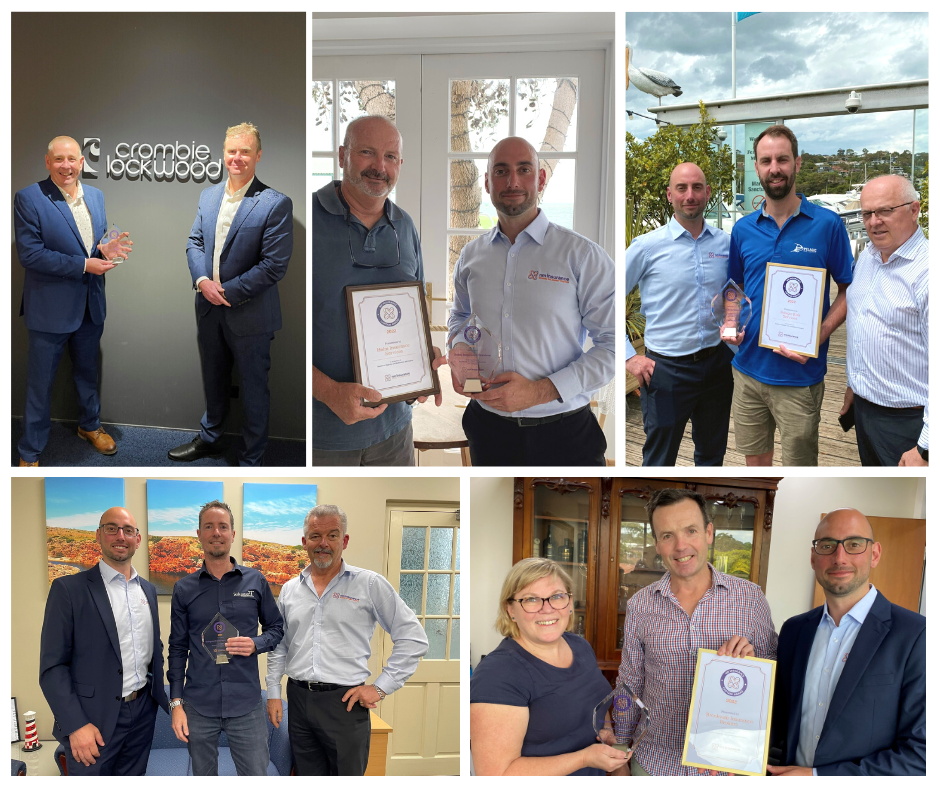
From left to right: Aaron Stephenson (PSC AMGI Insurance Brokers) and Glen Schembri (NM Insurance)
Mike Steel
Mike is the Commodore of Townsville Yacht Club and the owner and skipper of Boudica, an Elan E5 which he brought to Hamilton Island for the first time this year. Although new to the regatta with this boat, he has previously raced at Hamilton Island with two other yachts.
“I sit as Event Chairman of SeaLink Magnetic Island Race Week and have been involved in almost every edition of that regatta since its inception,” says Mike. “This was my fourth Hamilton Island Race Week. The convenience of everything being together here is a big drawcard, and the sailing conditions are always a challenge compared to what we experience at home. You learn a lot here and meet a lot of good people.”
Mike’s Race Week crew this year included friends from Sydney and locals from Townsville. He has relied on Nautilus Marine Insurance for over a decade. “I have been with Nautilus Marine for about 12 years,” says Mike. “I had one claim after bumping the bottom and they helped me repair the boat really well. They looked after me.”
From left to right: Peter Honan, Alison Barton and Tony Muller (FINPAC Insurance Brokers)
Andrew Bruce
Andrew Bruce and his co-owner Andrew Gibbs have been sailing their catamaran Fruition since 2012. Based out of the Royal Queensland Yacht Squadron, the crew made the 12-day cruise north to compete in Race Week. “This was our fourth Hamilton Island Race Week in a row. We love it,” Andrew says.
On the way up this year, Fruition struck a whale about 15 miles south of Hamilton Island, causing significant damage to the port keel. “It was very unfortunate, but Nautilus Marine Insurance responded quickly and helped us get everything sorted so we could still enjoy the regatta,” Andrew explains. Andrew has covered his yacht with Nautilus Marine for six years and says the experience has always been positive. “They have been great to deal with and really supportive,” says Andrew. “That makes a big difference when something unexpected happens.”
From left to right: Erin Ritchie (Network Insurance Group) and Louie Ralevski (NM Insurance)
Kevin Lord
Kevin has owned his Seawind 1160 catamaran Vivacious for eight years. Based in Yeppoon, Kevin sails with the Capricornia Cruising Yacht Club and races every second week. Each year, he and his crew make the trip north to Hamilton Island, with 2025 marking their eighth Race Week.
Before purchasing Vivacious, Kevin and his family enjoyed six years with their previous yacht, Overture. Kevin’s vessels have been covered by Nautilus Marine throughout. “We had a claim on a rudder after unfortunately hitting a rock with our old boat,” Kevin recalls. “We have been very pleased with Nautilus Marine Insurance when we have had to make claims. Everything has always been handled very well.”
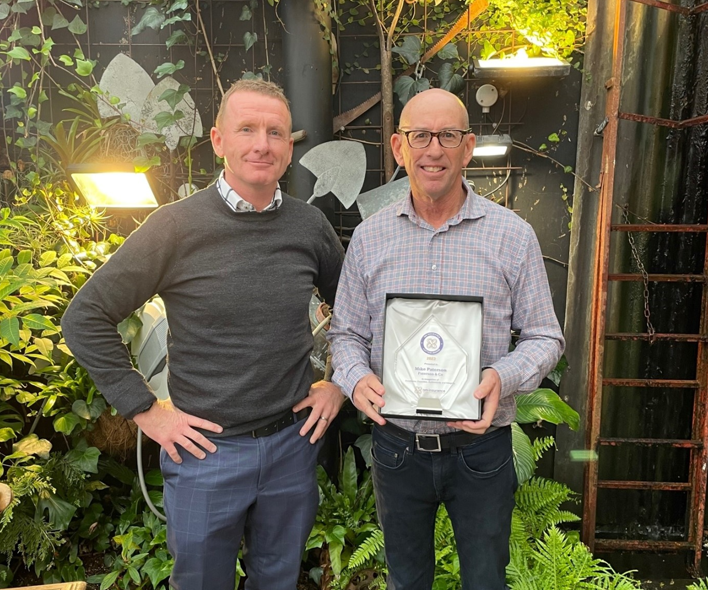
From left to right: Andrew McFetridge (NM Insurance NZ) and Mike Paterson (Paterson & Co NZ Ltd)
Mike Paterson, Paterson & Co NZ Ltd (Auckland)
Congratulations on receiving an NM Insurance Captain Award. How does it feel to be recognised with this award? It’s a huge recognition and I have not been recognised with an award like this before. We like to stay non-visible in market, stay out of the limelight and just do our thing as a specialist broker. But we are very proud and happy to be a recipient of such an award.
The NM Insurance Captain Awards concept recognise broker partners who consistently embody our NM Insurance values and traits. These include putting our customers first, building respect and trust through integrity and reliability, being results driven, working as one team and having a commitment to learning and growth. Do you see alignment between these values and your own company values and ethos? There is a strong synergy between our business and NM Insurance. Working with staff like Emma [Macadie, NM Insurance Marine Underwriter] and the team is important as it helps us provide our clients with a solution and makes the difficult, simple.
At NM Insurance, we’re always striving to make our broker relationships true partnerships, based on trust, shared values and mutual success and growth. What are your thoughts on that? How would you sum up your experience of working with NM Insurance and the relationships you have built with our team. This is a great example of a niche broker working with a specialist provider like NM, which helps us get the results and right outcomes for our clients.
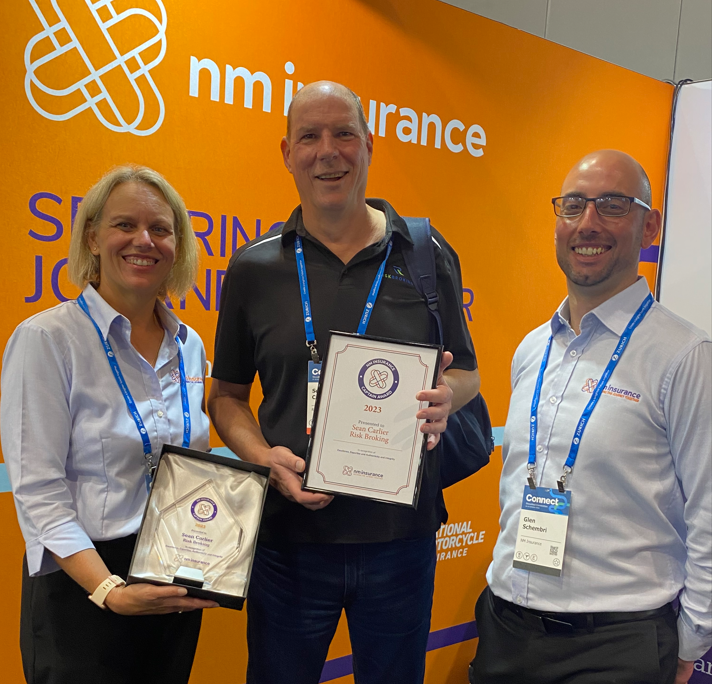
From left to right: Trish Flaherty (NM Insurance), Sean Carlier (Risk Broking Pty Ltd) and Glen Schembri (NM Insurance)
Sean Carlier, Risk Broking Pty Ltd (South Australia)
Congratulations on receiving an NM Insurance Captain Award. How does it feel to be recognised with this award? This award is confirmation we are doing the right thing and are focusing on our customers. It highlights the importance of working with our clients, combined with the support of our partners, to create solutions.
The NM Insurance Captain Awards concept recognise broker partners who consistently embody our NM Insurance values and traits. These include putting our customers first, building respect and trust through integrity and reliability, being results driven, working as one team and having a commitment to learning and growth. Do you see alignment between these values and your own company values and ethos? Customers are our number one priority and word of mouth is a powerful thing. It is very important to focus on these qualities to be successful.
At NM Insurance, we’re always striving to make our broker relationships true partnerships, based on trust, shared values and mutual success and growth. What are your thoughts on that? How would you sum up your experience of working with NM Insurance and the relationships you have built with our team? If you do the small things well, it will show in your results. Our relationship with NM Insurance is outstanding, even through tough times the support has always been there. NM Insurance has a great product, service, and support to match.
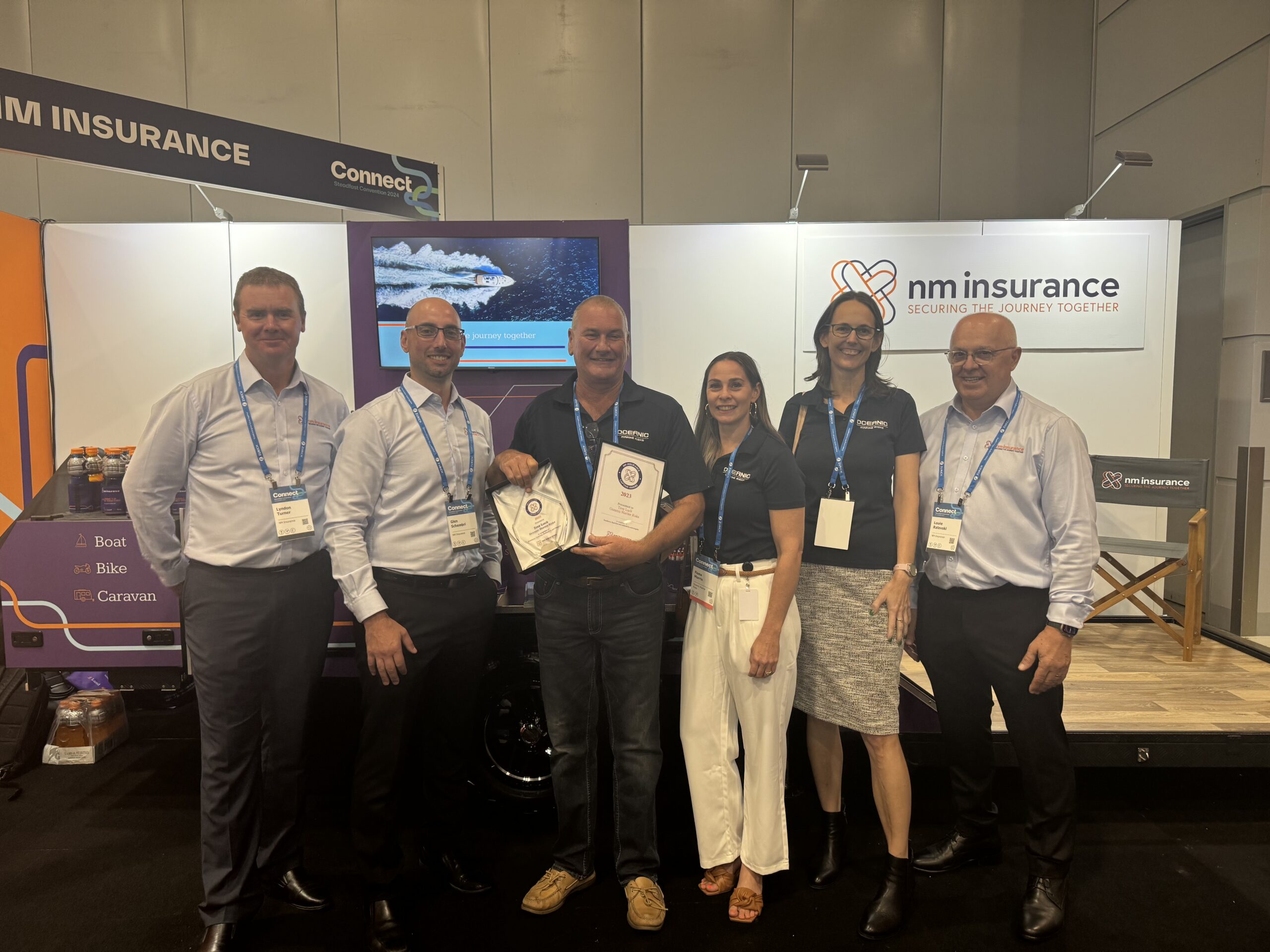
From left to right: Lyndon Turner (NM Insurance), Glen Schembri (NM Insurance), Troy Luck (Oceanic Marine Risks), Fiona Morris (Oceanic Marine Risks), Helen Hursey (Oceanic Marine Risks), Louie Ralevski (NM Insurance)
Troy Luck, Oceanic Marine Risks (Queensland)
Congratulations on receiving an NM Insurance Captain Award. How does it feel to be recognised with this award? It makes you feel special to receive recognition from providing the right outcome for customers through the relationship with NM Insurance.
The NM Insurance Captain Awards concept recognise broker partners who consistently embody our NM Insurance values and traits. These include putting our customers first, building respect and trust through integrity and reliability, being results driven, working as one team and having a commitment to learning and growth. Do you see alignment between these values and your own company values and ethos? Customers always come first, it is important to know your markets and get the right fit between customer and insurance provider.
At NM Insurance, we’re always striving to make our broker relationships true partnerships, based on trust, shared values and mutual success and growth. What are your thoughts on that? How would you sum up your experience of working with NM Insurance and the relationships you have built with our team? The relationship with NM Insurance is pretty seamless, and where issues may have arisen NM Insurance has been open and honest resulting in the best outcome for the customer.
NM Insurance is a trading name of Nautilus Marine Underwriting Agency Ltd NZBN: 9429031454261, FSP: 388326. NM Insurance is an insurance underwriting agency and has a binding authority from Zurich Australian Insurance Limited (ZAIL) which allows it to enter into and arrange policies of insurance. NM Insurance acts on behalf of ZAIL and not you when providing these services but does so under its own FSP number.
Content on this website is information only and not financial advice. It is intended as a summary of the highlights of any cover available and does not take into account any person’s objectives, financial situation or needs. Always read the relevant Policy Wording before buying or renewing insurance. It contains a full description of the applicable terms and conditions.
Steadfast Group Ltd (ABN 98 073 659 677) (‘SGL’) has a majority shareholding in NM Insurance Pty Ltd (NM Insurance).
SGL may receive a professional services fee (PSF) from insurers, premium funders and underwriting agencies such as NM Insurance (Partner) for access to regulatory and compliance support; marketing and communications; data insights; and access to technology platforms. The PSF is an agreed amount between SGL and the relevant Partner, usually annually. The PSF is not determined by the volume of the business that the Steadfast Network brokers place, nor is the amount of the PSF known to the Steadfast Network Brokers, so it is not able to influence recommendations to their clients.
NM Insurance may have access to shared services from SGL, including: compliance tools; procedures; manuals and training; legal; HR banking; and group purchasing arrangements. These services are funded by SGL, subsidised by SGL or SGL receives a fee for them.
SGL’s FSG is available at www.steadfast.com.au or on request by telephoning SGL’s Company Secretary on +61 2 9495 6500.
© 2021 NM Insurance Pty Ltd. Created by Codex.
Expert’s guide to storm safety
NM Insurance is pleased to announce the appointment of Andrew McFetridge as Executive Director of New Zealand. In this role, Andrew will be responsible for NM Insurance’s continued growth across the region, focussing energy on increased support to our customers, partners, product enhancement and service deliverables.
The old adage that you need a plan to succeed is absolutely relevant with storm preparedness,” says Andrew Chapman, Chief Operating Officer of Gold Coast City Marina & Shipyard (GCCM), President of the Marina Industries Association (MIA) and Certified Marina Manager. We asked Chapman to share some key risk mitigation advice to help you prepare your boat for storm season.
- Maintain your vessel and ensure it is in good, seaworthy condition with an appropriate trim. Damage should be repaired as soon as practical so as to maintain the vessel’s integrity which can be essential in some storm conditions. Vessel maintenance should include window and storm board seals and scupper operation checks.
- Have prepared storm emergency kits stocked and stored in an appropriate location on your vessel. This kit may include additional lines, torches including the new head lamps, duct tape, additional bilge pump, bucket, tools, straps, cable ties and a knife.
- Adding additional lines to alternative cleats can assist if the main mooring lines break or cleats fail. Spreading the load over longer lines allows some give when lines tighten. This spring effect will absorb some line shock and potentially extend the life of a line through extended storm events. Lines should be inspected regularly as different lines are affected by UV exposure or retained moisture. Mooring line life can be shortened by the conditions at each marina so inspect and replace as required at least twice a year. Fenders should also be inspected regularly as they are fastened with lines that are in the elements 24/7 when in use, which may include significant UV exposure. Fenders should be of an appropriate size and inflated to the designed pressure to absorb vessel movement against the dock.
- Batteries should be effectively maintained and have sufficient storage to operate bilge pumps in a prolonged power outage. Power outages may be grid orientated or marinas may turn off power in some storm surge events for safety reasons.
- Sails, biminis, cushions and dinghies should be removed or appropriately stowed from above deck if a storm is approaching to reduce windage. If a dinghy needs to remain on the boat ensure the bungs are removed and the path for rainwater to escape is clear.
- Fridges and freezers should be emptied to avoid spoiled food if power is off for any prolonged period. Frozen food that defrosts can be a major problem if it leaks outside galley fridges onto carpet and other surfaces.
- Bilge pumps should be well maintained and operationally tested and set to automatic mode. Bilges must be maintained in a clean state so as to prevent bilge pump or float switch fouling during operation. It’s imperative that bilges are also free from any fuel or oil residue so that this is not pumped into the environment. In some instances, back-up bilge pumps can be petrol-driven to give that power source redundancy in an extended event.
- Update the marina with contact information especially if you are going to be away. It’s important to nominate an additional person to make decisions in your absence.
- Consider moving your vessel to a more secure location depending on the type of extreme event that is impending. Considering a more protected marina or even an upriver mangrove refuge sometimes offers more protection than sitting in a berth close to the coast. However, each storm is very different and advice should be sought from appropriately qualified professionals with local knowledge. Remember to plan ahead and not move when the storm is in play. Your safety is most important.
- Make yourself aware of your marina’s emergency procedures and evacuation points as it’s important to remember that your personal safety is far more important than that of your vessel in a storm.
Visit gccm.com.au
NM Insurance is a trading name of Nautilus Marine Underwriting Agency Ltd NZBN: 9429031454261, FSP: 388326. NM Insurance is an insurance underwriting agency and has a binding authority from Zurich Australian Insurance Limited (ZAIL) which allows it to enter into and arrange policies of insurance. NM Insurance acts on behalf of ZAIL and not you when providing these services but does so under its own FSP number.
Content on this website is information only and not financial advice. It is intended as a summary of the highlights of any cover available and does not take into account any person’s objectives, financial situation or needs. Always read the relevant Policy Wording before buying or renewing insurance. It contains a full description of the applicable terms and conditions.
Steadfast Group Ltd (ABN 98 073 659 677) (‘SGL’) has a majority shareholding in NM Insurance Pty Ltd (NM Insurance).
SGL may receive a professional services fee (PSF) from insurers, premium funders and underwriting agencies such as NM Insurance (Partner) for access to regulatory and compliance support; marketing and communications; data insights; and access to technology platforms. The PSF is an agreed amount between SGL and the relevant Partner, usually annually. The PSF is not determined by the volume of the business that the Steadfast Network brokers place, nor is the amount of the PSF known to the Steadfast Network Brokers, so it is not able to influence recommendations to their clients.
NM Insurance may have access to shared services from SGL, including: compliance tools; procedures; manuals and training; legal; HR banking; and group purchasing arrangements. These services are funded by SGL, subsidised by SGL or SGL receives a fee for them.
SGL’s FSG is available at www.steadfast.com.au or on request by telephoning SGL’s Company Secretary on +61 2 9495 6500.
© 2021 NM Insurance Pty Ltd. Created by Codex.
Expert’s guide to storm safety
Whether you ride a dirt bike, road bike, tourer, cruiser or learner machine, your pride and joy is always a vulnerable target.
Easy to roll away and often worth thousands in parts alone, motorcycles remain an easy score for thieves. Unlike modern cars, many bikes lack factory immobilisers or alarms, and even with chains or locks, a determined crew can lift one into a van in no time. Once stolen, recovery rates are low, especially for competition bikes with no registration, which makes prevention essential on your part.
BE ALERT
Thieves strike in many ways. Bikes vanish from trailers and utes parked in driveways or hotel carparks, from sheds and garages without heavy-duty locks, or from roadside stops on trips. Social media posts that reveal your suburb or garage photos can set you up as a target, and fake buyers posing as customers often scope out homes before returning later to steal. Some riders have even been followed home from a ride and hit overnight.
In most cases, theft is not random, it is planned, and the thief has already seen your bike. The golden rule of motorcycle security is simple: be vigilant, all of the time. Reducing risk means being discreet and consistent. Do not wash, tune or leave your bike where it is visible from the street, and keep garage doors closed. Avoid leaving trailers out front, and if you think you are being followed, circle the block before pulling in.
STAY VIGILANT
Think twice before posting, because criminals scroll the same feeds you do, and do not share images that reveal number plates, houses or driveways. When selling, always meet buyers in public and avoid giving out your home address. Teach kids not to talk about your bikes at school and remind friends to be careful with what they share online as well.
A barking dog is still one of the best deterrents, and proper locks are essential. Anchor your bike inside the shed with a heavy-duty chain, add a disc lock or alarmed padlock, and secure trailers at the drawbar and wheels. Never leave a bike on an open trailer overnight. Enclosed trailers are safer, but even then, park the door against walls or poles and use multiple locks.
TRUST TECHNOLOGY
Technology is also useful, from GPS trackers and motion alarms to dummy cameras or warning signs. Microdot systems such as DataDot can improve the odds of recovery. Keep clear photos of your bike, VIN and engine numbers, and store receipts and paperwork safely. If locks or latches show signs of tampering, treat it as a warning, not an accident. Get onto it.
BE SMART
Every motorcycle is a potential target, from minibikes to million-dollar classics. Some bikes are harder to trace than others and stolen machines are quickly stripped, hidden interstate or moved overseas – once gone, the chance of recovery is slim. That is why vigilance matters. Be private, be smart and be cautious because someone is always looking for an easy target.
Words: Jeff Ware
NM Insurance is a trading name of Nautilus Marine Underwriting Agency Ltd NZBN: 9429031454261, FSP: 388326. NM Insurance is an insurance underwriting agency and has a binding authority from Zurich Australian Insurance Limited (ZAIL) which allows it to enter into and arrange policies of insurance. NM Insurance acts on behalf of ZAIL and not you when providing these services but does so under its own FSP number.
Content on this website is information only and not financial advice. It is intended as a summary of the highlights of any cover available and does not take into account any person’s objectives, financial situation or needs. Always read the relevant Policy Wording before buying or renewing insurance. It contains a full description of the applicable terms and conditions.
Steadfast Group Ltd (ABN 98 073 659 677) (‘SGL’) has a majority shareholding in NM Insurance Pty Ltd (NM Insurance).
SGL may receive a professional services fee (PSF) from insurers, premium funders and underwriting agencies such as NM Insurance (Partner) for access to regulatory and compliance support; marketing and communications; data insights; and access to technology platforms. The PSF is an agreed amount between SGL and the relevant Partner, usually annually. The PSF is not determined by the volume of the business that the Steadfast Network brokers place, nor is the amount of the PSF known to the Steadfast Network Brokers, so it is not able to influence recommendations to their clients.
NM Insurance may have access to shared services from SGL, including: compliance tools; procedures; manuals and training; legal; HR banking; and group purchasing arrangements. These services are funded by SGL, subsidised by SGL or SGL receives a fee for them.
SGL’s FSG is available at www.steadfast.com.au or on request by telephoning SGL’s Company Secretary on +61 2 9495 6500.
© 2021 NM Insurance Pty Ltd. Created by Codex.
Expert’s guide to storm safety
The best, brightest and proudest of the marina industry were recognised at the 2025 Nautilus Marine Insurance Marina of the Year Awards, held at Sydney’s picturesque Middle Harbour Skiff Club.
Opening the evening, Marina Industries Association (MIA) President and Master of Ceremonies, Andrew Chapman CMM remarked, “This is another incredibly successful celebration of our industry. The Awards attracted record entries across several categories, with over 110 guests and finalists gathering from across Australia, New Zealand, Thailand, the UAE and Singapore.”
Andrew Mulholland, Marketing Director / Commercial Partnerships Manager of event partner Nautilus Marine Insurance (NMI), echoed the sentiment, adding, “These Awards honour all entrants and finalists who consistently raise the bar and set new standards in our industry. While outstanding facilities are important, it’s the people who deliver the excellence we celebrate tonight.” Drawing a parallel with the Nautilus Marine Insurance values, Mullholland went on to say, “It’s about putting your customers at the core of everything you do and building trust through integrity and reliability.”
While the Awards have traditionally focused on facilities, 2025 saw the introduction of two new categories designed to spotlight and promote the achievements of individual contributions and rising talent. The inaugural Emerging Talent Award recognised future leaders under 35, with Jacob Morris, Director at Marine Structures, taking home the honour from a strong field. The new Industry Woman of the Year Award also made a strong debut, receiving a wave of impressive nominations. The winner, Stephanie Trounce, WHS Property and Compliance Manager at Gold Coast City Marina & Shipyard, was acknowledged for her deep expertise in safety systems and her leadership in maintaining high standards of property and compliance.
The flagship Marina of the Year categories were more competitive than ever. The recently redeveloped Jones Bay Superyacht Marina in Pyrmont, Sydney, emerged victorious as the Marina of the Year under 140 boats. It was a standout night for Gold Coast City Marina & Shipyard (GCCM), which claimed the Marina of the Year Award (over 140 boats), Boatyard of the Year (over 20 boats) and Dry Stack Facility Award. Celebrating 25 years of trailblazing excellence, GCCM has transformed former farming paddocks into a world-class marina and shipyard, playing a pivotal role in the development of the Coomera marine precinct.
Innovation was also in the spotlight this year, with Bellingham Marine taking home the Industry Innovation of the Year Award for its reimagined Unifloat system. The Royal Queensland Yacht Squadron (RQYS) once again claimed the coveted Club of the Year Award.
The competition in the Boatyard of the Year category for yards servicing under 20 boats was also strong, with White Bay 6 Marine Park taking the win. Industry veteran Lorraine Yates CMP reflected on the honour, “We’re grateful for industry recognition through awards like these. We have a beautiful facility in a stunning location, and I’m privileged that the owners trust us to manage it every day.”
The full list of Award winners for are 2025:
- Best Commercial Marina (Over 140 Boats): Gold Coast City Marina & Shipyard (GCCM), QLD
- Best Commercial Marina (Under 140 Boats): Jones Bay Superyacht Marina, NSW
- Club of the Year: Royal Queensland Yacht Squadron, QLD
- International Marina of the Year: Dubai Harbour Marina, UAE
- Dry Stack Storage Facility of the Year: Gold Coast City Marina & Shipyard, QLD
- Best Boat Yard (Under 20 Boats): White Bay 6 Marine Park, NSW
- Best Boat Yard (Over 20 Boats): Gold Coast City Marina & Shipyard, QLD
- Emerging Talent of the Year: Jacob Morris, QLD
- Industry Women of the Year: Stephanie Trounce, QLD
- MIA Environmental Award: Royal Phuket Marina, Thailand
- Industry Innovation Award: Bellingham Marine Australia, QLD
- Hall of Fame International Marina: ONE°15 Marina Sentosa Cove, Singapore
- Hall of Fame Dry Stack Storage Facility: Sydney Harbour Boat Storage
The old adage that you need a plan to succeed is absolutely relevant with storm preparedness,” says Andrew Chapman, Chief Operating Officer of Gold Coast City Marina & Shipyard (GCCM), President of the Marina Industries Association (MIA) and Certified Marina Manager. We asked Chapman to share some key risk mitigation advice to help you prepare your boat for storm season.
- Maintain your vessel and ensure it is in good, seaworthy condition with an appropriate trim. Damage should be repaired as soon as practical so as to maintain the vessel’s integrity which can be essential in some storm conditions. Vessel maintenance should include window and storm board seals and scupper operation checks.
- Have prepared storm emergency kits stocked and stored in an appropriate location on your vessel. This kit may include additional lines, torches including the new head lamps, duct tape, additional bilge pump, bucket, tools, straps, cable ties and a knife.
- Adding additional lines to alternative cleats can assist if the main mooring lines break or cleats fail. Spreading the load over longer lines allows some give when lines tighten. This spring effect will absorb some line shock and potentially extend the life of a line through extended storm events. Lines should be inspected regularly as different lines are affected by UV exposure or retained moisture. Mooring line life can be shortened by the conditions at each marina so inspect and replace as required at least twice a year. Fenders should also be inspected regularly as they are fastened with lines that are in the elements 24/7 when in use, which may include significant UV exposure. Fenders should be of an appropriate size and inflated to the designed pressure to absorb vessel movement against the dock.
- Batteries should be effectively maintained and have sufficient storage to operate bilge pumps in a prolonged power outage. Power outages may be grid orientated or marinas may turn off power in some storm surge events for safety reasons.
- Sails, biminis, cushions and dinghies should be removed or appropriately stowed from above deck if a storm is approaching to reduce windage. If a dinghy needs to remain on the boat ensure the bungs are removed and the path for rainwater to escape is clear.
- Fridges and freezers should be emptied to avoid spoiled food if power is off for any prolonged period. Frozen food that defrosts can be a major problem if it leaks outside galley fridges onto carpet and other surfaces.
- Bilge pumps should be well maintained and operationally tested and set to automatic mode. Bilges must be maintained in a clean state so as to prevent bilge pump or float switch fouling during operation. It’s imperative that bilges are also free from any fuel or oil residue so that this is not pumped into the environment. In some instances, back-up bilge pumps can be petrol-driven to give that power source redundancy in an extended event.
- Update the marina with contact information especially if you are going to be away. It’s important to nominate an additional person to make decisions in your absence.
- Consider moving your vessel to a more secure location depending on the type of extreme event that is impending. Considering a more protected marina or even an upriver mangrove refuge sometimes offers more protection than sitting in a berth close to the coast. However, each storm is very different and advice should be sought from appropriately qualified professionals with local knowledge. Remember to plan ahead and not move when the storm is in play. Your safety is most important.
- Make yourself aware of your marina’s emergency procedures and evacuation points as it’s important to remember that your personal safety is far more important than that of your vessel in a storm.
Visit gccm.com.au
NM Insurance is a trading name of Nautilus Marine Underwriting Agency Ltd NZBN: 9429031454261, FSP: 388326. NM Insurance is an insurance underwriting agency and has a binding authority from Zurich Australian Insurance Limited (ZAIL) which allows it to enter into and arrange policies of insurance. NM Insurance acts on behalf of ZAIL and not you when providing these services but does so under its own FSP number.
Content on this website is information only and not financial advice. It is intended as a summary of the highlights of any cover available and does not take into account any person’s objectives, financial situation or needs. Always read the relevant Policy Wording before buying or renewing insurance. It contains a full description of the applicable terms and conditions.
Steadfast Group Ltd (ABN 98 073 659 677) (‘SGL’) has a majority shareholding in NM Insurance Pty Ltd (NM Insurance).
SGL may receive a professional services fee (PSF) from insurers, premium funders and underwriting agencies such as NM Insurance (Partner) for access to regulatory and compliance support; marketing and communications; data insights; and access to technology platforms. The PSF is an agreed amount between SGL and the relevant Partner, usually annually. The PSF is not determined by the volume of the business that the Steadfast Network brokers place, nor is the amount of the PSF known to the Steadfast Network Brokers, so it is not able to influence recommendations to their clients.
NM Insurance may have access to shared services from SGL, including: compliance tools; procedures; manuals and training; legal; HR banking; and group purchasing arrangements. These services are funded by SGL, subsidised by SGL or SGL receives a fee for them.
SGL’s FSG is available at www.steadfast.com.au or on request by telephoning SGL’s Company Secretary on +61 2 9495 6500.
© 2021 NM Insurance Pty Ltd. Created by Codex.
Expert’s guide to storm safety
The old adage that you need a plan to succeed is absolutely relevant with storm preparedness,” says Andrew Chapman, Chief Operating Officer of Gold Coast City Marina & Shipyard (GCCM), President of the Marina Industries Association (MIA) and Certified Marina Manager. We asked Chapman to share some key risk mitigation advice to help you prepare your boat for storm season.
- Maintain your vessel and ensure it is in good, seaworthy condition with an appropriate trim. Damage should be repaired as soon as practical so as to maintain the vessel’s integrity which can be essential in some storm conditions. Vessel maintenance should include window and storm board seals and scupper operation checks.
- Have prepared storm emergency kits stocked and stored in an appropriate location on your vessel. This kit may include additional lines, torches including the new head lamps, duct tape, additional bilge pump, bucket, tools, straps, cable ties and a knife.
- Adding additional lines to alternative cleats can assist if the main mooring lines break or cleats fail. Spreading the load over longer lines allows some give when lines tighten. This spring effect will absorb some line shock and potentially extend the life of a line through extended storm events. Lines should be inspected regularly as different lines are affected by UV exposure or retained moisture. Mooring line life can be shortened by the conditions at each marina so inspect and replace as required at least twice a year. Fenders should also be inspected regularly as they are fastened with lines that are in the elements 24/7 when in use, which may include significant UV exposure. Fenders should be of an appropriate size and inflated to the designed pressure to absorb vessel movement against the dock.
- Batteries should be effectively maintained and have sufficient storage to operate bilge pumps in a prolonged power outage. Power outages may be grid orientated or marinas may turn off power in some storm surge events for safety reasons.
- Sails, biminis, cushions and dinghies should be removed or appropriately stowed from above deck if a storm is approaching to reduce windage. If a dinghy needs to remain on the boat ensure the bungs are removed and the path for rainwater to escape is clear.
- Fridges and freezers should be emptied to avoid spoiled food if power is off for any prolonged period. Frozen food that defrosts can be a major problem if it leaks outside galley fridges onto carpet and other surfaces.
- Bilge pumps should be well maintained and operationally tested and set to automatic mode. Bilges must be maintained in a clean state so as to prevent bilge pump or float switch fouling during operation. It’s imperative that bilges are also free from any fuel or oil residue so that this is not pumped into the environment. In some instances, back-up bilge pumps can be petrol-driven to give that power source redundancy in an extended event.
- Update the marina with contact information especially if you are going to be away. It’s important to nominate an additional person to make decisions in your absence.
- Consider moving your vessel to a more secure location depending on the type of extreme event that is impending. Considering a more protected marina or even an upriver mangrove refuge sometimes offers more protection than sitting in a berth close to the coast. However, each storm is very different and advice should be sought from appropriately qualified professionals with local knowledge. Remember to plan ahead and not move when the storm is in play. Your safety is most important.
- Make yourself aware of your marina’s emergency procedures and evacuation points as it’s important to remember that your personal safety is far more important than that of your vessel in a storm.
Visit gccm.com.au
NM Insurance is a trading name of Nautilus Marine Underwriting Agency Ltd NZBN: 9429031454261, FSP: 388326. NM Insurance is an insurance underwriting agency and has a binding authority from Zurich Australian Insurance Limited (ZAIL) which allows it to enter into and arrange policies of insurance. NM Insurance acts on behalf of ZAIL and not you when providing these services but does so under its own FSP number.
Content on this website is information only and not financial advice. It is intended as a summary of the highlights of any cover available and does not take into account any person’s objectives, financial situation or needs. Always read the relevant Policy Wording before buying or renewing insurance. It contains a full description of the applicable terms and conditions.
Steadfast Group Ltd (ABN 98 073 659 677) (‘SGL’) has a majority shareholding in NM Insurance Pty Ltd (NM Insurance).
SGL may receive a professional services fee (PSF) from insurers, premium funders and underwriting agencies such as NM Insurance (Partner) for access to regulatory and compliance support; marketing and communications; data insights; and access to technology platforms. The PSF is an agreed amount between SGL and the relevant Partner, usually annually. The PSF is not determined by the volume of the business that the Steadfast Network brokers place, nor is the amount of the PSF known to the Steadfast Network Brokers, so it is not able to influence recommendations to their clients.
NM Insurance may have access to shared services from SGL, including: compliance tools; procedures; manuals and training; legal; HR banking; and group purchasing arrangements. These services are funded by SGL, subsidised by SGL or SGL receives a fee for them.
SGL’s FSG is available at www.steadfast.com.au or on request by telephoning SGL’s Company Secretary on +61 2 9495 6500.
© 2021 NM Insurance Pty Ltd. Created by Codex.
Expert’s guide to storm safety
Whether you ride a dirt bike, road bike, tourer, cruiser or learner machine, your pride and joy is always a vulnerable target.
Easy to roll away and often worth thousands in parts alone, motorcycles remain an easy score for thieves. Unlike modern cars, many bikes lack factory immobilisers or alarms, and even with chains or locks, a determined crew can lift one into a van in no time. Once stolen, recovery rates are low, especially for competition bikes with no registration, which makes prevention essential on your part.
BE ALERT
Thieves strike in many ways. Bikes vanish from trailers and utes parked in driveways or hotel carparks, from sheds and garages without heavy-duty locks, or from roadside stops on trips. Social media posts that reveal your suburb or garage photos can set you up as a target, and fake buyers posing as customers often scope out homes before returning later to steal. Some riders have even been followed home from a ride and hit overnight.
In most cases, theft is not random, it is planned, and the thief has already seen your bike. The golden rule of motorcycle security is simple: be vigilant, all of the time. Reducing risk means being discreet and consistent. Do not wash, tune or leave your bike where it is visible from the street, and keep garage doors closed. Avoid leaving trailers out front, and if you think you are being followed, circle the block before pulling in.
STAY VIGILANT
Think twice before posting, because criminals scroll the same feeds you do, and do not share images that reveal number plates, houses or driveways. When selling, always meet buyers in public and avoid giving out your home address. Teach kids not to talk about your bikes at school and remind friends to be careful with what they share online as well.
A barking dog is still one of the best deterrents, and proper locks are essential. Anchor your bike inside the shed with a heavy-duty chain, add a disc lock or alarmed padlock, and secure trailers at the drawbar and wheels. Never leave a bike on an open trailer overnight. Enclosed trailers are safer, but even then, park the door against walls or poles and use multiple locks.
TRUST TECHNOLOGY
Technology is also useful, from GPS trackers and motion alarms to dummy cameras or warning signs. Microdot systems such as DataDot can improve the odds of recovery. Keep clear photos of your bike, VIN and engine numbers, and store receipts and paperwork safely. If locks or latches show signs of tampering, treat it as a warning, not an accident. Get onto it.
BE SMART
Every motorcycle is a potential target, from minibikes to million-dollar classics. Some bikes are harder to trace than others and stolen machines are quickly stripped, hidden interstate or moved overseas – once gone, the chance of recovery is slim. That is why vigilance matters. Be private, be smart and be cautious because someone is always looking for an easy target.
Words: Jeff Ware
From left to right: Aaron Stephenson (PSC AMGI Insurance Brokers) and Glen Schembri (NM Insurance)
Mike Steel
Mike is the Commodore of Townsville Yacht Club and the owner and skipper of Boudica, an Elan E5 which he brought to Hamilton Island for the first time this year. Although new to the regatta with this boat, he has previously raced at Hamilton Island with two other yachts.
“I sit as Event Chairman of SeaLink Magnetic Island Race Week and have been involved in almost every edition of that regatta since its inception,” says Mike. “This was my fourth Hamilton Island Race Week. The convenience of everything being together here is a big drawcard, and the sailing conditions are always a challenge compared to what we experience at home. You learn a lot here and meet a lot of good people.”
Mike’s Race Week crew this year included friends from Sydney and locals from Townsville. He has relied on Nautilus Marine Insurance for over a decade. “I have been with Nautilus Marine for about 12 years,” says Mike. “I had one claim after bumping the bottom and they helped me repair the boat really well. They looked after me.”
From left to right: Peter Honan, Alison Barton and Tony Muller (FINPAC Insurance Brokers)
Andrew Bruce
Andrew Bruce and his co-owner Andrew Gibbs have been sailing their catamaran Fruition since 2012. Based out of the Royal Queensland Yacht Squadron, the crew made the 12-day cruise north to compete in Race Week. “This was our fourth Hamilton Island Race Week in a row. We love it,” Andrew says.
On the way up this year, Fruition struck a whale about 15 miles south of Hamilton Island, causing significant damage to the port keel. “It was very unfortunate, but Nautilus Marine Insurance responded quickly and helped us get everything sorted so we could still enjoy the regatta,” Andrew explains. Andrew has covered his yacht with Nautilus Marine for six years and says the experience has always been positive. “They have been great to deal with and really supportive,” says Andrew. “That makes a big difference when something unexpected happens.”
From left to right: Erin Ritchie (Network Insurance Group) and Louie Ralevski (NM Insurance)
Kevin Lord
Kevin has owned his Seawind 1160 catamaran Vivacious for eight years. Based in Yeppoon, Kevin sails with the Capricornia Cruising Yacht Club and races every second week. Each year, he and his crew make the trip north to Hamilton Island, with 2025 marking their eighth Race Week.
Before purchasing Vivacious, Kevin and his family enjoyed six years with their previous yacht, Overture. Kevin’s vessels have been covered by Nautilus Marine throughout. “We had a claim on a rudder after unfortunately hitting a rock with our old boat,” Kevin recalls. “We have been very pleased with Nautilus Marine Insurance when we have had to make claims. Everything has always been handled very well.”
From left to right: Andrew McFetridge (NM Insurance NZ) and Mike Paterson (Paterson & Co NZ Ltd)
Mike Paterson, Paterson & Co NZ Ltd (Auckland)
Congratulations on receiving an NM Insurance Captain Award. How does it feel to be recognised with this award? It’s a huge recognition and I have not been recognised with an award like this before. We like to stay non-visible in market, stay out of the limelight and just do our thing as a specialist broker. But we are very proud and happy to be a recipient of such an award.
The NM Insurance Captain Awards concept recognise broker partners who consistently embody our NM Insurance values and traits. These include putting our customers first, building respect and trust through integrity and reliability, being results driven, working as one team and having a commitment to learning and growth. Do you see alignment between these values and your own company values and ethos? There is a strong synergy between our business and NM Insurance. Working with staff like Emma [Macadie, NM Insurance Marine Underwriter] and the team is important as it helps us provide our clients with a solution and makes the difficult, simple.
At NM Insurance, we’re always striving to make our broker relationships true partnerships, based on trust, shared values and mutual success and growth. What are your thoughts on that? How would you sum up your experience of working with NM Insurance and the relationships you have built with our team. This is a great example of a niche broker working with a specialist provider like NM, which helps us get the results and right outcomes for our clients.
From left to right: Trish Flaherty (NM Insurance), Sean Carlier (Risk Broking Pty Ltd) and Glen Schembri (NM Insurance)
Sean Carlier, Risk Broking Pty Ltd (South Australia)
Congratulations on receiving an NM Insurance Captain Award. How does it feel to be recognised with this award? This award is confirmation we are doing the right thing and are focusing on our customers. It highlights the importance of working with our clients, combined with the support of our partners, to create solutions.
The NM Insurance Captain Awards concept recognise broker partners who consistently embody our NM Insurance values and traits. These include putting our customers first, building respect and trust through integrity and reliability, being results driven, working as one team and having a commitment to learning and growth. Do you see alignment between these values and your own company values and ethos? Customers are our number one priority and word of mouth is a powerful thing. It is very important to focus on these qualities to be successful.
At NM Insurance, we’re always striving to make our broker relationships true partnerships, based on trust, shared values and mutual success and growth. What are your thoughts on that? How would you sum up your experience of working with NM Insurance and the relationships you have built with our team? If you do the small things well, it will show in your results. Our relationship with NM Insurance is outstanding, even through tough times the support has always been there. NM Insurance has a great product, service, and support to match.
NM Insurance is a trading name of Nautilus Marine Underwriting Agency Ltd NZBN: 9429031454261, FSP: 388326. NM Insurance is an insurance underwriting agency and has a binding authority from Zurich Australian Insurance Limited (ZAIL) which allows it to enter into and arrange policies of insurance. NM Insurance acts on behalf of ZAIL and not you when providing these services but does so under its own FSP number.
Content on this website is information only and not financial advice. It is intended as a summary of the highlights of any cover available and does not take into account any person’s objectives, financial situation or needs. Always read the relevant Policy Wording before buying or renewing insurance. It contains a full description of the applicable terms and conditions.
Steadfast Group Ltd (ABN 98 073 659 677) (‘SGL’) has a majority shareholding in NM Insurance Pty Ltd (NM Insurance).
SGL may receive a professional services fee (PSF) from insurers, premium funders and underwriting agencies such as NM Insurance (Partner) for access to regulatory and compliance support; marketing and communications; data insights; and access to technology platforms. The PSF is an agreed amount between SGL and the relevant Partner, usually annually. The PSF is not determined by the volume of the business that the Steadfast Network brokers place, nor is the amount of the PSF known to the Steadfast Network Brokers, so it is not able to influence recommendations to their clients.
NM Insurance may have access to shared services from SGL, including: compliance tools; procedures; manuals and training; legal; HR banking; and group purchasing arrangements. These services are funded by SGL, subsidised by SGL or SGL receives a fee for them.
SGL’s FSG is available at www.steadfast.com.au or on request by telephoning SGL’s Company Secretary on +61 2 9495 6500.
© 2021 NM Insurance Pty Ltd. Created by Codex.
Expert’s guide to storm safety
NM Insurance is proud to announce the launch of the inaugural NM Insurance Captain Awards. Judged by a panel of NM Insurance senior leadership team members, the awards have been created in recognition of insurance broker partners who embody excellence, expertise, authenticity, and integrity.
The winners of this year’s NM Insurance Captain Awards include Brookvale Insurance Brokers (NSW), Crombie Lockwood (New Zealand-wide), Helm Insurance Services (QLD), Pelagic Risk Services (NSW), and Safeguard Insurance Solutions (WA).
The old adage that you need a plan to succeed is absolutely relevant with storm preparedness,” says Andrew Chapman, Chief Operating Officer of Gold Coast City Marina & Shipyard (GCCM), President of the Marina Industries Association (MIA) and Certified Marina Manager. We asked Chapman to share some key risk mitigation advice to help you prepare your boat for storm season.
- Maintain your vessel and ensure it is in good, seaworthy condition with an appropriate trim. Damage should be repaired as soon as practical so as to maintain the vessel’s integrity which can be essential in some storm conditions. Vessel maintenance should include window and storm board seals and scupper operation checks.
- Have prepared storm emergency kits stocked and stored in an appropriate location on your vessel. This kit may include additional lines, torches including the new head lamps, duct tape, additional bilge pump, bucket, tools, straps, cable ties and a knife.
- Adding additional lines to alternative cleats can assist if the main mooring lines break or cleats fail. Spreading the load over longer lines allows some give when lines tighten. This spring effect will absorb some line shock and potentially extend the life of a line through extended storm events. Lines should be inspected regularly as different lines are affected by UV exposure or retained moisture. Mooring line life can be shortened by the conditions at each marina so inspect and replace as required at least twice a year. Fenders should also be inspected regularly as they are fastened with lines that are in the elements 24/7 when in use, which may include significant UV exposure. Fenders should be of an appropriate size and inflated to the designed pressure to absorb vessel movement against the dock.
- Batteries should be effectively maintained and have sufficient storage to operate bilge pumps in a prolonged power outage. Power outages may be grid orientated or marinas may turn off power in some storm surge events for safety reasons.
- Sails, biminis, cushions and dinghies should be removed or appropriately stowed from above deck if a storm is approaching to reduce windage. If a dinghy needs to remain on the boat ensure the bungs are removed and the path for rainwater to escape is clear.
- Fridges and freezers should be emptied to avoid spoiled food if power is off for any prolonged period. Frozen food that defrosts can be a major problem if it leaks outside galley fridges onto carpet and other surfaces.
- Bilge pumps should be well maintained and operationally tested and set to automatic mode. Bilges must be maintained in a clean state so as to prevent bilge pump or float switch fouling during operation. It’s imperative that bilges are also free from any fuel or oil residue so that this is not pumped into the environment. In some instances, back-up bilge pumps can be petrol-driven to give that power source redundancy in an extended event.
- Update the marina with contact information especially if you are going to be away. It’s important to nominate an additional person to make decisions in your absence.
- Consider moving your vessel to a more secure location depending on the type of extreme event that is impending. Considering a more protected marina or even an upriver mangrove refuge sometimes offers more protection than sitting in a berth close to the coast. However, each storm is very different and advice should be sought from appropriately qualified professionals with local knowledge. Remember to plan ahead and not move when the storm is in play. Your safety is most important.
- Make yourself aware of your marina’s emergency procedures and evacuation points as it’s important to remember that your personal safety is far more important than that of your vessel in a storm.
Visit gccm.com.au
NM Insurance is a trading name of Nautilus Marine Underwriting Agency Ltd NZBN: 9429031454261, FSP: 388326. NM Insurance is an insurance underwriting agency and has a binding authority from Zurich Australian Insurance Limited (ZAIL) which allows it to enter into and arrange policies of insurance. NM Insurance acts on behalf of ZAIL and not you when providing these services but does so under its own FSP number.
Content on this website is information only and not financial advice. It is intended as a summary of the highlights of any cover available and does not take into account any person’s objectives, financial situation or needs. Always read the relevant Policy Wording before buying or renewing insurance. It contains a full description of the applicable terms and conditions.
Steadfast Group Ltd (ABN 98 073 659 677) (‘SGL’) has a majority shareholding in NM Insurance Pty Ltd (NM Insurance).
SGL may receive a professional services fee (PSF) from insurers, premium funders and underwriting agencies such as NM Insurance (Partner) for access to regulatory and compliance support; marketing and communications; data insights; and access to technology platforms. The PSF is an agreed amount between SGL and the relevant Partner, usually annually. The PSF is not determined by the volume of the business that the Steadfast Network brokers place, nor is the amount of the PSF known to the Steadfast Network Brokers, so it is not able to influence recommendations to their clients.
NM Insurance may have access to shared services from SGL, including: compliance tools; procedures; manuals and training; legal; HR banking; and group purchasing arrangements. These services are funded by SGL, subsidised by SGL or SGL receives a fee for them.
SGL’s FSG is available at www.steadfast.com.au or on request by telephoning SGL’s Company Secretary on +61 2 9495 6500.
© 2021 NM Insurance Pty Ltd. Created by Codex.
Expert’s guide to storm safety
NM Insurance is proud to announce the launch of the inaugural NM Insurance Captain Awards. Judged by a panel of NM Insurance senior leadership team members, the awards have been created in recognition of insurance broker partners who embody excellence, expertise, authenticity, and integrity.
The winners of this year’s NM Insurance Captain Awards include Brookvale Insurance Brokers (NSW), Crombie Lockwood (New Zealand-wide), Helm Insurance Services (QLD), Pelagic Risk Services (NSW), and Safeguard Insurance Solutions (WA).
Chris Baker
Head of Underwriting – Industry Lines
The old adage that you need a plan to succeed is absolutely relevant with storm preparedness,” says Andrew Chapman, Chief Operating Officer of Gold Coast City Marina & Shipyard (GCCM), President of the Marina Industries Association (MIA) and Certified Marina Manager. We asked Chapman to share some key risk mitigation advice to help you prepare your boat for storm season.
- Maintain your vessel and ensure it is in good, seaworthy condition with an appropriate trim. Damage should be repaired as soon as practical so as to maintain the vessel’s integrity which can be essential in some storm conditions. Vessel maintenance should include window and storm board seals and scupper operation checks.
- Have prepared storm emergency kits stocked and stored in an appropriate location on your vessel. This kit may include additional lines, torches including the new head lamps, duct tape, additional bilge pump, bucket, tools, straps, cable ties and a knife.
- Adding additional lines to alternative cleats can assist if the main mooring lines break or cleats fail. Spreading the load over longer lines allows some give when lines tighten. This spring effect will absorb some line shock and potentially extend the life of a line through extended storm events. Lines should be inspected regularly as different lines are affected by UV exposure or retained moisture. Mooring line life can be shortened by the conditions at each marina so inspect and replace as required at least twice a year. Fenders should also be inspected regularly as they are fastened with lines that are in the elements 24/7 when in use, which may include significant UV exposure. Fenders should be of an appropriate size and inflated to the designed pressure to absorb vessel movement against the dock.
- Batteries should be effectively maintained and have sufficient storage to operate bilge pumps in a prolonged power outage. Power outages may be grid orientated or marinas may turn off power in some storm surge events for safety reasons.
- Sails, biminis, cushions and dinghies should be removed or appropriately stowed from above deck if a storm is approaching to reduce windage. If a dinghy needs to remain on the boat ensure the bungs are removed and the path for rainwater to escape is clear.
- Fridges and freezers should be emptied to avoid spoiled food if power is off for any prolonged period. Frozen food that defrosts can be a major problem if it leaks outside galley fridges onto carpet and other surfaces.
- Bilge pumps should be well maintained and operationally tested and set to automatic mode. Bilges must be maintained in a clean state so as to prevent bilge pump or float switch fouling during operation. It’s imperative that bilges are also free from any fuel or oil residue so that this is not pumped into the environment. In some instances, back-up bilge pumps can be petrol-driven to give that power source redundancy in an extended event.
- Update the marina with contact information especially if you are going to be away. It’s important to nominate an additional person to make decisions in your absence.
- Consider moving your vessel to a more secure location depending on the type of extreme event that is impending. Considering a more protected marina or even an upriver mangrove refuge sometimes offers more protection than sitting in a berth close to the coast. However, each storm is very different and advice should be sought from appropriately qualified professionals with local knowledge. Remember to plan ahead and not move when the storm is in play. Your safety is most important.
- Make yourself aware of your marina’s emergency procedures and evacuation points as it’s important to remember that your personal safety is far more important than that of your vessel in a storm.
Visit gccm.com.au
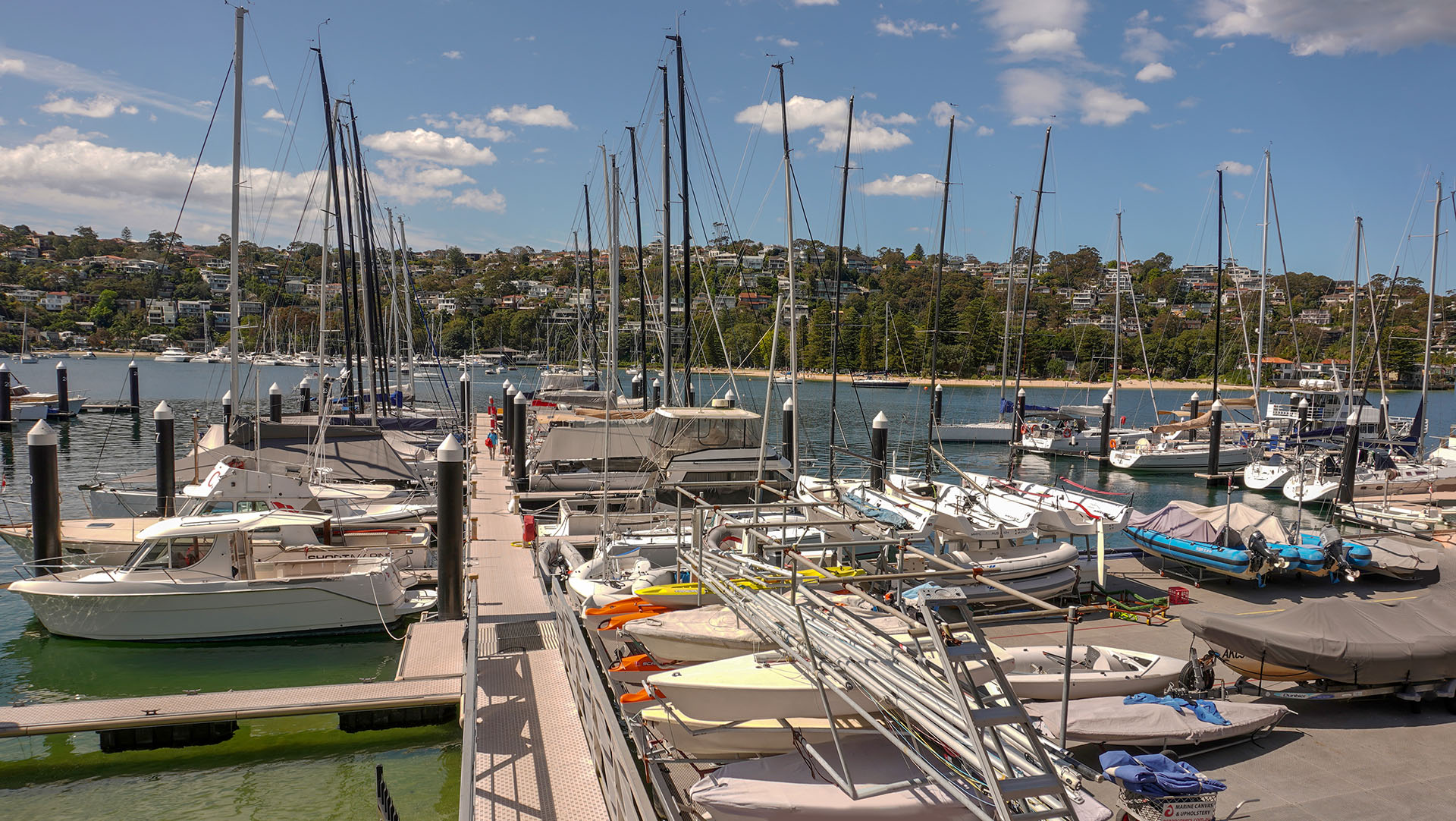
Engaging with an insurance broker
Nautilus Marine Insurance only transacts insurance business through insurance brokers. Insurance brokers operate independently of insurers, they work for you as your adviser. They should be impartial and should act in your best interests, at all times.
It is important to engage with an insurance broker who understands the marine industry. When speaking to your broker about information required by Insurers, it is essential to provide as much information as possible to help secure the best possible terms and avoid the Insurer making assumptions.
Highlight membership with the Marina Industries Association (MIA) and any accreditations that you have received such as Gold Anchor and Clean Marina. These programs demonstrate a good level of operational competence and risk management.
It is advantageous that your insurance solutions provider has an expert local claims team to support you should an incident occur.
Common risk exposures and claims
Damage to boats in your care: You have a duty of care, and a legal liability, to ensure that all customers and other third-party property is looked after while at your premises.
Fuelling activities: Pollution to waterways and other property damage can result from fuelling activities. Risk management practices in the Clean Marina Program can help you manage this risk.
Water damage to vessels: reminder notices to boat owners are very useful.
Incorrect boat storage on stands: poorly maintained stands, or stands with inadequate weight capacity, present a significant risk. Bad weather conditions also need to be considered as a factor for hard-stand facilities.
Spray painting: overspray from workshops could cause damage to surrounding property.
Contractor injuries or damage caused by contractors: injury claims can be very costly and take many years to be settled.
Customer accidents: slip and fall claims from customers are common, especially when getting on and off vessels. After hours risk management: procedures must be in place for out of hours risk management, especially in terms of weather events.
Weather damage to facilities: storm damage to floating assets such as wharves, piles and jetties are common risks.
Fire risks: we have seen claims from fires that start on a customer’s vessel and spread to the marina and other vessels at the marina. The marina operator can be held liable for damage to other customers vessels at the marina.
We hope you have found these insights useful. As you can see, most of these exposures and risk scenarios can be minimised by the implementation of documented risk management procedures.
Read the latest issue of the Marina Industries Association’s Waterline magazine here. To find out more information about the MIA visit www.marinas.net.au
NM Insurance is a trading name of Nautilus Marine Underwriting Agency Ltd NZBN: 9429031454261, FSP: 388326. NM Insurance is an insurance underwriting agency and has a binding authority from Zurich Australian Insurance Limited (ZAIL) which allows it to enter into and arrange policies of insurance. NM Insurance acts on behalf of ZAIL and not you when providing these services but does so under its own FSP number.
Content on this website is information only and not financial advice. It is intended as a summary of the highlights of any cover available and does not take into account any person’s objectives, financial situation or needs. Always read the relevant Policy Wording before buying or renewing insurance. It contains a full description of the applicable terms and conditions.
Steadfast Group Ltd (ABN 98 073 659 677) (‘SGL’) has a majority shareholding in NM Insurance Pty Ltd (NM Insurance).
SGL may receive a professional services fee (PSF) from insurers, premium funders and underwriting agencies such as NM Insurance (Partner) for access to regulatory and compliance support; marketing and communications; data insights; and access to technology platforms. The PSF is an agreed amount between SGL and the relevant Partner, usually annually. The PSF is not determined by the volume of the business that the Steadfast Network brokers place, nor is the amount of the PSF known to the Steadfast Network Brokers, so it is not able to influence recommendations to their clients.
NM Insurance may have access to shared services from SGL, including: compliance tools; procedures; manuals and training; legal; HR banking; and group purchasing arrangements. These services are funded by SGL, subsidised by SGL or SGL receives a fee for them.
SGL’s FSG is available at www.steadfast.com.au or on request by telephoning SGL’s Company Secretary on +61 2 9495 6500.
© 2021 NM Insurance Pty Ltd. Created by Codex.
Expert’s guide to storm safety
The best, brightest and proudest of the marina industry were recognised at the 2025 Nautilus Marine Insurance Marina of the Year Awards, held at Sydney’s picturesque Middle Harbour Skiff Club.
Opening the evening, Marina Industries Association (MIA) President and Master of Ceremonies, Andrew Chapman CMM remarked, “This is another incredibly successful celebration of our industry. The Awards attracted record entries across several categories, with over 110 guests and finalists gathering from across Australia, New Zealand, Thailand, the UAE and Singapore.”
Andrew Mulholland, Marketing Director / Commercial Partnerships Manager of event partner Nautilus Marine Insurance (NMI), echoed the sentiment, adding, “These Awards honour all entrants and finalists who consistently raise the bar and set new standards in our industry. While outstanding facilities are important, it’s the people who deliver the excellence we celebrate tonight.” Drawing a parallel with the Nautilus Marine Insurance values, Mullholland went on to say, “It’s about putting your customers at the core of everything you do and building trust through integrity and reliability.”
While the Awards have traditionally focused on facilities, 2025 saw the introduction of two new categories designed to spotlight and promote the achievements of individual contributions and rising talent. The inaugural Emerging Talent Award recognised future leaders under 35, with Jacob Morris, Director at Marine Structures, taking home the honour from a strong field. The new Industry Woman of the Year Award also made a strong debut, receiving a wave of impressive nominations. The winner, Stephanie Trounce, WHS Property and Compliance Manager at Gold Coast City Marina & Shipyard, was acknowledged for her deep expertise in safety systems and her leadership in maintaining high standards of property and compliance.
The flagship Marina of the Year categories were more competitive than ever. The recently redeveloped Jones Bay Superyacht Marina in Pyrmont, Sydney, emerged victorious as the Marina of the Year under 140 boats. It was a standout night for Gold Coast City Marina & Shipyard (GCCM), which claimed the Marina of the Year Award (over 140 boats), Boatyard of the Year (over 20 boats) and Dry Stack Facility Award. Celebrating 25 years of trailblazing excellence, GCCM has transformed former farming paddocks into a world-class marina and shipyard, playing a pivotal role in the development of the Coomera marine precinct.
Innovation was also in the spotlight this year, with Bellingham Marine taking home the Industry Innovation of the Year Award for its reimagined Unifloat system. The Royal Queensland Yacht Squadron (RQYS) once again claimed the coveted Club of the Year Award.
The competition in the Boatyard of the Year category for yards servicing under 20 boats was also strong, with White Bay 6 Marine Park taking the win. Industry veteran Lorraine Yates CMP reflected on the honour, “We’re grateful for industry recognition through awards like these. We have a beautiful facility in a stunning location, and I’m privileged that the owners trust us to manage it every day.”
The full list of Award winners for are 2025:
- Best Commercial Marina (Over 140 Boats): Gold Coast City Marina & Shipyard (GCCM), QLD
- Best Commercial Marina (Under 140 Boats): Jones Bay Superyacht Marina, NSW
- Club of the Year: Royal Queensland Yacht Squadron, QLD
- International Marina of the Year: Dubai Harbour Marina, UAE
- Dry Stack Storage Facility of the Year: Gold Coast City Marina & Shipyard, QLD
- Best Boat Yard (Under 20 Boats): White Bay 6 Marine Park, NSW
- Best Boat Yard (Over 20 Boats): Gold Coast City Marina & Shipyard, QLD
- Emerging Talent of the Year: Jacob Morris, QLD
- Industry Women of the Year: Stephanie Trounce, QLD
- MIA Environmental Award: Royal Phuket Marina, Thailand
- Industry Innovation Award: Bellingham Marine Australia, QLD
- Hall of Fame International Marina: ONE°15 Marina Sentosa Cove, Singapore
- Hall of Fame Dry Stack Storage Facility: Sydney Harbour Boat Storage
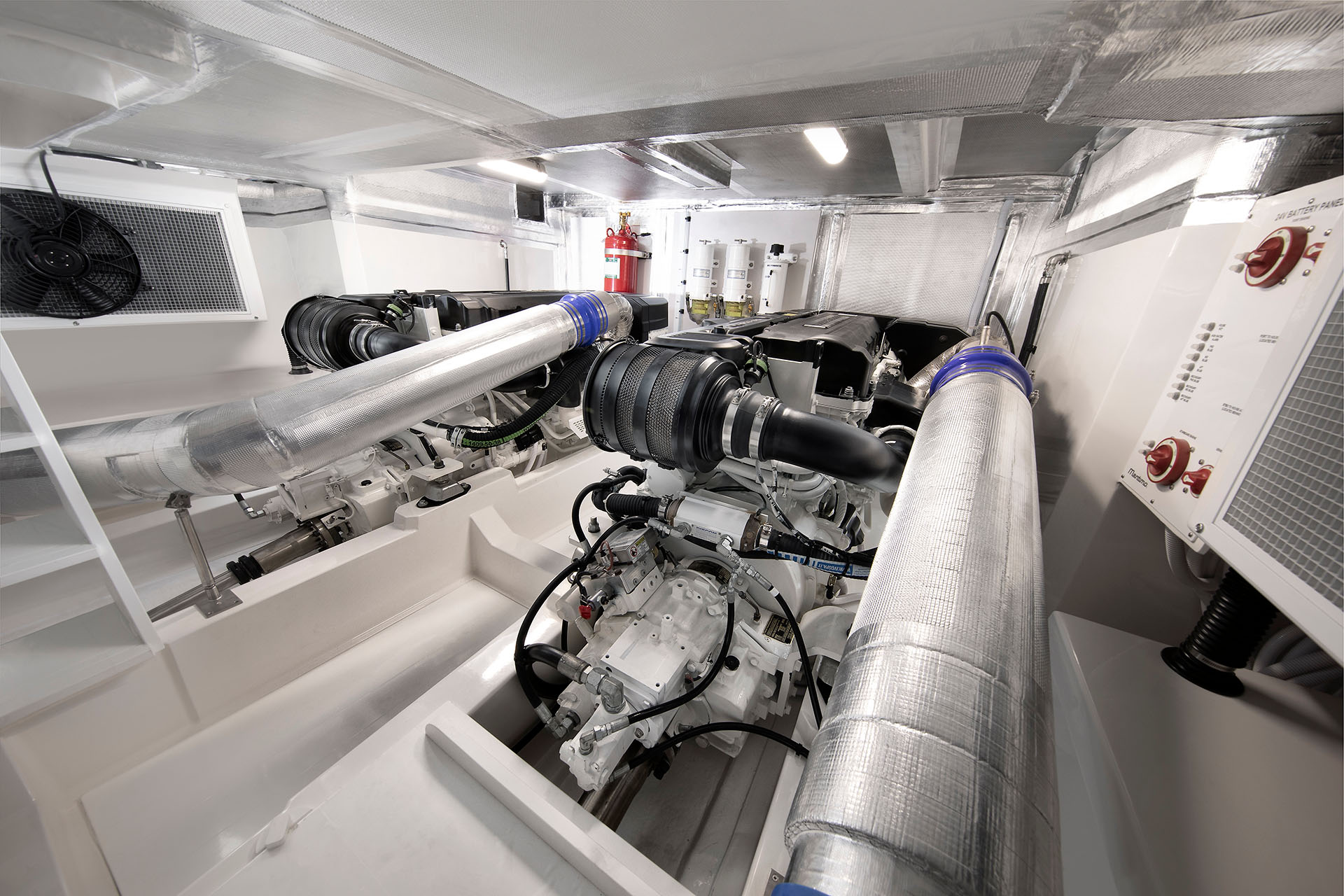
The old adage that you need a plan to succeed is absolutely relevant with storm preparedness,” says Andrew Chapman, Chief Operating Officer of Gold Coast City Marina & Shipyard (GCCM), President of the Marina Industries Association (MIA) and Certified Marina Manager. We asked Chapman to share some key risk mitigation advice to help you prepare your boat for storm season.
- Maintain your vessel and ensure it is in good, seaworthy condition with an appropriate trim. Damage should be repaired as soon as practical so as to maintain the vessel’s integrity which can be essential in some storm conditions. Vessel maintenance should include window and storm board seals and scupper operation checks.
- Have prepared storm emergency kits stocked and stored in an appropriate location on your vessel. This kit may include additional lines, torches including the new head lamps, duct tape, additional bilge pump, bucket, tools, straps, cable ties and a knife.
- Adding additional lines to alternative cleats can assist if the main mooring lines break or cleats fail. Spreading the load over longer lines allows some give when lines tighten. This spring effect will absorb some line shock and potentially extend the life of a line through extended storm events. Lines should be inspected regularly as different lines are affected by UV exposure or retained moisture. Mooring line life can be shortened by the conditions at each marina so inspect and replace as required at least twice a year. Fenders should also be inspected regularly as they are fastened with lines that are in the elements 24/7 when in use, which may include significant UV exposure. Fenders should be of an appropriate size and inflated to the designed pressure to absorb vessel movement against the dock.
- Batteries should be effectively maintained and have sufficient storage to operate bilge pumps in a prolonged power outage. Power outages may be grid orientated or marinas may turn off power in some storm surge events for safety reasons.
- Sails, biminis, cushions and dinghies should be removed or appropriately stowed from above deck if a storm is approaching to reduce windage. If a dinghy needs to remain on the boat ensure the bungs are removed and the path for rainwater to escape is clear.
- Fridges and freezers should be emptied to avoid spoiled food if power is off for any prolonged period. Frozen food that defrosts can be a major problem if it leaks outside galley fridges onto carpet and other surfaces.
- Bilge pumps should be well maintained and operationally tested and set to automatic mode. Bilges must be maintained in a clean state so as to prevent bilge pump or float switch fouling during operation. It’s imperative that bilges are also free from any fuel or oil residue so that this is not pumped into the environment. In some instances, back-up bilge pumps can be petrol-driven to give that power source redundancy in an extended event.
- Update the marina with contact information especially if you are going to be away. It’s important to nominate an additional person to make decisions in your absence.
- Consider moving your vessel to a more secure location depending on the type of extreme event that is impending. Considering a more protected marina or even an upriver mangrove refuge sometimes offers more protection than sitting in a berth close to the coast. However, each storm is very different and advice should be sought from appropriately qualified professionals with local knowledge. Remember to plan ahead and not move when the storm is in play. Your safety is most important.
- Make yourself aware of your marina’s emergency procedures and evacuation points as it’s important to remember that your personal safety is far more important than that of your vessel in a storm.
Visit gccm.com.au
NM Insurance is a trading name of Nautilus Marine Underwriting Agency Ltd NZBN: 9429031454261, FSP: 388326. NM Insurance is an insurance underwriting agency and has a binding authority from Zurich Australian Insurance Limited (ZAIL) which allows it to enter into and arrange policies of insurance. NM Insurance acts on behalf of ZAIL and not you when providing these services but does so under its own FSP number.
Content on this website is information only and not financial advice. It is intended as a summary of the highlights of any cover available and does not take into account any person’s objectives, financial situation or needs. Always read the relevant Policy Wording before buying or renewing insurance. It contains a full description of the applicable terms and conditions.
Steadfast Group Ltd (ABN 98 073 659 677) (‘SGL’) has a majority shareholding in NM Insurance Pty Ltd (NM Insurance).
SGL may receive a professional services fee (PSF) from insurers, premium funders and underwriting agencies such as NM Insurance (Partner) for access to regulatory and compliance support; marketing and communications; data insights; and access to technology platforms. The PSF is an agreed amount between SGL and the relevant Partner, usually annually. The PSF is not determined by the volume of the business that the Steadfast Network brokers place, nor is the amount of the PSF known to the Steadfast Network Brokers, so it is not able to influence recommendations to their clients.
NM Insurance may have access to shared services from SGL, including: compliance tools; procedures; manuals and training; legal; HR banking; and group purchasing arrangements. These services are funded by SGL, subsidised by SGL or SGL receives a fee for them.
SGL’s FSG is available at www.steadfast.com.au or on request by telephoning SGL’s Company Secretary on +61 2 9495 6500.
© 2021 NM Insurance Pty Ltd. Created by Codex.
Expert’s guide to storm safety
NM Insurance is pleased to announce the appointment of Andrew McFetridge as Executive Director of New Zealand. In this role, Andrew will be responsible for NM Insurance’s continued growth across the region, focussing energy on increased support to our customers, partners, product enhancement and service deliverables.
The old adage that you need a plan to succeed is absolutely relevant with storm preparedness,” says Andrew Chapman, Chief Operating Officer of Gold Coast City Marina & Shipyard (GCCM), President of the Marina Industries Association (MIA) and Certified Marina Manager. We asked Chapman to share some key risk mitigation advice to help you prepare your boat for storm season.
- Maintain your vessel and ensure it is in good, seaworthy condition with an appropriate trim. Damage should be repaired as soon as practical so as to maintain the vessel’s integrity which can be essential in some storm conditions. Vessel maintenance should include window and storm board seals and scupper operation checks.
- Have prepared storm emergency kits stocked and stored in an appropriate location on your vessel. This kit may include additional lines, torches including the new head lamps, duct tape, additional bilge pump, bucket, tools, straps, cable ties and a knife.
- Adding additional lines to alternative cleats can assist if the main mooring lines break or cleats fail. Spreading the load over longer lines allows some give when lines tighten. This spring effect will absorb some line shock and potentially extend the life of a line through extended storm events. Lines should be inspected regularly as different lines are affected by UV exposure or retained moisture. Mooring line life can be shortened by the conditions at each marina so inspect and replace as required at least twice a year. Fenders should also be inspected regularly as they are fastened with lines that are in the elements 24/7 when in use, which may include significant UV exposure. Fenders should be of an appropriate size and inflated to the designed pressure to absorb vessel movement against the dock.
- Batteries should be effectively maintained and have sufficient storage to operate bilge pumps in a prolonged power outage. Power outages may be grid orientated or marinas may turn off power in some storm surge events for safety reasons.
- Sails, biminis, cushions and dinghies should be removed or appropriately stowed from above deck if a storm is approaching to reduce windage. If a dinghy needs to remain on the boat ensure the bungs are removed and the path for rainwater to escape is clear.
- Fridges and freezers should be emptied to avoid spoiled food if power is off for any prolonged period. Frozen food that defrosts can be a major problem if it leaks outside galley fridges onto carpet and other surfaces.
- Bilge pumps should be well maintained and operationally tested and set to automatic mode. Bilges must be maintained in a clean state so as to prevent bilge pump or float switch fouling during operation. It’s imperative that bilges are also free from any fuel or oil residue so that this is not pumped into the environment. In some instances, back-up bilge pumps can be petrol-driven to give that power source redundancy in an extended event.
- Update the marina with contact information especially if you are going to be away. It’s important to nominate an additional person to make decisions in your absence.
- Consider moving your vessel to a more secure location depending on the type of extreme event that is impending. Considering a more protected marina or even an upriver mangrove refuge sometimes offers more protection than sitting in a berth close to the coast. However, each storm is very different and advice should be sought from appropriately qualified professionals with local knowledge. Remember to plan ahead and not move when the storm is in play. Your safety is most important.
- Make yourself aware of your marina’s emergency procedures and evacuation points as it’s important to remember that your personal safety is far more important than that of your vessel in a storm.
Visit gccm.com.au
NM Insurance is a trading name of Nautilus Marine Underwriting Agency Ltd NZBN: 9429031454261, FSP: 388326. NM Insurance is an insurance underwriting agency and has a binding authority from Zurich Australian Insurance Limited (ZAIL) which allows it to enter into and arrange policies of insurance. NM Insurance acts on behalf of ZAIL and not you when providing these services but does so under its own FSP number.
Content on this website is information only and not financial advice. It is intended as a summary of the highlights of any cover available and does not take into account any person’s objectives, financial situation or needs. Always read the relevant Policy Wording before buying or renewing insurance. It contains a full description of the applicable terms and conditions.
Steadfast Group Ltd (ABN 98 073 659 677) (‘SGL’) has a majority shareholding in NM Insurance Pty Ltd (NM Insurance).
SGL may receive a professional services fee (PSF) from insurers, premium funders and underwriting agencies such as NM Insurance (Partner) for access to regulatory and compliance support; marketing and communications; data insights; and access to technology platforms. The PSF is an agreed amount between SGL and the relevant Partner, usually annually. The PSF is not determined by the volume of the business that the Steadfast Network brokers place, nor is the amount of the PSF known to the Steadfast Network Brokers, so it is not able to influence recommendations to their clients.
NM Insurance may have access to shared services from SGL, including: compliance tools; procedures; manuals and training; legal; HR banking; and group purchasing arrangements. These services are funded by SGL, subsidised by SGL or SGL receives a fee for them.
SGL’s FSG is available at www.steadfast.com.au or on request by telephoning SGL’s Company Secretary on +61 2 9495 6500.
© 2021 NM Insurance Pty Ltd. Created by Codex.
Expert’s guide to storm safety
NM Insurance is pleased to announce the appointment of Andrew McFetridge as Executive Director of New Zealand. In this role, Andrew will be responsible for NM Insurance’s continued growth across the region, focussing energy on increased support to our customers, partners, product enhancement and service deliverables.
The old adage that you need a plan to succeed is absolutely relevant with storm preparedness,” says Andrew Chapman, Chief Operating Officer of Gold Coast City Marina & Shipyard (GCCM), President of the Marina Industries Association (MIA) and Certified Marina Manager. We asked Chapman to share some key risk mitigation advice to help you prepare your boat for storm season.
- Maintain your vessel and ensure it is in good, seaworthy condition with an appropriate trim. Damage should be repaired as soon as practical so as to maintain the vessel’s integrity which can be essential in some storm conditions. Vessel maintenance should include window and storm board seals and scupper operation checks.
- Have prepared storm emergency kits stocked and stored in an appropriate location on your vessel. This kit may include additional lines, torches including the new head lamps, duct tape, additional bilge pump, bucket, tools, straps, cable ties and a knife.
- Adding additional lines to alternative cleats can assist if the main mooring lines break or cleats fail. Spreading the load over longer lines allows some give when lines tighten. This spring effect will absorb some line shock and potentially extend the life of a line through extended storm events. Lines should be inspected regularly as different lines are affected by UV exposure or retained moisture. Mooring line life can be shortened by the conditions at each marina so inspect and replace as required at least twice a year. Fenders should also be inspected regularly as they are fastened with lines that are in the elements 24/7 when in use, which may include significant UV exposure. Fenders should be of an appropriate size and inflated to the designed pressure to absorb vessel movement against the dock.
- Batteries should be effectively maintained and have sufficient storage to operate bilge pumps in a prolonged power outage. Power outages may be grid orientated or marinas may turn off power in some storm surge events for safety reasons.
- Sails, biminis, cushions and dinghies should be removed or appropriately stowed from above deck if a storm is approaching to reduce windage. If a dinghy needs to remain on the boat ensure the bungs are removed and the path for rainwater to escape is clear.
- Fridges and freezers should be emptied to avoid spoiled food if power is off for any prolonged period. Frozen food that defrosts can be a major problem if it leaks outside galley fridges onto carpet and other surfaces.
- Bilge pumps should be well maintained and operationally tested and set to automatic mode. Bilges must be maintained in a clean state so as to prevent bilge pump or float switch fouling during operation. It’s imperative that bilges are also free from any fuel or oil residue so that this is not pumped into the environment. In some instances, back-up bilge pumps can be petrol-driven to give that power source redundancy in an extended event.
- Update the marina with contact information especially if you are going to be away. It’s important to nominate an additional person to make decisions in your absence.
- Consider moving your vessel to a more secure location depending on the type of extreme event that is impending. Considering a more protected marina or even an upriver mangrove refuge sometimes offers more protection than sitting in a berth close to the coast. However, each storm is very different and advice should be sought from appropriately qualified professionals with local knowledge. Remember to plan ahead and not move when the storm is in play. Your safety is most important.
- Make yourself aware of your marina’s emergency procedures and evacuation points as it’s important to remember that your personal safety is far more important than that of your vessel in a storm.
Visit gccm.com.au
NM Insurance is a trading name of Nautilus Marine Underwriting Agency Ltd NZBN: 9429031454261, FSP: 388326. NM Insurance is an insurance underwriting agency and has a binding authority from Zurich Australian Insurance Limited (ZAIL) which allows it to enter into and arrange policies of insurance. NM Insurance acts on behalf of ZAIL and not you when providing these services but does so under its own FSP number.
Content on this website is information only and not financial advice. It is intended as a summary of the highlights of any cover available and does not take into account any person’s objectives, financial situation or needs. Always read the relevant Policy Wording before buying or renewing insurance. It contains a full description of the applicable terms and conditions.
Steadfast Group Ltd (ABN 98 073 659 677) (‘SGL’) has a majority shareholding in NM Insurance Pty Ltd (NM Insurance).
SGL may receive a professional services fee (PSF) from insurers, premium funders and underwriting agencies such as NM Insurance (Partner) for access to regulatory and compliance support; marketing and communications; data insights; and access to technology platforms. The PSF is an agreed amount between SGL and the relevant Partner, usually annually. The PSF is not determined by the volume of the business that the Steadfast Network brokers place, nor is the amount of the PSF known to the Steadfast Network Brokers, so it is not able to influence recommendations to their clients.
NM Insurance may have access to shared services from SGL, including: compliance tools; procedures; manuals and training; legal; HR banking; and group purchasing arrangements. These services are funded by SGL, subsidised by SGL or SGL receives a fee for them.
SGL’s FSG is available at www.steadfast.com.au or on request by telephoning SGL’s Company Secretary on +61 2 9495 6500.
© 2021 NM Insurance Pty Ltd. Created by Codex.
Expert’s guide to storm safety
NM Insurance is pleased to announce the appointment of Andrew McFetridge as Executive Director of New Zealand. In this role, Andrew will be responsible for NM Insurance’s continued growth across the region, focussing energy on increased support to our customers, partners, product enhancement and service deliverables.
The best, brightest and proudest of the marina industry were recognised at the 2025 Nautilus Marine Insurance Marina of the Year Awards, held at Sydney’s picturesque Middle Harbour Skiff Club.
Opening the evening, Marina Industries Association (MIA) President and Master of Ceremonies, Andrew Chapman CMM remarked, “This is another incredibly successful celebration of our industry. The Awards attracted record entries across several categories, with over 110 guests and finalists gathering from across Australia, New Zealand, Thailand, the UAE and Singapore.”
Andrew Mulholland, Marketing Director / Commercial Partnerships Manager of event partner Nautilus Marine Insurance (NMI), echoed the sentiment, adding, “These Awards honour all entrants and finalists who consistently raise the bar and set new standards in our industry. While outstanding facilities are important, it’s the people who deliver the excellence we celebrate tonight.” Drawing a parallel with the Nautilus Marine Insurance values, Mullholland went on to say, “It’s about putting your customers at the core of everything you do and building trust through integrity and reliability.”
While the Awards have traditionally focused on facilities, 2025 saw the introduction of two new categories designed to spotlight and promote the achievements of individual contributions and rising talent. The inaugural Emerging Talent Award recognised future leaders under 35, with Jacob Morris, Director at Marine Structures, taking home the honour from a strong field. The new Industry Woman of the Year Award also made a strong debut, receiving a wave of impressive nominations. The winner, Stephanie Trounce, WHS Property and Compliance Manager at Gold Coast City Marina & Shipyard, was acknowledged for her deep expertise in safety systems and her leadership in maintaining high standards of property and compliance.
The flagship Marina of the Year categories were more competitive than ever. The recently redeveloped Jones Bay Superyacht Marina in Pyrmont, Sydney, emerged victorious as the Marina of the Year under 140 boats. It was a standout night for Gold Coast City Marina & Shipyard (GCCM), which claimed the Marina of the Year Award (over 140 boats), Boatyard of the Year (over 20 boats) and Dry Stack Facility Award. Celebrating 25 years of trailblazing excellence, GCCM has transformed former farming paddocks into a world-class marina and shipyard, playing a pivotal role in the development of the Coomera marine precinct.
Innovation was also in the spotlight this year, with Bellingham Marine taking home the Industry Innovation of the Year Award for its reimagined Unifloat system. The Royal Queensland Yacht Squadron (RQYS) once again claimed the coveted Club of the Year Award.
The competition in the Boatyard of the Year category for yards servicing under 20 boats was also strong, with White Bay 6 Marine Park taking the win. Industry veteran Lorraine Yates CMP reflected on the honour, “We’re grateful for industry recognition through awards like these. We have a beautiful facility in a stunning location, and I’m privileged that the owners trust us to manage it every day.”
The full list of Award winners for are 2025:
- Best Commercial Marina (Over 140 Boats): Gold Coast City Marina & Shipyard (GCCM), QLD
- Best Commercial Marina (Under 140 Boats): Jones Bay Superyacht Marina, NSW
- Club of the Year: Royal Queensland Yacht Squadron, QLD
- International Marina of the Year: Dubai Harbour Marina, UAE
- Dry Stack Storage Facility of the Year: Gold Coast City Marina & Shipyard, QLD
- Best Boat Yard (Under 20 Boats): White Bay 6 Marine Park, NSW
- Best Boat Yard (Over 20 Boats): Gold Coast City Marina & Shipyard, QLD
- Emerging Talent of the Year: Jacob Morris, QLD
- Industry Women of the Year: Stephanie Trounce, QLD
- MIA Environmental Award: Royal Phuket Marina, Thailand
- Industry Innovation Award: Bellingham Marine Australia, QLD
- Hall of Fame International Marina: ONE°15 Marina Sentosa Cove, Singapore
- Hall of Fame Dry Stack Storage Facility: Sydney Harbour Boat Storage
Chris Baker
Head of Underwriting – Industry Lines
The old adage that you need a plan to succeed is absolutely relevant with storm preparedness,” says Andrew Chapman, Chief Operating Officer of Gold Coast City Marina & Shipyard (GCCM), President of the Marina Industries Association (MIA) and Certified Marina Manager. We asked Chapman to share some key risk mitigation advice to help you prepare your boat for storm season.
- Maintain your vessel and ensure it is in good, seaworthy condition with an appropriate trim. Damage should be repaired as soon as practical so as to maintain the vessel’s integrity which can be essential in some storm conditions. Vessel maintenance should include window and storm board seals and scupper operation checks.
- Have prepared storm emergency kits stocked and stored in an appropriate location on your vessel. This kit may include additional lines, torches including the new head lamps, duct tape, additional bilge pump, bucket, tools, straps, cable ties and a knife.
- Adding additional lines to alternative cleats can assist if the main mooring lines break or cleats fail. Spreading the load over longer lines allows some give when lines tighten. This spring effect will absorb some line shock and potentially extend the life of a line through extended storm events. Lines should be inspected regularly as different lines are affected by UV exposure or retained moisture. Mooring line life can be shortened by the conditions at each marina so inspect and replace as required at least twice a year. Fenders should also be inspected regularly as they are fastened with lines that are in the elements 24/7 when in use, which may include significant UV exposure. Fenders should be of an appropriate size and inflated to the designed pressure to absorb vessel movement against the dock.
- Batteries should be effectively maintained and have sufficient storage to operate bilge pumps in a prolonged power outage. Power outages may be grid orientated or marinas may turn off power in some storm surge events for safety reasons.
- Sails, biminis, cushions and dinghies should be removed or appropriately stowed from above deck if a storm is approaching to reduce windage. If a dinghy needs to remain on the boat ensure the bungs are removed and the path for rainwater to escape is clear.
- Fridges and freezers should be emptied to avoid spoiled food if power is off for any prolonged period. Frozen food that defrosts can be a major problem if it leaks outside galley fridges onto carpet and other surfaces.
- Bilge pumps should be well maintained and operationally tested and set to automatic mode. Bilges must be maintained in a clean state so as to prevent bilge pump or float switch fouling during operation. It’s imperative that bilges are also free from any fuel or oil residue so that this is not pumped into the environment. In some instances, back-up bilge pumps can be petrol-driven to give that power source redundancy in an extended event.
- Update the marina with contact information especially if you are going to be away. It’s important to nominate an additional person to make decisions in your absence.
- Consider moving your vessel to a more secure location depending on the type of extreme event that is impending. Considering a more protected marina or even an upriver mangrove refuge sometimes offers more protection than sitting in a berth close to the coast. However, each storm is very different and advice should be sought from appropriately qualified professionals with local knowledge. Remember to plan ahead and not move when the storm is in play. Your safety is most important.
- Make yourself aware of your marina’s emergency procedures and evacuation points as it’s important to remember that your personal safety is far more important than that of your vessel in a storm.
Visit gccm.com.au
NM Insurance is a trading name of Nautilus Marine Underwriting Agency Ltd NZBN: 9429031454261, FSP: 388326. NM Insurance is an insurance underwriting agency and has a binding authority from Zurich Australian Insurance Limited (ZAIL) which allows it to enter into and arrange policies of insurance. NM Insurance acts on behalf of ZAIL and not you when providing these services but does so under its own FSP number.
Content on this website is information only and not financial advice. It is intended as a summary of the highlights of any cover available and does not take into account any person’s objectives, financial situation or needs. Always read the relevant Policy Wording before buying or renewing insurance. It contains a full description of the applicable terms and conditions.
Steadfast Group Ltd (ABN 98 073 659 677) (‘SGL’) has a majority shareholding in NM Insurance Pty Ltd (NM Insurance).
SGL may receive a professional services fee (PSF) from insurers, premium funders and underwriting agencies such as NM Insurance (Partner) for access to regulatory and compliance support; marketing and communications; data insights; and access to technology platforms. The PSF is an agreed amount between SGL and the relevant Partner, usually annually. The PSF is not determined by the volume of the business that the Steadfast Network brokers place, nor is the amount of the PSF known to the Steadfast Network Brokers, so it is not able to influence recommendations to their clients.
NM Insurance may have access to shared services from SGL, including: compliance tools; procedures; manuals and training; legal; HR banking; and group purchasing arrangements. These services are funded by SGL, subsidised by SGL or SGL receives a fee for them.
SGL’s FSG is available at www.steadfast.com.au or on request by telephoning SGL’s Company Secretary on +61 2 9495 6500.
© 2021 NM Insurance Pty Ltd. Created by Codex.
Expert’s guide to storm safety
NM Insurance is pleased to announce the appointment of Andrew McFetridge as Executive Director of New Zealand. In this role, Andrew will be responsible for NM Insurance’s continued growth across the region, focussing energy on increased support to our customers, partners, product enhancement and service deliverables.
The best, brightest and proudest of the marina industry were recognised at the 2025 Nautilus Marine Insurance Marina of the Year Awards, held at Sydney’s picturesque Middle Harbour Skiff Club.
Opening the evening, Marina Industries Association (MIA) President and Master of Ceremonies, Andrew Chapman CMM remarked, “This is another incredibly successful celebration of our industry. The Awards attracted record entries across several categories, with over 110 guests and finalists gathering from across Australia, New Zealand, Thailand, the UAE and Singapore.”
Andrew Mulholland, Marketing Director / Commercial Partnerships Manager of event partner Nautilus Marine Insurance (NMI), echoed the sentiment, adding, “These Awards honour all entrants and finalists who consistently raise the bar and set new standards in our industry. While outstanding facilities are important, it’s the people who deliver the excellence we celebrate tonight.” Drawing a parallel with the Nautilus Marine Insurance values, Mullholland went on to say, “It’s about putting your customers at the core of everything you do and building trust through integrity and reliability.”
While the Awards have traditionally focused on facilities, 2025 saw the introduction of two new categories designed to spotlight and promote the achievements of individual contributions and rising talent. The inaugural Emerging Talent Award recognised future leaders under 35, with Jacob Morris, Director at Marine Structures, taking home the honour from a strong field. The new Industry Woman of the Year Award also made a strong debut, receiving a wave of impressive nominations. The winner, Stephanie Trounce, WHS Property and Compliance Manager at Gold Coast City Marina & Shipyard, was acknowledged for her deep expertise in safety systems and her leadership in maintaining high standards of property and compliance.
The flagship Marina of the Year categories were more competitive than ever. The recently redeveloped Jones Bay Superyacht Marina in Pyrmont, Sydney, emerged victorious as the Marina of the Year under 140 boats. It was a standout night for Gold Coast City Marina & Shipyard (GCCM), which claimed the Marina of the Year Award (over 140 boats), Boatyard of the Year (over 20 boats) and Dry Stack Facility Award. Celebrating 25 years of trailblazing excellence, GCCM has transformed former farming paddocks into a world-class marina and shipyard, playing a pivotal role in the development of the Coomera marine precinct.
Innovation was also in the spotlight this year, with Bellingham Marine taking home the Industry Innovation of the Year Award for its reimagined Unifloat system. The Royal Queensland Yacht Squadron (RQYS) once again claimed the coveted Club of the Year Award.
The competition in the Boatyard of the Year category for yards servicing under 20 boats was also strong, with White Bay 6 Marine Park taking the win. Industry veteran Lorraine Yates CMP reflected on the honour, “We’re grateful for industry recognition through awards like these. We have a beautiful facility in a stunning location, and I’m privileged that the owners trust us to manage it every day.”
The full list of Award winners for are 2025:
- Best Commercial Marina (Over 140 Boats): Gold Coast City Marina & Shipyard (GCCM), QLD
- Best Commercial Marina (Under 140 Boats): Jones Bay Superyacht Marina, NSW
- Club of the Year: Royal Queensland Yacht Squadron, QLD
- International Marina of the Year: Dubai Harbour Marina, UAE
- Dry Stack Storage Facility of the Year: Gold Coast City Marina & Shipyard, QLD
- Best Boat Yard (Under 20 Boats): White Bay 6 Marine Park, NSW
- Best Boat Yard (Over 20 Boats): Gold Coast City Marina & Shipyard, QLD
- Emerging Talent of the Year: Jacob Morris, QLD
- Industry Women of the Year: Stephanie Trounce, QLD
- MIA Environmental Award: Royal Phuket Marina, Thailand
- Industry Innovation Award: Bellingham Marine Australia, QLD
- Hall of Fame International Marina: ONE°15 Marina Sentosa Cove, Singapore
- Hall of Fame Dry Stack Storage Facility: Sydney Harbour Boat Storage
Chris Baker
Head of Underwriting – Industry Lines
The old adage that you need a plan to succeed is absolutely relevant with storm preparedness,” says Andrew Chapman, Chief Operating Officer of Gold Coast City Marina & Shipyard (GCCM), President of the Marina Industries Association (MIA) and Certified Marina Manager. We asked Chapman to share some key risk mitigation advice to help you prepare your boat for storm season.
- Maintain your vessel and ensure it is in good, seaworthy condition with an appropriate trim. Damage should be repaired as soon as practical so as to maintain the vessel’s integrity which can be essential in some storm conditions. Vessel maintenance should include window and storm board seals and scupper operation checks.
- Have prepared storm emergency kits stocked and stored in an appropriate location on your vessel. This kit may include additional lines, torches including the new head lamps, duct tape, additional bilge pump, bucket, tools, straps, cable ties and a knife.
- Adding additional lines to alternative cleats can assist if the main mooring lines break or cleats fail. Spreading the load over longer lines allows some give when lines tighten. This spring effect will absorb some line shock and potentially extend the life of a line through extended storm events. Lines should be inspected regularly as different lines are affected by UV exposure or retained moisture. Mooring line life can be shortened by the conditions at each marina so inspect and replace as required at least twice a year. Fenders should also be inspected regularly as they are fastened with lines that are in the elements 24/7 when in use, which may include significant UV exposure. Fenders should be of an appropriate size and inflated to the designed pressure to absorb vessel movement against the dock.
- Batteries should be effectively maintained and have sufficient storage to operate bilge pumps in a prolonged power outage. Power outages may be grid orientated or marinas may turn off power in some storm surge events for safety reasons.
- Sails, biminis, cushions and dinghies should be removed or appropriately stowed from above deck if a storm is approaching to reduce windage. If a dinghy needs to remain on the boat ensure the bungs are removed and the path for rainwater to escape is clear.
- Fridges and freezers should be emptied to avoid spoiled food if power is off for any prolonged period. Frozen food that defrosts can be a major problem if it leaks outside galley fridges onto carpet and other surfaces.
- Bilge pumps should be well maintained and operationally tested and set to automatic mode. Bilges must be maintained in a clean state so as to prevent bilge pump or float switch fouling during operation. It’s imperative that bilges are also free from any fuel or oil residue so that this is not pumped into the environment. In some instances, back-up bilge pumps can be petrol-driven to give that power source redundancy in an extended event.
- Update the marina with contact information especially if you are going to be away. It’s important to nominate an additional person to make decisions in your absence.
- Consider moving your vessel to a more secure location depending on the type of extreme event that is impending. Considering a more protected marina or even an upriver mangrove refuge sometimes offers more protection than sitting in a berth close to the coast. However, each storm is very different and advice should be sought from appropriately qualified professionals with local knowledge. Remember to plan ahead and not move when the storm is in play. Your safety is most important.
- Make yourself aware of your marina’s emergency procedures and evacuation points as it’s important to remember that your personal safety is far more important than that of your vessel in a storm.
Visit gccm.com.au
Read Lyndon Turner’s full column in the latest issue of the Marina Industries Association’s Waterline magazine here. To find out more information about the MIA visit www.marinas.net.au
NM Insurance is a trading name of Nautilus Marine Underwriting Agency Ltd NZBN: 9429031454261, FSP: 388326. NM Insurance is an insurance underwriting agency and has a binding authority from Zurich Australian Insurance Limited (ZAIL) which allows it to enter into and arrange policies of insurance. NM Insurance acts on behalf of ZAIL and not you when providing these services but does so under its own FSP number.
Content on this website is information only and not financial advice. It is intended as a summary of the highlights of any cover available and does not take into account any person’s objectives, financial situation or needs. Always read the relevant Policy Wording before buying or renewing insurance. It contains a full description of the applicable terms and conditions.
Steadfast Group Ltd (ABN 98 073 659 677) (‘SGL’) has a majority shareholding in NM Insurance Pty Ltd (NM Insurance).
SGL may receive a professional services fee (PSF) from insurers, premium funders and underwriting agencies such as NM Insurance (Partner) for access to regulatory and compliance support; marketing and communications; data insights; and access to technology platforms. The PSF is an agreed amount between SGL and the relevant Partner, usually annually. The PSF is not determined by the volume of the business that the Steadfast Network brokers place, nor is the amount of the PSF known to the Steadfast Network Brokers, so it is not able to influence recommendations to their clients.
NM Insurance may have access to shared services from SGL, including: compliance tools; procedures; manuals and training; legal; HR banking; and group purchasing arrangements. These services are funded by SGL, subsidised by SGL or SGL receives a fee for them.
SGL’s FSG is available at www.steadfast.com.au or on request by telephoning SGL’s Company Secretary on +61 2 9495 6500.
© 2021 NM Insurance Pty Ltd. Created by Codex.
Expert’s guide to storm safety
The best, brightest and proudest of the marina industry were recognised at the 2025 Nautilus Marine Insurance Marina of the Year Awards, held at Sydney’s picturesque Middle Harbour Skiff Club.
Opening the evening, Marina Industries Association (MIA) President and Master of Ceremonies, Andrew Chapman CMM remarked, “This is another incredibly successful celebration of our industry. The Awards attracted record entries across several categories, with over 110 guests and finalists gathering from across Australia, New Zealand, Thailand, the UAE and Singapore.”
Andrew Mulholland, Marketing Director / Commercial Partnerships Manager of event partner Nautilus Marine Insurance (NMI), echoed the sentiment, adding, “These Awards honour all entrants and finalists who consistently raise the bar and set new standards in our industry. While outstanding facilities are important, it’s the people who deliver the excellence we celebrate tonight.” Drawing a parallel with the Nautilus Marine Insurance values, Mullholland went on to say, “It’s about putting your customers at the core of everything you do and building trust through integrity and reliability.”
While the Awards have traditionally focused on facilities, 2025 saw the introduction of two new categories designed to spotlight and promote the achievements of individual contributions and rising talent. The inaugural Emerging Talent Award recognised future leaders under 35, with Jacob Morris, Director at Marine Structures, taking home the honour from a strong field. The new Industry Woman of the Year Award also made a strong debut, receiving a wave of impressive nominations. The winner, Stephanie Trounce, WHS Property and Compliance Manager at Gold Coast City Marina & Shipyard, was acknowledged for her deep expertise in safety systems and her leadership in maintaining high standards of property and compliance.
The flagship Marina of the Year categories were more competitive than ever. The recently redeveloped Jones Bay Superyacht Marina in Pyrmont, Sydney, emerged victorious as the Marina of the Year under 140 boats. It was a standout night for Gold Coast City Marina & Shipyard (GCCM), which claimed the Marina of the Year Award (over 140 boats), Boatyard of the Year (over 20 boats) and Dry Stack Facility Award. Celebrating 25 years of trailblazing excellence, GCCM has transformed former farming paddocks into a world-class marina and shipyard, playing a pivotal role in the development of the Coomera marine precinct.
Innovation was also in the spotlight this year, with Bellingham Marine taking home the Industry Innovation of the Year Award for its reimagined Unifloat system. The Royal Queensland Yacht Squadron (RQYS) once again claimed the coveted Club of the Year Award.
The competition in the Boatyard of the Year category for yards servicing under 20 boats was also strong, with White Bay 6 Marine Park taking the win. Industry veteran Lorraine Yates CMP reflected on the honour, “We’re grateful for industry recognition through awards like these. We have a beautiful facility in a stunning location, and I’m privileged that the owners trust us to manage it every day.”
The full list of Award winners for are 2025:
- Best Commercial Marina (Over 140 Boats): Gold Coast City Marina & Shipyard (GCCM), QLD
- Best Commercial Marina (Under 140 Boats): Jones Bay Superyacht Marina, NSW
- Club of the Year: Royal Queensland Yacht Squadron, QLD
- International Marina of the Year: Dubai Harbour Marina, UAE
- Dry Stack Storage Facility of the Year: Gold Coast City Marina & Shipyard, QLD
- Best Boat Yard (Under 20 Boats): White Bay 6 Marine Park, NSW
- Best Boat Yard (Over 20 Boats): Gold Coast City Marina & Shipyard, QLD
- Emerging Talent of the Year: Jacob Morris, QLD
- Industry Women of the Year: Stephanie Trounce, QLD
- MIA Environmental Award: Royal Phuket Marina, Thailand
- Industry Innovation Award: Bellingham Marine Australia, QLD
- Hall of Fame International Marina: ONE°15 Marina Sentosa Cove, Singapore
- Hall of Fame Dry Stack Storage Facility: Sydney Harbour Boat Storage
The old adage that you need a plan to succeed is absolutely relevant with storm preparedness,” says Andrew Chapman, Chief Operating Officer of Gold Coast City Marina & Shipyard (GCCM), President of the Marina Industries Association (MIA) and Certified Marina Manager. We asked Chapman to share some key risk mitigation advice to help you prepare your boat for storm season.
- Maintain your vessel and ensure it is in good, seaworthy condition with an appropriate trim. Damage should be repaired as soon as practical so as to maintain the vessel’s integrity which can be essential in some storm conditions. Vessel maintenance should include window and storm board seals and scupper operation checks.
- Have prepared storm emergency kits stocked and stored in an appropriate location on your vessel. This kit may include additional lines, torches including the new head lamps, duct tape, additional bilge pump, bucket, tools, straps, cable ties and a knife.
- Adding additional lines to alternative cleats can assist if the main mooring lines break or cleats fail. Spreading the load over longer lines allows some give when lines tighten. This spring effect will absorb some line shock and potentially extend the life of a line through extended storm events. Lines should be inspected regularly as different lines are affected by UV exposure or retained moisture. Mooring line life can be shortened by the conditions at each marina so inspect and replace as required at least twice a year. Fenders should also be inspected regularly as they are fastened with lines that are in the elements 24/7 when in use, which may include significant UV exposure. Fenders should be of an appropriate size and inflated to the designed pressure to absorb vessel movement against the dock.
- Batteries should be effectively maintained and have sufficient storage to operate bilge pumps in a prolonged power outage. Power outages may be grid orientated or marinas may turn off power in some storm surge events for safety reasons.
- Sails, biminis, cushions and dinghies should be removed or appropriately stowed from above deck if a storm is approaching to reduce windage. If a dinghy needs to remain on the boat ensure the bungs are removed and the path for rainwater to escape is clear.
- Fridges and freezers should be emptied to avoid spoiled food if power is off for any prolonged period. Frozen food that defrosts can be a major problem if it leaks outside galley fridges onto carpet and other surfaces.
- Bilge pumps should be well maintained and operationally tested and set to automatic mode. Bilges must be maintained in a clean state so as to prevent bilge pump or float switch fouling during operation. It’s imperative that bilges are also free from any fuel or oil residue so that this is not pumped into the environment. In some instances, back-up bilge pumps can be petrol-driven to give that power source redundancy in an extended event.
- Update the marina with contact information especially if you are going to be away. It’s important to nominate an additional person to make decisions in your absence.
- Consider moving your vessel to a more secure location depending on the type of extreme event that is impending. Considering a more protected marina or even an upriver mangrove refuge sometimes offers more protection than sitting in a berth close to the coast. However, each storm is very different and advice should be sought from appropriately qualified professionals with local knowledge. Remember to plan ahead and not move when the storm is in play. Your safety is most important.
- Make yourself aware of your marina’s emergency procedures and evacuation points as it’s important to remember that your personal safety is far more important than that of your vessel in a storm.
Visit gccm.com.au
NM Insurance is a trading name of Nautilus Marine Underwriting Agency Ltd NZBN: 9429031454261, FSP: 388326. NM Insurance is an insurance underwriting agency and has a binding authority from Zurich Australian Insurance Limited (ZAIL) which allows it to enter into and arrange policies of insurance. NM Insurance acts on behalf of ZAIL and not you when providing these services but does so under its own FSP number.
Content on this website is information only and not financial advice. It is intended as a summary of the highlights of any cover available and does not take into account any person’s objectives, financial situation or needs. Always read the relevant Policy Wording before buying or renewing insurance. It contains a full description of the applicable terms and conditions.
Steadfast Group Ltd (ABN 98 073 659 677) (‘SGL’) has a majority shareholding in NM Insurance Pty Ltd (NM Insurance).
SGL may receive a professional services fee (PSF) from insurers, premium funders and underwriting agencies such as NM Insurance (Partner) for access to regulatory and compliance support; marketing and communications; data insights; and access to technology platforms. The PSF is an agreed amount between SGL and the relevant Partner, usually annually. The PSF is not determined by the volume of the business that the Steadfast Network brokers place, nor is the amount of the PSF known to the Steadfast Network Brokers, so it is not able to influence recommendations to their clients.
NM Insurance may have access to shared services from SGL, including: compliance tools; procedures; manuals and training; legal; HR banking; and group purchasing arrangements. These services are funded by SGL, subsidised by SGL or SGL receives a fee for them.
SGL’s FSG is available at www.steadfast.com.au or on request by telephoning SGL’s Company Secretary on +61 2 9495 6500.
© 2021 NM Insurance Pty Ltd. Created by Codex.
Expert’s guide to storm safety
NM Insurance is pleased to announce the appointment of Andrew McFetridge as Executive Director of New Zealand. In this role, Andrew will be responsible for NM Insurance’s continued growth across the region, focussing energy on increased support to our customers, partners, product enhancement and service deliverables.
The old adage that you need a plan to succeed is absolutely relevant with storm preparedness,” says Andrew Chapman, Chief Operating Officer of Gold Coast City Marina & Shipyard (GCCM), President of the Marina Industries Association (MIA) and Certified Marina Manager. We asked Chapman to share some key risk mitigation advice to help you prepare your boat for storm season.
- Maintain your vessel and ensure it is in good, seaworthy condition with an appropriate trim. Damage should be repaired as soon as practical so as to maintain the vessel’s integrity which can be essential in some storm conditions. Vessel maintenance should include window and storm board seals and scupper operation checks.
- Have prepared storm emergency kits stocked and stored in an appropriate location on your vessel. This kit may include additional lines, torches including the new head lamps, duct tape, additional bilge pump, bucket, tools, straps, cable ties and a knife.
- Adding additional lines to alternative cleats can assist if the main mooring lines break or cleats fail. Spreading the load over longer lines allows some give when lines tighten. This spring effect will absorb some line shock and potentially extend the life of a line through extended storm events. Lines should be inspected regularly as different lines are affected by UV exposure or retained moisture. Mooring line life can be shortened by the conditions at each marina so inspect and replace as required at least twice a year. Fenders should also be inspected regularly as they are fastened with lines that are in the elements 24/7 when in use, which may include significant UV exposure. Fenders should be of an appropriate size and inflated to the designed pressure to absorb vessel movement against the dock.
- Batteries should be effectively maintained and have sufficient storage to operate bilge pumps in a prolonged power outage. Power outages may be grid orientated or marinas may turn off power in some storm surge events for safety reasons.
- Sails, biminis, cushions and dinghies should be removed or appropriately stowed from above deck if a storm is approaching to reduce windage. If a dinghy needs to remain on the boat ensure the bungs are removed and the path for rainwater to escape is clear.
- Fridges and freezers should be emptied to avoid spoiled food if power is off for any prolonged period. Frozen food that defrosts can be a major problem if it leaks outside galley fridges onto carpet and other surfaces.
- Bilge pumps should be well maintained and operationally tested and set to automatic mode. Bilges must be maintained in a clean state so as to prevent bilge pump or float switch fouling during operation. It’s imperative that bilges are also free from any fuel or oil residue so that this is not pumped into the environment. In some instances, back-up bilge pumps can be petrol-driven to give that power source redundancy in an extended event.
- Update the marina with contact information especially if you are going to be away. It’s important to nominate an additional person to make decisions in your absence.
- Consider moving your vessel to a more secure location depending on the type of extreme event that is impending. Considering a more protected marina or even an upriver mangrove refuge sometimes offers more protection than sitting in a berth close to the coast. However, each storm is very different and advice should be sought from appropriately qualified professionals with local knowledge. Remember to plan ahead and not move when the storm is in play. Your safety is most important.
- Make yourself aware of your marina’s emergency procedures and evacuation points as it’s important to remember that your personal safety is far more important than that of your vessel in a storm.
Visit gccm.com.au
NM Insurance is a trading name of Nautilus Marine Underwriting Agency Ltd NZBN: 9429031454261, FSP: 388326. NM Insurance is an insurance underwriting agency and has a binding authority from Zurich Australian Insurance Limited (ZAIL) which allows it to enter into and arrange policies of insurance. NM Insurance acts on behalf of ZAIL and not you when providing these services but does so under its own FSP number.
Content on this website is information only and not financial advice. It is intended as a summary of the highlights of any cover available and does not take into account any person’s objectives, financial situation or needs. Always read the relevant Policy Wording before buying or renewing insurance. It contains a full description of the applicable terms and conditions.
Steadfast Group Ltd (ABN 98 073 659 677) (‘SGL’) has a majority shareholding in NM Insurance Pty Ltd (NM Insurance).
SGL may receive a professional services fee (PSF) from insurers, premium funders and underwriting agencies such as NM Insurance (Partner) for access to regulatory and compliance support; marketing and communications; data insights; and access to technology platforms. The PSF is an agreed amount between SGL and the relevant Partner, usually annually. The PSF is not determined by the volume of the business that the Steadfast Network brokers place, nor is the amount of the PSF known to the Steadfast Network Brokers, so it is not able to influence recommendations to their clients.
NM Insurance may have access to shared services from SGL, including: compliance tools; procedures; manuals and training; legal; HR banking; and group purchasing arrangements. These services are funded by SGL, subsidised by SGL or SGL receives a fee for them.
SGL’s FSG is available at www.steadfast.com.au or on request by telephoning SGL’s Company Secretary on +61 2 9495 6500.
© 2021 NM Insurance Pty Ltd. Created by Codex.
Expert’s guide to storm safety
NM Insurance is pleased to announce the appointment of Andrew McFetridge as Executive Director of New Zealand. In this role, Andrew will be responsible for NM Insurance’s continued growth across the region, focussing energy on increased support to our customers, partners, product enhancement and service deliverables.
The best, brightest and proudest of the marina industry were recognised at the 2025 Nautilus Marine Insurance Marina of the Year Awards, held at Sydney’s picturesque Middle Harbour Skiff Club.
Opening the evening, Marina Industries Association (MIA) President and Master of Ceremonies, Andrew Chapman CMM remarked, “This is another incredibly successful celebration of our industry. The Awards attracted record entries across several categories, with over 110 guests and finalists gathering from across Australia, New Zealand, Thailand, the UAE and Singapore.”
Andrew Mulholland, Marketing Director / Commercial Partnerships Manager of event partner Nautilus Marine Insurance (NMI), echoed the sentiment, adding, “These Awards honour all entrants and finalists who consistently raise the bar and set new standards in our industry. While outstanding facilities are important, it’s the people who deliver the excellence we celebrate tonight.” Drawing a parallel with the Nautilus Marine Insurance values, Mullholland went on to say, “It’s about putting your customers at the core of everything you do and building trust through integrity and reliability.”
While the Awards have traditionally focused on facilities, 2025 saw the introduction of two new categories designed to spotlight and promote the achievements of individual contributions and rising talent. The inaugural Emerging Talent Award recognised future leaders under 35, with Jacob Morris, Director at Marine Structures, taking home the honour from a strong field. The new Industry Woman of the Year Award also made a strong debut, receiving a wave of impressive nominations. The winner, Stephanie Trounce, WHS Property and Compliance Manager at Gold Coast City Marina & Shipyard, was acknowledged for her deep expertise in safety systems and her leadership in maintaining high standards of property and compliance.
The flagship Marina of the Year categories were more competitive than ever. The recently redeveloped Jones Bay Superyacht Marina in Pyrmont, Sydney, emerged victorious as the Marina of the Year under 140 boats. It was a standout night for Gold Coast City Marina & Shipyard (GCCM), which claimed the Marina of the Year Award (over 140 boats), Boatyard of the Year (over 20 boats) and Dry Stack Facility Award. Celebrating 25 years of trailblazing excellence, GCCM has transformed former farming paddocks into a world-class marina and shipyard, playing a pivotal role in the development of the Coomera marine precinct.
Innovation was also in the spotlight this year, with Bellingham Marine taking home the Industry Innovation of the Year Award for its reimagined Unifloat system. The Royal Queensland Yacht Squadron (RQYS) once again claimed the coveted Club of the Year Award.
The competition in the Boatyard of the Year category for yards servicing under 20 boats was also strong, with White Bay 6 Marine Park taking the win. Industry veteran Lorraine Yates CMP reflected on the honour, “We’re grateful for industry recognition through awards like these. We have a beautiful facility in a stunning location, and I’m privileged that the owners trust us to manage it every day.”
The full list of Award winners for are 2025:
- Best Commercial Marina (Over 140 Boats): Gold Coast City Marina & Shipyard (GCCM), QLD
- Best Commercial Marina (Under 140 Boats): Jones Bay Superyacht Marina, NSW
- Club of the Year: Royal Queensland Yacht Squadron, QLD
- International Marina of the Year: Dubai Harbour Marina, UAE
- Dry Stack Storage Facility of the Year: Gold Coast City Marina & Shipyard, QLD
- Best Boat Yard (Under 20 Boats): White Bay 6 Marine Park, NSW
- Best Boat Yard (Over 20 Boats): Gold Coast City Marina & Shipyard, QLD
- Emerging Talent of the Year: Jacob Morris, QLD
- Industry Women of the Year: Stephanie Trounce, QLD
- MIA Environmental Award: Royal Phuket Marina, Thailand
- Industry Innovation Award: Bellingham Marine Australia, QLD
- Hall of Fame International Marina: ONE°15 Marina Sentosa Cove, Singapore
- Hall of Fame Dry Stack Storage Facility: Sydney Harbour Boat Storage
Chris Baker
Head of Underwriting – Industry Lines
The old adage that you need a plan to succeed is absolutely relevant with storm preparedness,” says Andrew Chapman, Chief Operating Officer of Gold Coast City Marina & Shipyard (GCCM), President of the Marina Industries Association (MIA) and Certified Marina Manager. We asked Chapman to share some key risk mitigation advice to help you prepare your boat for storm season.
- Maintain your vessel and ensure it is in good, seaworthy condition with an appropriate trim. Damage should be repaired as soon as practical so as to maintain the vessel’s integrity which can be essential in some storm conditions. Vessel maintenance should include window and storm board seals and scupper operation checks.
- Have prepared storm emergency kits stocked and stored in an appropriate location on your vessel. This kit may include additional lines, torches including the new head lamps, duct tape, additional bilge pump, bucket, tools, straps, cable ties and a knife.
- Adding additional lines to alternative cleats can assist if the main mooring lines break or cleats fail. Spreading the load over longer lines allows some give when lines tighten. This spring effect will absorb some line shock and potentially extend the life of a line through extended storm events. Lines should be inspected regularly as different lines are affected by UV exposure or retained moisture. Mooring line life can be shortened by the conditions at each marina so inspect and replace as required at least twice a year. Fenders should also be inspected regularly as they are fastened with lines that are in the elements 24/7 when in use, which may include significant UV exposure. Fenders should be of an appropriate size and inflated to the designed pressure to absorb vessel movement against the dock.
- Batteries should be effectively maintained and have sufficient storage to operate bilge pumps in a prolonged power outage. Power outages may be grid orientated or marinas may turn off power in some storm surge events for safety reasons.
- Sails, biminis, cushions and dinghies should be removed or appropriately stowed from above deck if a storm is approaching to reduce windage. If a dinghy needs to remain on the boat ensure the bungs are removed and the path for rainwater to escape is clear.
- Fridges and freezers should be emptied to avoid spoiled food if power is off for any prolonged period. Frozen food that defrosts can be a major problem if it leaks outside galley fridges onto carpet and other surfaces.
- Bilge pumps should be well maintained and operationally tested and set to automatic mode. Bilges must be maintained in a clean state so as to prevent bilge pump or float switch fouling during operation. It’s imperative that bilges are also free from any fuel or oil residue so that this is not pumped into the environment. In some instances, back-up bilge pumps can be petrol-driven to give that power source redundancy in an extended event.
- Update the marina with contact information especially if you are going to be away. It’s important to nominate an additional person to make decisions in your absence.
- Consider moving your vessel to a more secure location depending on the type of extreme event that is impending. Considering a more protected marina or even an upriver mangrove refuge sometimes offers more protection than sitting in a berth close to the coast. However, each storm is very different and advice should be sought from appropriately qualified professionals with local knowledge. Remember to plan ahead and not move when the storm is in play. Your safety is most important.
- Make yourself aware of your marina’s emergency procedures and evacuation points as it’s important to remember that your personal safety is far more important than that of your vessel in a storm.
Visit gccm.com.au
NM Insurance is a trading name of Nautilus Marine Underwriting Agency Ltd NZBN: 9429031454261, FSP: 388326. NM Insurance is an insurance underwriting agency and has a binding authority from Zurich Australian Insurance Limited (ZAIL) which allows it to enter into and arrange policies of insurance. NM Insurance acts on behalf of ZAIL and not you when providing these services but does so under its own FSP number.
Content on this website is information only and not financial advice. It is intended as a summary of the highlights of any cover available and does not take into account any person’s objectives, financial situation or needs. Always read the relevant Policy Wording before buying or renewing insurance. It contains a full description of the applicable terms and conditions.
Steadfast Group Ltd (ABN 98 073 659 677) (‘SGL’) has a majority shareholding in NM Insurance Pty Ltd (NM Insurance).
SGL may receive a professional services fee (PSF) from insurers, premium funders and underwriting agencies such as NM Insurance (Partner) for access to regulatory and compliance support; marketing and communications; data insights; and access to technology platforms. The PSF is an agreed amount between SGL and the relevant Partner, usually annually. The PSF is not determined by the volume of the business that the Steadfast Network brokers place, nor is the amount of the PSF known to the Steadfast Network Brokers, so it is not able to influence recommendations to their clients.
NM Insurance may have access to shared services from SGL, including: compliance tools; procedures; manuals and training; legal; HR banking; and group purchasing arrangements. These services are funded by SGL, subsidised by SGL or SGL receives a fee for them.
SGL’s FSG is available at www.steadfast.com.au or on request by telephoning SGL’s Company Secretary on +61 2 9495 6500.
© 2021 NM Insurance Pty Ltd. Created by Codex.
Expert’s guide to storm safety
NM Insurance is pleased to announce the appointment of Andrew McFetridge as Executive Director of New Zealand. In this role, Andrew will be responsible for NM Insurance’s continued growth across the region, focussing energy on increased support to our customers, partners, product enhancement and service deliverables.
The best, brightest and proudest of the marina industry were recognised at the 2025 Nautilus Marine Insurance Marina of the Year Awards, held at Sydney’s picturesque Middle Harbour Skiff Club.
Opening the evening, Marina Industries Association (MIA) President and Master of Ceremonies, Andrew Chapman CMM remarked, “This is another incredibly successful celebration of our industry. The Awards attracted record entries across several categories, with over 110 guests and finalists gathering from across Australia, New Zealand, Thailand, the UAE and Singapore.”
Andrew Mulholland, Marketing Director / Commercial Partnerships Manager of event partner Nautilus Marine Insurance (NMI), echoed the sentiment, adding, “These Awards honour all entrants and finalists who consistently raise the bar and set new standards in our industry. While outstanding facilities are important, it’s the people who deliver the excellence we celebrate tonight.” Drawing a parallel with the Nautilus Marine Insurance values, Mullholland went on to say, “It’s about putting your customers at the core of everything you do and building trust through integrity and reliability.”
While the Awards have traditionally focused on facilities, 2025 saw the introduction of two new categories designed to spotlight and promote the achievements of individual contributions and rising talent. The inaugural Emerging Talent Award recognised future leaders under 35, with Jacob Morris, Director at Marine Structures, taking home the honour from a strong field. The new Industry Woman of the Year Award also made a strong debut, receiving a wave of impressive nominations. The winner, Stephanie Trounce, WHS Property and Compliance Manager at Gold Coast City Marina & Shipyard, was acknowledged for her deep expertise in safety systems and her leadership in maintaining high standards of property and compliance.
The flagship Marina of the Year categories were more competitive than ever. The recently redeveloped Jones Bay Superyacht Marina in Pyrmont, Sydney, emerged victorious as the Marina of the Year under 140 boats. It was a standout night for Gold Coast City Marina & Shipyard (GCCM), which claimed the Marina of the Year Award (over 140 boats), Boatyard of the Year (over 20 boats) and Dry Stack Facility Award. Celebrating 25 years of trailblazing excellence, GCCM has transformed former farming paddocks into a world-class marina and shipyard, playing a pivotal role in the development of the Coomera marine precinct.
Innovation was also in the spotlight this year, with Bellingham Marine taking home the Industry Innovation of the Year Award for its reimagined Unifloat system. The Royal Queensland Yacht Squadron (RQYS) once again claimed the coveted Club of the Year Award.
The competition in the Boatyard of the Year category for yards servicing under 20 boats was also strong, with White Bay 6 Marine Park taking the win. Industry veteran Lorraine Yates CMP reflected on the honour, “We’re grateful for industry recognition through awards like these. We have a beautiful facility in a stunning location, and I’m privileged that the owners trust us to manage it every day.”
The full list of Award winners for are 2025:
- Best Commercial Marina (Over 140 Boats): Gold Coast City Marina & Shipyard (GCCM), QLD
- Best Commercial Marina (Under 140 Boats): Jones Bay Superyacht Marina, NSW
- Club of the Year: Royal Queensland Yacht Squadron, QLD
- International Marina of the Year: Dubai Harbour Marina, UAE
- Dry Stack Storage Facility of the Year: Gold Coast City Marina & Shipyard, QLD
- Best Boat Yard (Under 20 Boats): White Bay 6 Marine Park, NSW
- Best Boat Yard (Over 20 Boats): Gold Coast City Marina & Shipyard, QLD
- Emerging Talent of the Year: Jacob Morris, QLD
- Industry Women of the Year: Stephanie Trounce, QLD
- MIA Environmental Award: Royal Phuket Marina, Thailand
- Industry Innovation Award: Bellingham Marine Australia, QLD
- Hall of Fame International Marina: ONE°15 Marina Sentosa Cove, Singapore
- Hall of Fame Dry Stack Storage Facility: Sydney Harbour Boat Storage
Chris Baker
Head of Underwriting – Industry Lines
The old adage that you need a plan to succeed is absolutely relevant with storm preparedness,” says Andrew Chapman, Chief Operating Officer of Gold Coast City Marina & Shipyard (GCCM), President of the Marina Industries Association (MIA) and Certified Marina Manager. We asked Chapman to share some key risk mitigation advice to help you prepare your boat for storm season.
- Maintain your vessel and ensure it is in good, seaworthy condition with an appropriate trim. Damage should be repaired as soon as practical so as to maintain the vessel’s integrity which can be essential in some storm conditions. Vessel maintenance should include window and storm board seals and scupper operation checks.
- Have prepared storm emergency kits stocked and stored in an appropriate location on your vessel. This kit may include additional lines, torches including the new head lamps, duct tape, additional bilge pump, bucket, tools, straps, cable ties and a knife.
- Adding additional lines to alternative cleats can assist if the main mooring lines break or cleats fail. Spreading the load over longer lines allows some give when lines tighten. This spring effect will absorb some line shock and potentially extend the life of a line through extended storm events. Lines should be inspected regularly as different lines are affected by UV exposure or retained moisture. Mooring line life can be shortened by the conditions at each marina so inspect and replace as required at least twice a year. Fenders should also be inspected regularly as they are fastened with lines that are in the elements 24/7 when in use, which may include significant UV exposure. Fenders should be of an appropriate size and inflated to the designed pressure to absorb vessel movement against the dock.
- Batteries should be effectively maintained and have sufficient storage to operate bilge pumps in a prolonged power outage. Power outages may be grid orientated or marinas may turn off power in some storm surge events for safety reasons.
- Sails, biminis, cushions and dinghies should be removed or appropriately stowed from above deck if a storm is approaching to reduce windage. If a dinghy needs to remain on the boat ensure the bungs are removed and the path for rainwater to escape is clear.
- Fridges and freezers should be emptied to avoid spoiled food if power is off for any prolonged period. Frozen food that defrosts can be a major problem if it leaks outside galley fridges onto carpet and other surfaces.
- Bilge pumps should be well maintained and operationally tested and set to automatic mode. Bilges must be maintained in a clean state so as to prevent bilge pump or float switch fouling during operation. It’s imperative that bilges are also free from any fuel or oil residue so that this is not pumped into the environment. In some instances, back-up bilge pumps can be petrol-driven to give that power source redundancy in an extended event.
- Update the marina with contact information especially if you are going to be away. It’s important to nominate an additional person to make decisions in your absence.
- Consider moving your vessel to a more secure location depending on the type of extreme event that is impending. Considering a more protected marina or even an upriver mangrove refuge sometimes offers more protection than sitting in a berth close to the coast. However, each storm is very different and advice should be sought from appropriately qualified professionals with local knowledge. Remember to plan ahead and not move when the storm is in play. Your safety is most important.
- Make yourself aware of your marina’s emergency procedures and evacuation points as it’s important to remember that your personal safety is far more important than that of your vessel in a storm.
Visit gccm.com.au
NM Insurance is a trading name of Nautilus Marine Underwriting Agency Ltd NZBN: 9429031454261, FSP: 388326. NM Insurance is an insurance underwriting agency and has a binding authority from Zurich Australian Insurance Limited (ZAIL) which allows it to enter into and arrange policies of insurance. NM Insurance acts on behalf of ZAIL and not you when providing these services but does so under its own FSP number.
Content on this website is information only and not financial advice. It is intended as a summary of the highlights of any cover available and does not take into account any person’s objectives, financial situation or needs. Always read the relevant Policy Wording before buying or renewing insurance. It contains a full description of the applicable terms and conditions.
Steadfast Group Ltd (ABN 98 073 659 677) (‘SGL’) has a majority shareholding in NM Insurance Pty Ltd (NM Insurance).
SGL may receive a professional services fee (PSF) from insurers, premium funders and underwriting agencies such as NM Insurance (Partner) for access to regulatory and compliance support; marketing and communications; data insights; and access to technology platforms. The PSF is an agreed amount between SGL and the relevant Partner, usually annually. The PSF is not determined by the volume of the business that the Steadfast Network brokers place, nor is the amount of the PSF known to the Steadfast Network Brokers, so it is not able to influence recommendations to their clients.
NM Insurance may have access to shared services from SGL, including: compliance tools; procedures; manuals and training; legal; HR banking; and group purchasing arrangements. These services are funded by SGL, subsidised by SGL or SGL receives a fee for them.
SGL’s FSG is available at www.steadfast.com.au or on request by telephoning SGL’s Company Secretary on +61 2 9495 6500.
© 2021 NM Insurance Pty Ltd. Created by Codex.
Expert’s guide to storm safety
NM Insurance is pleased to announce the appointment of Andrew McFetridge as Executive Director of New Zealand. In this role, Andrew will be responsible for NM Insurance’s continued growth across the region, focussing energy on increased support to our customers, partners, product enhancement and service deliverables.
The best, brightest and proudest of the marina industry were recognised at the 2025 Nautilus Marine Insurance Marina of the Year Awards, held at Sydney’s picturesque Middle Harbour Skiff Club.
Opening the evening, Marina Industries Association (MIA) President and Master of Ceremonies, Andrew Chapman CMM remarked, “This is another incredibly successful celebration of our industry. The Awards attracted record entries across several categories, with over 110 guests and finalists gathering from across Australia, New Zealand, Thailand, the UAE and Singapore.”
Andrew Mulholland, Marketing Director / Commercial Partnerships Manager of event partner Nautilus Marine Insurance (NMI), echoed the sentiment, adding, “These Awards honour all entrants and finalists who consistently raise the bar and set new standards in our industry. While outstanding facilities are important, it’s the people who deliver the excellence we celebrate tonight.” Drawing a parallel with the Nautilus Marine Insurance values, Mullholland went on to say, “It’s about putting your customers at the core of everything you do and building trust through integrity and reliability.”
While the Awards have traditionally focused on facilities, 2025 saw the introduction of two new categories designed to spotlight and promote the achievements of individual contributions and rising talent. The inaugural Emerging Talent Award recognised future leaders under 35, with Jacob Morris, Director at Marine Structures, taking home the honour from a strong field. The new Industry Woman of the Year Award also made a strong debut, receiving a wave of impressive nominations. The winner, Stephanie Trounce, WHS Property and Compliance Manager at Gold Coast City Marina & Shipyard, was acknowledged for her deep expertise in safety systems and her leadership in maintaining high standards of property and compliance.
The flagship Marina of the Year categories were more competitive than ever. The recently redeveloped Jones Bay Superyacht Marina in Pyrmont, Sydney, emerged victorious as the Marina of the Year under 140 boats. It was a standout night for Gold Coast City Marina & Shipyard (GCCM), which claimed the Marina of the Year Award (over 140 boats), Boatyard of the Year (over 20 boats) and Dry Stack Facility Award. Celebrating 25 years of trailblazing excellence, GCCM has transformed former farming paddocks into a world-class marina and shipyard, playing a pivotal role in the development of the Coomera marine precinct.
Innovation was also in the spotlight this year, with Bellingham Marine taking home the Industry Innovation of the Year Award for its reimagined Unifloat system. The Royal Queensland Yacht Squadron (RQYS) once again claimed the coveted Club of the Year Award.
The competition in the Boatyard of the Year category for yards servicing under 20 boats was also strong, with White Bay 6 Marine Park taking the win. Industry veteran Lorraine Yates CMP reflected on the honour, “We’re grateful for industry recognition through awards like these. We have a beautiful facility in a stunning location, and I’m privileged that the owners trust us to manage it every day.”
The full list of Award winners for are 2025:
- Best Commercial Marina (Over 140 Boats): Gold Coast City Marina & Shipyard (GCCM), QLD
- Best Commercial Marina (Under 140 Boats): Jones Bay Superyacht Marina, NSW
- Club of the Year: Royal Queensland Yacht Squadron, QLD
- International Marina of the Year: Dubai Harbour Marina, UAE
- Dry Stack Storage Facility of the Year: Gold Coast City Marina & Shipyard, QLD
- Best Boat Yard (Under 20 Boats): White Bay 6 Marine Park, NSW
- Best Boat Yard (Over 20 Boats): Gold Coast City Marina & Shipyard, QLD
- Emerging Talent of the Year: Jacob Morris, QLD
- Industry Women of the Year: Stephanie Trounce, QLD
- MIA Environmental Award: Royal Phuket Marina, Thailand
- Industry Innovation Award: Bellingham Marine Australia, QLD
- Hall of Fame International Marina: ONE°15 Marina Sentosa Cove, Singapore
- Hall of Fame Dry Stack Storage Facility: Sydney Harbour Boat Storage
Chris Baker
Head of Underwriting – Industry Lines
The old adage that you need a plan to succeed is absolutely relevant with storm preparedness,” says Andrew Chapman, Chief Operating Officer of Gold Coast City Marina & Shipyard (GCCM), President of the Marina Industries Association (MIA) and Certified Marina Manager. We asked Chapman to share some key risk mitigation advice to help you prepare your boat for storm season.
- Maintain your vessel and ensure it is in good, seaworthy condition with an appropriate trim. Damage should be repaired as soon as practical so as to maintain the vessel’s integrity which can be essential in some storm conditions. Vessel maintenance should include window and storm board seals and scupper operation checks.
- Have prepared storm emergency kits stocked and stored in an appropriate location on your vessel. This kit may include additional lines, torches including the new head lamps, duct tape, additional bilge pump, bucket, tools, straps, cable ties and a knife.
- Adding additional lines to alternative cleats can assist if the main mooring lines break or cleats fail. Spreading the load over longer lines allows some give when lines tighten. This spring effect will absorb some line shock and potentially extend the life of a line through extended storm events. Lines should be inspected regularly as different lines are affected by UV exposure or retained moisture. Mooring line life can be shortened by the conditions at each marina so inspect and replace as required at least twice a year. Fenders should also be inspected regularly as they are fastened with lines that are in the elements 24/7 when in use, which may include significant UV exposure. Fenders should be of an appropriate size and inflated to the designed pressure to absorb vessel movement against the dock.
- Batteries should be effectively maintained and have sufficient storage to operate bilge pumps in a prolonged power outage. Power outages may be grid orientated or marinas may turn off power in some storm surge events for safety reasons.
- Sails, biminis, cushions and dinghies should be removed or appropriately stowed from above deck if a storm is approaching to reduce windage. If a dinghy needs to remain on the boat ensure the bungs are removed and the path for rainwater to escape is clear.
- Fridges and freezers should be emptied to avoid spoiled food if power is off for any prolonged period. Frozen food that defrosts can be a major problem if it leaks outside galley fridges onto carpet and other surfaces.
- Bilge pumps should be well maintained and operationally tested and set to automatic mode. Bilges must be maintained in a clean state so as to prevent bilge pump or float switch fouling during operation. It’s imperative that bilges are also free from any fuel or oil residue so that this is not pumped into the environment. In some instances, back-up bilge pumps can be petrol-driven to give that power source redundancy in an extended event.
- Update the marina with contact information especially if you are going to be away. It’s important to nominate an additional person to make decisions in your absence.
- Consider moving your vessel to a more secure location depending on the type of extreme event that is impending. Considering a more protected marina or even an upriver mangrove refuge sometimes offers more protection than sitting in a berth close to the coast. However, each storm is very different and advice should be sought from appropriately qualified professionals with local knowledge. Remember to plan ahead and not move when the storm is in play. Your safety is most important.
- Make yourself aware of your marina’s emergency procedures and evacuation points as it’s important to remember that your personal safety is far more important than that of your vessel in a storm.
Visit gccm.com.au
Read Lyndon Turner’s full column in the latest issue of the Marina Industries Association’s Waterline magazine here. To find out more information about the MIA visit www.marinas.net.au
NM Insurance is a trading name of Nautilus Marine Underwriting Agency Ltd NZBN: 9429031454261, FSP: 388326. NM Insurance is an insurance underwriting agency and has a binding authority from Zurich Australian Insurance Limited (ZAIL) which allows it to enter into and arrange policies of insurance. NM Insurance acts on behalf of ZAIL and not you when providing these services but does so under its own FSP number.
Content on this website is information only and not financial advice. It is intended as a summary of the highlights of any cover available and does not take into account any person’s objectives, financial situation or needs. Always read the relevant Policy Wording before buying or renewing insurance. It contains a full description of the applicable terms and conditions.
Steadfast Group Ltd (ABN 98 073 659 677) (‘SGL’) has a majority shareholding in NM Insurance Pty Ltd (NM Insurance).
SGL may receive a professional services fee (PSF) from insurers, premium funders and underwriting agencies such as NM Insurance (Partner) for access to regulatory and compliance support; marketing and communications; data insights; and access to technology platforms. The PSF is an agreed amount between SGL and the relevant Partner, usually annually. The PSF is not determined by the volume of the business that the Steadfast Network brokers place, nor is the amount of the PSF known to the Steadfast Network Brokers, so it is not able to influence recommendations to their clients.
NM Insurance may have access to shared services from SGL, including: compliance tools; procedures; manuals and training; legal; HR banking; and group purchasing arrangements. These services are funded by SGL, subsidised by SGL or SGL receives a fee for them.
SGL’s FSG is available at www.steadfast.com.au or on request by telephoning SGL’s Company Secretary on +61 2 9495 6500.
© 2021 NM Insurance Pty Ltd. Created by Codex.
Expert’s guide to storm safety
NM Insurance has relaunched to market with a new visual identity and brand message that reflects the trusted security and support we provide our customers and partners. Operating across Australia and New Zealand, our NM Insurance brands are already well-known within the industries they secure. NM Insurance’s new look, website, and brand message aims to increase awareness of our corporate brand and represent NM Insurance’s strong industry reputation for passionate insurance expertise.
“All of us here at NM Insurance are incredibly excited about our brand relaunch,” says Lyndon Turner, CEO, NM Insurance. “Our new brand message ‘on the journey together’ absolutely reflects who we are as a business and the expertise, security, and support NM Insurance provides for our customers and business partners. At NM Insurance we believe that knowledge drives passion. We align the insurance expertise of our passionate NM Insurance team, and their strong technical knowledge of the assets we secure, with the aspirations of our customers and business partners. We’re on that journey with our customers and business partners and are always aiming to go above and beyond to deliver great experiences and support. Put simply, we are passionate insurance experts who know our stuff, and our expertise helps both our customers and business partners. This is the reputation NM Insurance has already earned with industry experts. It’s the reason thousands of insurance advisers and brokers choose to work with us. It’s why trusted brands in boating, motorcycling and caravanning partner with us to deliver insurance products and services.”
“With this relaunch we’re excited to create wider awareness of NM Insurance – who we are, what we do, and the brands we encompass,” added Neha Taskar, Head of Marketing, Brand, and Communications, NM Insurance. “Many of our customers may be unaware that the brand that secures their boat, bike, or caravan, is part of the NM Insurance family. We felt it was incredibly important to build greater awareness and brand recognition for NM Insurance. Our brand message and visual identity are a true representation of our purpose and fit with the support, scale, and capacity we have as an established trans-Tasman insurance agency.”
You may also be interested in
NM Insurance is a trading name of Nautilus Marine Underwriting Agency Ltd NZBN: 9429031454261, FSP: 388326. NM Insurance is an insurance underwriting agency and has a binding authority from Zurich Australian Insurance Limited (ZAIL) which allows it to enter into and arrange policies of insurance. NM Insurance acts on behalf of ZAIL and not you when providing these services but does so under its own FSP number.
Content on this website is information only and not financial advice. It is intended as a summary of the highlights of any cover available and does not take into account any person’s objectives, financial situation or needs. Always read the relevant Policy Wording before buying or renewing insurance. It contains a full description of the applicable terms and conditions.
Steadfast Group Ltd (ABN 98 073 659 677) (‘SGL’) has a majority shareholding in NM Insurance Pty Ltd (NM Insurance).
SGL may receive a professional services fee (PSF) from insurers, premium funders and underwriting agencies such as NM Insurance (Partner) for access to regulatory and compliance support; marketing and communications; data insights; and access to technology platforms. The PSF is an agreed amount between SGL and the relevant Partner, usually annually. The PSF is not determined by the volume of the business that the Steadfast Network brokers place, nor is the amount of the PSF known to the Steadfast Network Brokers, so it is not able to influence recommendations to their clients.
NM Insurance may have access to shared services from SGL, including: compliance tools; procedures; manuals and training; legal; HR banking; and group purchasing arrangements. These services are funded by SGL, subsidised by SGL or SGL receives a fee for them.
SGL’s FSG is available at www.steadfast.com.au or on request by telephoning SGL’s Company Secretary on +61 2 9495 6500.
© 2021 NM Insurance Pty Ltd. Created by Codex.
Expert’s guide to storm safety
NM Insurance is pleased to announce the appointment of Andrew McFetridge as Executive Director of New Zealand. In this role, Andrew will be responsible for NM Insurance’s continued growth across the region, focussing energy on increased support to our customers, partners, product enhancement and service deliverables.
MAT BELCHER
470 CLASS
The best, brightest and proudest of the marina industry were recognised at the 2025 Nautilus Marine Insurance Marina of the Year Awards, held at Sydney’s picturesque Middle Harbour Skiff Club.
Opening the evening, Marina Industries Association (MIA) President and Master of Ceremonies, Andrew Chapman CMM remarked, “This is another incredibly successful celebration of our industry. The Awards attracted record entries across several categories, with over 110 guests and finalists gathering from across Australia, New Zealand, Thailand, the UAE and Singapore.”
Andrew Mulholland, Marketing Director / Commercial Partnerships Manager of event partner Nautilus Marine Insurance (NMI), echoed the sentiment, adding, “These Awards honour all entrants and finalists who consistently raise the bar and set new standards in our industry. While outstanding facilities are important, it’s the people who deliver the excellence we celebrate tonight.” Drawing a parallel with the Nautilus Marine Insurance values, Mullholland went on to say, “It’s about putting your customers at the core of everything you do and building trust through integrity and reliability.”
While the Awards have traditionally focused on facilities, 2025 saw the introduction of two new categories designed to spotlight and promote the achievements of individual contributions and rising talent. The inaugural Emerging Talent Award recognised future leaders under 35, with Jacob Morris, Director at Marine Structures, taking home the honour from a strong field. The new Industry Woman of the Year Award also made a strong debut, receiving a wave of impressive nominations. The winner, Stephanie Trounce, WHS Property and Compliance Manager at Gold Coast City Marina & Shipyard, was acknowledged for her deep expertise in safety systems and her leadership in maintaining high standards of property and compliance.
The flagship Marina of the Year categories were more competitive than ever. The recently redeveloped Jones Bay Superyacht Marina in Pyrmont, Sydney, emerged victorious as the Marina of the Year under 140 boats. It was a standout night for Gold Coast City Marina & Shipyard (GCCM), which claimed the Marina of the Year Award (over 140 boats), Boatyard of the Year (over 20 boats) and Dry Stack Facility Award. Celebrating 25 years of trailblazing excellence, GCCM has transformed former farming paddocks into a world-class marina and shipyard, playing a pivotal role in the development of the Coomera marine precinct.
Innovation was also in the spotlight this year, with Bellingham Marine taking home the Industry Innovation of the Year Award for its reimagined Unifloat system. The Royal Queensland Yacht Squadron (RQYS) once again claimed the coveted Club of the Year Award.
The competition in the Boatyard of the Year category for yards servicing under 20 boats was also strong, with White Bay 6 Marine Park taking the win. Industry veteran Lorraine Yates CMP reflected on the honour, “We’re grateful for industry recognition through awards like these. We have a beautiful facility in a stunning location, and I’m privileged that the owners trust us to manage it every day.”
The full list of Award winners for are 2025:
- Best Commercial Marina (Over 140 Boats): Gold Coast City Marina & Shipyard (GCCM), QLD
- Best Commercial Marina (Under 140 Boats): Jones Bay Superyacht Marina, NSW
- Club of the Year: Royal Queensland Yacht Squadron, QLD
- International Marina of the Year: Dubai Harbour Marina, UAE
- Dry Stack Storage Facility of the Year: Gold Coast City Marina & Shipyard, QLD
- Best Boat Yard (Under 20 Boats): White Bay 6 Marine Park, NSW
- Best Boat Yard (Over 20 Boats): Gold Coast City Marina & Shipyard, QLD
- Emerging Talent of the Year: Jacob Morris, QLD
- Industry Women of the Year: Stephanie Trounce, QLD
- MIA Environmental Award: Royal Phuket Marina, Thailand
- Industry Innovation Award: Bellingham Marine Australia, QLD
- Hall of Fame International Marina: ONE°15 Marina Sentosa Cove, Singapore
- Hall of Fame Dry Stack Storage Facility: Sydney Harbour Boat Storage
Chris Baker
The old adage that you need a plan to succeed is absolutely relevant with storm preparedness,” says Andrew Chapman, Chief Operating Officer of Gold Coast City Marina & Shipyard (GCCM), President of the Marina Industries Association (MIA) and Certified Marina Manager. We asked Chapman to share some key risk mitigation advice to help you prepare your boat for storm season.
- Maintain your vessel and ensure it is in good, seaworthy condition with an appropriate trim. Damage should be repaired as soon as practical so as to maintain the vessel’s integrity which can be essential in some storm conditions. Vessel maintenance should include window and storm board seals and scupper operation checks.
- Have prepared storm emergency kits stocked and stored in an appropriate location on your vessel. This kit may include additional lines, torches including the new head lamps, duct tape, additional bilge pump, bucket, tools, straps, cable ties and a knife.
- Adding additional lines to alternative cleats can assist if the main mooring lines break or cleats fail. Spreading the load over longer lines allows some give when lines tighten. This spring effect will absorb some line shock and potentially extend the life of a line through extended storm events. Lines should be inspected regularly as different lines are affected by UV exposure or retained moisture. Mooring line life can be shortened by the conditions at each marina so inspect and replace as required at least twice a year. Fenders should also be inspected regularly as they are fastened with lines that are in the elements 24/7 when in use, which may include significant UV exposure. Fenders should be of an appropriate size and inflated to the designed pressure to absorb vessel movement against the dock.
- Batteries should be effectively maintained and have sufficient storage to operate bilge pumps in a prolonged power outage. Power outages may be grid orientated or marinas may turn off power in some storm surge events for safety reasons.
- Sails, biminis, cushions and dinghies should be removed or appropriately stowed from above deck if a storm is approaching to reduce windage. If a dinghy needs to remain on the boat ensure the bungs are removed and the path for rainwater to escape is clear.
- Fridges and freezers should be emptied to avoid spoiled food if power is off for any prolonged period. Frozen food that defrosts can be a major problem if it leaks outside galley fridges onto carpet and other surfaces.
- Bilge pumps should be well maintained and operationally tested and set to automatic mode. Bilges must be maintained in a clean state so as to prevent bilge pump or float switch fouling during operation. It’s imperative that bilges are also free from any fuel or oil residue so that this is not pumped into the environment. In some instances, back-up bilge pumps can be petrol-driven to give that power source redundancy in an extended event.
- Update the marina with contact information especially if you are going to be away. It’s important to nominate an additional person to make decisions in your absence.
- Consider moving your vessel to a more secure location depending on the type of extreme event that is impending. Considering a more protected marina or even an upriver mangrove refuge sometimes offers more protection than sitting in a berth close to the coast. However, each storm is very different and advice should be sought from appropriately qualified professionals with local knowledge. Remember to plan ahead and not move when the storm is in play. Your safety is most important.
- Make yourself aware of your marina’s emergency procedures and evacuation points as it’s important to remember that your personal safety is far more important than that of your vessel in a storm.
Visit gccm.com.au
MATT WEARN
LASER CLASS
Australia cheered on as Perth native Matthew ‘Matt’ Wearn took home the gold in the Laser class at his first Olympics in Tokyo. The 26-year-old Perth native was enjoying a well-earned break post-Games in Belgium with his fiancée and fellow sailor Emma Plasschaert, when we chatted to him via video call. We asked Matt about his Olympics experience and his future plans within sailing.
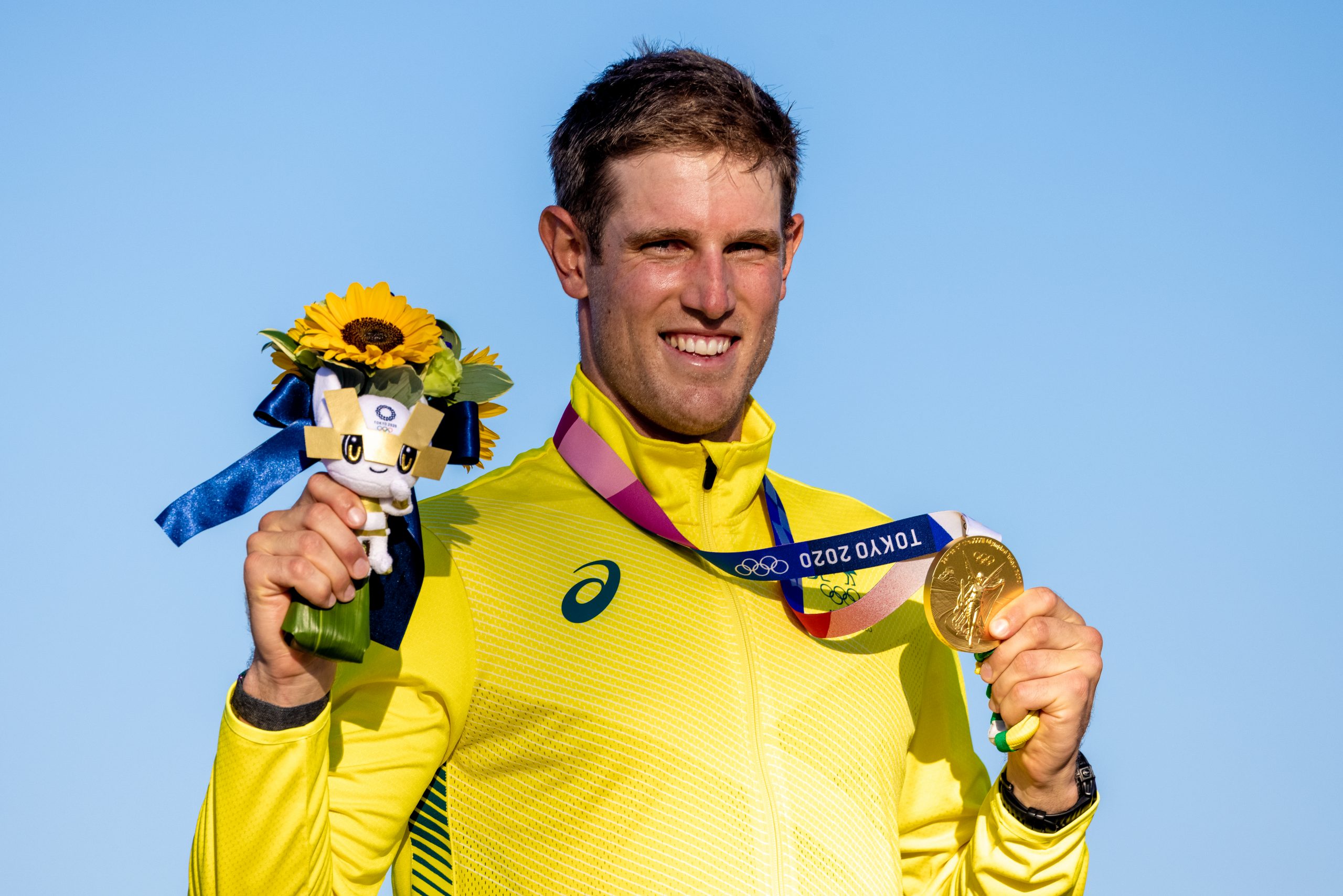
Above: Matt Wearn’s golden moment.
Any key mentors or sailing role models who had a formative impact on you? Belinda Stowell is someone who has been there and part of the sailing culture from the beginning. She took me under her wing and helped guide me along the track. Tom Slingsby is obviously another person I looked up to. He dominated the Laser class for many years and so as a young kid I was sort of a fan boy. His coach Michael Blackburn is another big name I always wanted to meet and he’s now been my coach for 10 years. It’s a pretty cool sport in that you can have those experiences with people you admire.
Talk us through the actual moment of being on the medal podium in Tokyo and receiving that gold medal. What goes through your mind? From the moment you get off the water after the medal race, it’s just insanity. You get whisked away for live media interviews and other formalities. It wasn’t until I was standing behind the podium that I got to just stop for five minutes with myself. That was a really cool moment of just letting everything in. The weight of the last five years, sort of lifts off your shoulders in some sense. Then when they call your name and you stand on the podium, you watch the flag raise and listen to the national anthem, you do get emotional. You start to shed a little bit of a tear in the corner of your eye. All the hard work and sacrifice is for that moment and it just sort of flows through you.
What’s next for you? You’ve no doubt earned a bit of time off but do you already have the next big goal in mind? The initial plan is to have some time off then to get back into more of the professional side of sailing. I’ve been doing some more sailing on bigger boats and I’ve enjoyed that team environment as well – it brings out another aspect of sailing. The main goal is definitely set firmly on Paris, with only three years between the Olympics it’s going to come around quickly. So I’ll get back into training for that early next year. I haven’t ever won a World Championship either so that is definitely on the list as well
Read Lyndon Turner’s full column in the latest issue of the Marina Industries Association’s Waterline magazine here. To find out more information about the MIA visit www.marinas.net.au
You may also be interested in
NM Insurance is a trading name of Nautilus Marine Underwriting Agency Ltd NZBN: 9429031454261, FSP: 388326. NM Insurance is an insurance underwriting agency and has a binding authority from Zurich Australian Insurance Limited (ZAIL) which allows it to enter into and arrange policies of insurance. NM Insurance acts on behalf of ZAIL and not you when providing these services but does so under its own FSP number.
Content on this website is information only and not financial advice. It is intended as a summary of the highlights of any cover available and does not take into account any person’s objectives, financial situation or needs. Always read the relevant Policy Wording before buying or renewing insurance. It contains a full description of the applicable terms and conditions.
Steadfast Group Ltd (ABN 98 073 659 677) (‘SGL’) has a majority shareholding in NM Insurance Pty Ltd (NM Insurance).
SGL may receive a professional services fee (PSF) from insurers, premium funders and underwriting agencies such as NM Insurance (Partner) for access to regulatory and compliance support; marketing and communications; data insights; and access to technology platforms. The PSF is an agreed amount between SGL and the relevant Partner, usually annually. The PSF is not determined by the volume of the business that the Steadfast Network brokers place, nor is the amount of the PSF known to the Steadfast Network Brokers, so it is not able to influence recommendations to their clients.
NM Insurance may have access to shared services from SGL, including: compliance tools; procedures; manuals and training; legal; HR banking; and group purchasing arrangements. These services are funded by SGL, subsidised by SGL or SGL receives a fee for them.
SGL’s FSG is available at www.steadfast.com.au or on request by telephoning SGL’s Company Secretary on +61 2 9495 6500.
© 2021 NM Insurance Pty Ltd. Created by Codex.
Expert’s guide to storm safety
Passionate supporters
NM Insurance has relaunched to market with a new visual identity and brand message that reflects the trusted security and support we provide our customers and partners. Operating across Australia and New Zealand, our NM Insurance brands are already well-known within the industries they secure. NM Insurance’s new look, website, and brand message aims to increase awareness of our corporate brand and represent NM Insurance’s strong industry reputation for passionate insurance expertise.
“All of us here at NM Insurance are incredibly excited about our brand relaunch,” says Lyndon Turner, CEO, NM Insurance. “Our new brand message ‘on the journey together’ absolutely reflects who we are as a business and the expertise, security, and support NM Insurance provides for our customers and business partners. At NM Insurance we believe that knowledge drives passion. We align the insurance expertise of our passionate NM Insurance team, and their strong technical knowledge of the assets we secure, with the aspirations of our customers and business partners. We’re on that journey with our customers and business partners and are always aiming to go above and beyond to deliver great experiences and support. Put simply, we are passionate insurance experts who know our stuff, and our expertise helps both our customers and business partners. This is the reputation NM Insurance has already earned with industry experts. It’s the reason thousands of insurance advisers and brokers choose to work with us. It’s why trusted brands in boating, motorcycling and caravanning partner with us to deliver insurance products and services.”
“With this relaunch we’re excited to create wider awareness of NM Insurance – who we are, what we do, and the brands we encompass,” added Neha Taskar, Head of Marketing, Brand, and Communications, NM Insurance. “Many of our customers may be unaware that the brand that secures their boat, bike, or caravan, is part of the NM Insurance family. We felt it was incredibly important to build greater awareness and brand recognition for NM Insurance. Our brand message and visual identity are a true representation of our purpose and fit with the support, scale, and capacity we have as an established trans-Tasman insurance agency.”
You may also be interested in
NM Insurance is a trading name of Nautilus Marine Underwriting Agency Ltd NZBN: 9429031454261, FSP: 388326. NM Insurance is an insurance underwriting agency and has a binding authority from Zurich Australian Insurance Limited (ZAIL) which allows it to enter into and arrange policies of insurance. NM Insurance acts on behalf of ZAIL and not you when providing these services but does so under its own FSP number.
Content on this website is information only and not financial advice. It is intended as a summary of the highlights of any cover available and does not take into account any person’s objectives, financial situation or needs. Always read the relevant Policy Wording before buying or renewing insurance. It contains a full description of the applicable terms and conditions.
Steadfast Group Ltd (ABN 98 073 659 677) (‘SGL’) has a majority shareholding in NM Insurance Pty Ltd (NM Insurance).
SGL may receive a professional services fee (PSF) from insurers, premium funders and underwriting agencies such as NM Insurance (Partner) for access to regulatory and compliance support; marketing and communications; data insights; and access to technology platforms. The PSF is an agreed amount between SGL and the relevant Partner, usually annually. The PSF is not determined by the volume of the business that the Steadfast Network brokers place, nor is the amount of the PSF known to the Steadfast Network Brokers, so it is not able to influence recommendations to their clients.
NM Insurance may have access to shared services from SGL, including: compliance tools; procedures; manuals and training; legal; HR banking; and group purchasing arrangements. These services are funded by SGL, subsidised by SGL or SGL receives a fee for them.
SGL’s FSG is available at www.steadfast.com.au or on request by telephoning SGL’s Company Secretary on +61 2 9495 6500.
© 2021 NM Insurance Pty Ltd. Created by Codex.
Expert’s guide to storm safety
NM Insurance has relaunched to market with a new visual identity and brand message that reflects the trusted security and support we provide our customers and partners. Operating across Australia and New Zealand, our NM Insurance brands are already well-known within the industries they secure. NM Insurance’s new look, website, and brand message aims to increase awareness of our corporate brand and represent NM Insurance’s strong industry reputation for passionate insurance expertise.
“All of us here at NM Insurance are incredibly excited about our brand relaunch,” says Lyndon Turner, CEO, NM Insurance. “Our new brand message ‘on the journey together’ absolutely reflects who we are as a business and the expertise, security, and support NM Insurance provides for our customers and business partners. At NM Insurance we believe that knowledge drives passion. We align the insurance expertise of our passionate NM Insurance team, and their strong technical knowledge of the assets we secure, with the aspirations of our customers and business partners. We’re on that journey with our customers and business partners and are always aiming to go above and beyond to deliver great experiences and support. Put simply, we are passionate insurance experts who know our stuff, and our expertise helps both our customers and business partners. This is the reputation NM Insurance has already earned with industry experts. It’s the reason thousands of insurance advisers and brokers choose to work with us. It’s why trusted brands in boating, motorcycling and caravanning partner with us to deliver insurance products and services.”
“With this relaunch we’re excited to create wider awareness of NM Insurance – who we are, what we do, and the brands we encompass,” added Neha Taskar, Head of Marketing, Brand, and Communications, NM Insurance. “Many of our customers may be unaware that the brand that secures their boat, bike, or caravan, is part of the NM Insurance family. We felt it was incredibly important to build greater awareness and brand recognition for NM Insurance. Our brand message and visual identity are a true representation of our purpose and fit with the support, scale, and capacity we have as an established trans-Tasman insurance agency.”
You may also be interested in
NM Insurance is a trading name of Nautilus Marine Underwriting Agency Ltd NZBN: 9429031454261, FSP: 388326. NM Insurance is an insurance underwriting agency and has a binding authority from Zurich Australian Insurance Limited (ZAIL) which allows it to enter into and arrange policies of insurance. NM Insurance acts on behalf of ZAIL and not you when providing these services but does so under its own FSP number.
Content on this website is information only and not financial advice. It is intended as a summary of the highlights of any cover available and does not take into account any person’s objectives, financial situation or needs. Always read the relevant Policy Wording before buying or renewing insurance. It contains a full description of the applicable terms and conditions.
Steadfast Group Ltd (ABN 98 073 659 677) (‘SGL’) has a majority shareholding in NM Insurance Pty Ltd (NM Insurance).
SGL may receive a professional services fee (PSF) from insurers, premium funders and underwriting agencies such as NM Insurance (Partner) for access to regulatory and compliance support; marketing and communications; data insights; and access to technology platforms. The PSF is an agreed amount between SGL and the relevant Partner, usually annually. The PSF is not determined by the volume of the business that the Steadfast Network brokers place, nor is the amount of the PSF known to the Steadfast Network Brokers, so it is not able to influence recommendations to their clients.
NM Insurance may have access to shared services from SGL, including: compliance tools; procedures; manuals and training; legal; HR banking; and group purchasing arrangements. These services are funded by SGL, subsidised by SGL or SGL receives a fee for them.
SGL’s FSG is available at www.steadfast.com.au or on request by telephoning SGL’s Company Secretary on +61 2 9495 6500.
© 2021 NM Insurance Pty Ltd. Created by Codex.
Expert’s guide to storm safety
NM Insurance has relaunched to market with a new visual identity and brand message that reflects the trusted security and support we provide our customers and partners. Operating across Australia and New Zealand, our NM Insurance brands are already well-known within the industries they secure. NM Insurance’s new look, website, and brand message aims to increase awareness of our corporate brand and represent NM Insurance’s strong industry reputation for passionate insurance expertise.
“All of us here at NM Insurance are incredibly excited about our brand relaunch,” says Lyndon Turner, CEO, NM Insurance. “Our new brand message ‘on the journey together’ absolutely reflects who we are as a business and the expertise, security, and support NM Insurance provides for our customers and business partners. At NM Insurance we believe that knowledge drives passion. We align the insurance expertise of our passionate NM Insurance team, and their strong technical knowledge of the assets we secure, with the aspirations of our customers and business partners. We’re on that journey with our customers and business partners and are always aiming to go above and beyond to deliver great experiences and support. Put simply, we are passionate insurance experts who know our stuff, and our expertise helps both our customers and business partners. This is the reputation NM Insurance has already earned with industry experts. It’s the reason thousands of insurance advisers and brokers choose to work with us. It’s why trusted brands in boating, motorcycling and caravanning partner with us to deliver insurance products and services.”
“With this relaunch we’re excited to create wider awareness of NM Insurance – who we are, what we do, and the brands we encompass,” added Neha Taskar, Head of Marketing, Brand, and Communications, NM Insurance. “Many of our customers may be unaware that the brand that secures their boat, bike, or caravan, is part of the NM Insurance family. We felt it was incredibly important to build greater awareness and brand recognition for NM Insurance. Our brand message and visual identity are a true representation of our purpose and fit with the support, scale, and capacity we have as an established trans-Tasman insurance agency.”
You may also be interested in
NM Insurance is a trading name of Nautilus Marine Underwriting Agency Ltd NZBN: 9429031454261, FSP: 388326. NM Insurance is an insurance underwriting agency and has a binding authority from Zurich Australian Insurance Limited (ZAIL) which allows it to enter into and arrange policies of insurance. NM Insurance acts on behalf of ZAIL and not you when providing these services but does so under its own FSP number.
Content on this website is information only and not financial advice. It is intended as a summary of the highlights of any cover available and does not take into account any person’s objectives, financial situation or needs. Always read the relevant Policy Wording before buying or renewing insurance. It contains a full description of the applicable terms and conditions.
Steadfast Group Ltd (ABN 98 073 659 677) (‘SGL’) has a majority shareholding in NM Insurance Pty Ltd (NM Insurance).
SGL may receive a professional services fee (PSF) from insurers, premium funders and underwriting agencies such as NM Insurance (Partner) for access to regulatory and compliance support; marketing and communications; data insights; and access to technology platforms. The PSF is an agreed amount between SGL and the relevant Partner, usually annually. The PSF is not determined by the volume of the business that the Steadfast Network brokers place, nor is the amount of the PSF known to the Steadfast Network Brokers, so it is not able to influence recommendations to their clients.
NM Insurance may have access to shared services from SGL, including: compliance tools; procedures; manuals and training; legal; HR banking; and group purchasing arrangements. These services are funded by SGL, subsidised by SGL or SGL receives a fee for them.
SGL’s FSG is available at www.steadfast.com.au or on request by telephoning SGL’s Company Secretary on +61 2 9495 6500.
© 2021 NM Insurance Pty Ltd. Created by Codex.
Expert’s guide to storm safety
NM Insurance has relaunched to market with a new visual identity and brand message that reflects the trusted security and support we provide our customers and partners. Operating across Australia and New Zealand, our NM Insurance brands are already well-known within the industries they secure. NM Insurance’s new look, website, and brand message aims to increase awareness of our corporate brand and represent NM Insurance’s strong industry reputation for passionate insurance expertise.
“All of us here at NM Insurance are incredibly excited about our brand relaunch,” says Lyndon Turner, CEO, NM Insurance. “Our new brand message ‘on the journey together’ absolutely reflects who we are as a business and the expertise, security, and support NM Insurance provides for our customers and business partners. At NM Insurance we believe that knowledge drives passion. We align the insurance expertise of our passionate NM Insurance team, and their strong technical knowledge of the assets we secure, with the aspirations of our customers and business partners. We’re on that journey with our customers and business partners and are always aiming to go above and beyond to deliver great experiences and support. Put simply, we are passionate insurance experts who know our stuff, and our expertise helps both our customers and business partners. This is the reputation NM Insurance has already earned with industry experts. It’s the reason thousands of insurance advisers and brokers choose to work with us. It’s why trusted brands in boating, motorcycling and caravanning partner with us to deliver insurance products and services.”
“With this relaunch we’re excited to create wider awareness of NM Insurance – who we are, what we do, and the brands we encompass,” added Neha Taskar, Head of Marketing, Brand, and Communications, NM Insurance. “Many of our customers may be unaware that the brand that secures their boat, bike, or caravan, is part of the NM Insurance family. We felt it was incredibly important to build greater awareness and brand recognition for NM Insurance. Our brand message and visual identity are a true representation of our purpose and fit with the support, scale, and capacity we have as an established trans-Tasman insurance agency.”
You may also be interested in
NM Insurance is a trading name of Nautilus Marine Underwriting Agency Ltd NZBN: 9429031454261, FSP: 388326. NM Insurance is an insurance underwriting agency and has a binding authority from Zurich Australian Insurance Limited (ZAIL) which allows it to enter into and arrange policies of insurance. NM Insurance acts on behalf of ZAIL and not you when providing these services but does so under its own FSP number.
Content on this website is information only and not financial advice. It is intended as a summary of the highlights of any cover available and does not take into account any person’s objectives, financial situation or needs. Always read the relevant Policy Wording before buying or renewing insurance. It contains a full description of the applicable terms and conditions.
Steadfast Group Ltd (ABN 98 073 659 677) (‘SGL’) has a majority shareholding in NM Insurance Pty Ltd (NM Insurance).
SGL may receive a professional services fee (PSF) from insurers, premium funders and underwriting agencies such as NM Insurance (Partner) for access to regulatory and compliance support; marketing and communications; data insights; and access to technology platforms. The PSF is an agreed amount between SGL and the relevant Partner, usually annually. The PSF is not determined by the volume of the business that the Steadfast Network brokers place, nor is the amount of the PSF known to the Steadfast Network Brokers, so it is not able to influence recommendations to their clients.
NM Insurance may have access to shared services from SGL, including: compliance tools; procedures; manuals and training; legal; HR banking; and group purchasing arrangements. These services are funded by SGL, subsidised by SGL or SGL receives a fee for them.
SGL’s FSG is available at www.steadfast.com.au or on request by telephoning SGL’s Company Secretary on +61 2 9495 6500.
© 2021 NM Insurance Pty Ltd. Created by Codex.